Tree Care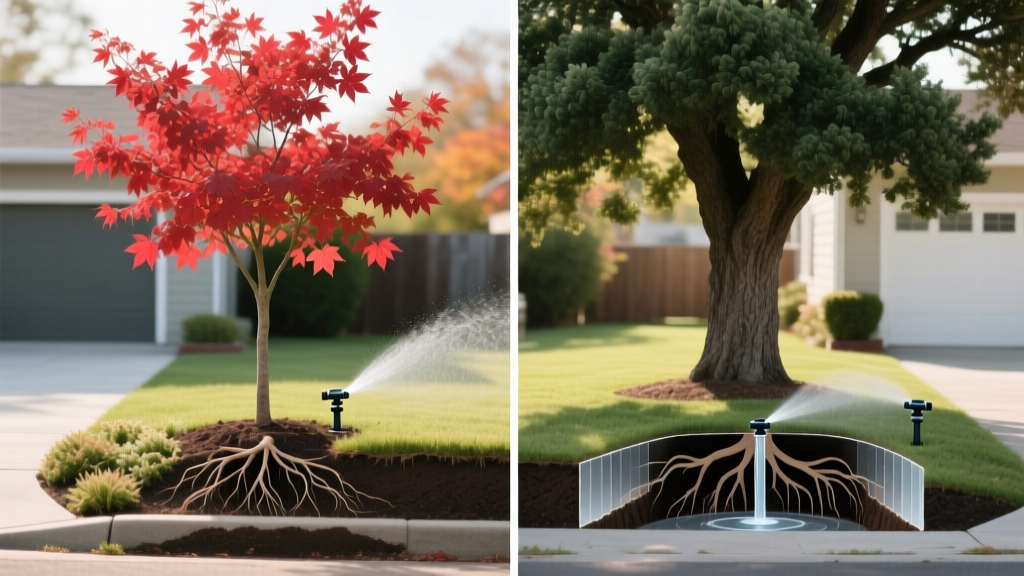
Red Maple vs Live Oak: 2026 Irrigation Guide for Small Yards
Anna KowalskiPublished
Selecting the Right Shade Tree for Small Yard Irrigation in 2026
When designing a landscape for a small yard in 2026, homeowners face a complex balancing act between aesthetic appeal, spatial constraints, and water management. Two of the most popular shade trees in North America are the Red Maple (Acer rubrum) and the Live Oak (Quercus virginiana). While both offer spectacular canopy coverage and vibrant seasonal interest, their underlying hydro-profiles and root architectures are drastically different. From the perspective of sprinkler and irrigation system design, choosing between these two species will fundamentally dictate how you zone your landscape, what type of emitters you install, and how you protect your underground infrastructure.
In a small yard, there is no room for irrigation errors. Overwatering a drought-tolerant tree can lead to fatal fungal pathogens, while underwatering a moisture-loving species will result in stunted growth and premature canopy dieback. Furthermore, aggressive root systems can easily crush shallow PVC sprinkler lines or heave pop-up spray heads out of the ground. This comprehensive 2026 guide breaks down the irrigation compatibility of Red Maples and Live Oaks, helping you make an informed decision that protects your landscape investment and your water bill.
The Hydro-Profile: Understanding Water Demands
The first step in integrating a shade tree into your irrigation system is understanding its native water requirements. According to the USDA Forest Service Silvics Manual, the Red Maple is incredibly adaptable but naturally thrives in bottomlands, swamps, and consistently moist soils. In a residential setting, this translates to a high water demand, especially during the critical first three years of establishment and during peak summer heat waves. Red Maples lack the deep taproot structure required to access subterranean water tables in dry urban soils, meaning they rely heavily on your irrigation system to maintain their lush, vibrant foliage.
Conversely, the Live Oak is a hallmark of drought tolerance. Native to the coastal plains and maritime forests of the Southeast, Live Oaks are xerophytic adapters. Once a Live Oak establishes its deep taproot—usually by year three or four—it requires minimal supplemental irrigation. In fact, the most common mistake homeowners make with Live Oaks in small yards is leaving them on the same irrigation zone as the surrounding turfgrass. Constant, shallow watering from standard pop-up spray heads keeps the upper soil profile saturated, depriving the oak's roots of oxygen and inviting devastating diseases like Armillaria root rot and oak root fungus.
Root Architecture vs. Sprinkler Infrastructure
In a small yard, your trees and your sprinkler lines are going to be in close proximity. How the roots interact with your irrigation hardware is a critical deciding factor.
Red Maple: The Surface Root Menace
Red Maples are notorious for developing shallow, fibrous, and highly aggressive surface roots. In compacted urban soils, these roots will seek out the easiest path to moisture and oxygen. If you use traditional pop-up spray sprinklers near a Red Maple, the roots will eventually engulf the sprinkler bodies, preventing them from popping up and causing localized flooding. Furthermore, shallow lateral roots can easily heave pavers and wrap around flexible polyethylene drip lines, crushing them over time. If you choose a Red Maple for a small yard, you must plan to convert the surrounding turf zone to a subsurface drip irrigation system or install deep root barriers to protect your hardscaping and shallow irrigation mains.
Live Oak: The Deep Anchor with Lateral Spread
Live Oaks begin with a strong, deep taproot that easily bypasses shallow sprinkler lines and turf-grade PVC pipes. However, as the tree matures, it develops massive, structural lateral roots that can span well beyond the dripline. While these roots are generally deeper than those of a Red Maple, their sheer girth can still compromise shallow irrigation trenches if the tree is planted too close to the mainline. For small yards, it is highly recommended to install a flexible root barrier and route all rigid PVC irrigation mains at least 10 feet away from the trunk of a mature Live Oak to prevent pipe shearing as the root collar expands.
Comparison Chart: Irrigation & Small Yard Suitability
| Feature | Red Maple (Acer rubrum) | Live Oak (Quercus virginiana) |
|---|---|---|
| Water Demand | High (Consistent moisture required) | Low (Drought-tolerant once established) |
| Root Depth | Shallow, fibrous, surface-heavy | Deep taproot initially, massive laterals later |
| Sprinkler Interference | High (Will engulf pop-up spray heads) | Low (Taproot avoids shallow spray lines) |
| Best Irrigation Type | Subsurface drip or deep-soak bubblers | Expanding drip rings or infrequent bubblers |
| Overwatering Risk | Low (Tolerates wet soils well) | High (Prone to root rot in saturated soils) |
| Small Yard Hydrozoning | Can share zones with high-water shrubs | Must be on a dedicated, low-water zone |
Designing the 2026 Smart Irrigation Zone
In 2026, modern landscape design strictly adheres to the principle of hydrozoning—grouping plants with similar water needs onto dedicated irrigation valves. You should never place a Red Maple or a Live Oak on the same valve as your lawn. Turfgrass requires frequent, shallow watering, which is detrimental to tree health. Instead, follow these specific setups based on your chosen tree.
The Red Maple Setup: Subsurface Drip and Bubblers
Because Red Maples hate dry spells but suffer from surface root interference with spray heads, the ideal irrigation method is a subsurface drip grid or a dedicated tree bubbler. If using a bubbler, install a 2 GPH (gallons per hour) pressure-compensating bubbler in a 3-foot-wide mulch basin around the root ball. As the tree grows, expand the basin. Alternatively, use a grid of 1 GPH inline drip emitters buried 2 to 3 inches beneath the mulch layer. This delivers moisture directly to the root zone without encouraging the roots to grow upward toward the surface in search of water, thereby protecting your nearby hardscaping and sprinkler infrastructure.
The Live Oak Setup: Expanding Drip Rings
Live Oaks require deep, infrequent soakings to encourage the taproot to drive downward. A standard spray head will only wet the top two inches of soil, forcing the oak to develop shallow, unstable roots. For a newly planted Live Oak, install a circular drip ring using 2 GPH emitters spaced 12 inches apart. Place the ring just outside the root ball. Each year, physically expand the drip ring outward to match the growing dripline of the canopy. By year four, the tree should be largely removed from the automated irrigation schedule, relying only on deep, manual soaks during severe droughts.
Leveraging Smart Controllers and Soil Sensors
To optimize water usage and protect your trees, integrating smart irrigation technology is essential. The EPA WaterSense program heavily advocates for the use of Weather-Based Irrigation Controllers (WBICs) and soil moisture sensors. In 2026, controllers like the Rachio 4 or Hunter Hydrawise utilize hyper-local evapotranspiration (ET) data to adjust watering schedules automatically.
For a Red Maple, pairing a smart controller with a buried soil moisture sensor ensures the tree receives water exactly when the soil moisture drops below 40% capacity, preventing the wilting that occurs during late-summer heat domes. For a Live Oak, the smart controller can be programmed with a 'cycle and soak' method, delivering water in three 10-minute bursts over an hour to allow deep penetration into heavy clay soils without causing runoff. Proper watering techniques, as outlined by the University of Minnesota Extension, dictate that slow, deep watering is always superior to frequent, shallow applications for long-term tree vigor and structural root stability.
Mulching and Final Infrastructure Considerations
No irrigation system is complete without proper mulching, which acts as a biological insulator for the soil moisture you are paying to deliver. Apply a 2-to-3-inch layer of organic hardwood mulch over the drip irrigation lines of your Red Maple or Live Oak. Crucially, keep the mulch at least 6 inches away from the trunk flare to prevent 'volcano mulching,' which traps moisture against the bark and invites rot. In small yards, space is a premium. If you are planting within 15 feet of your home's foundation or main irrigation manifold, consider installing a heavy-duty polyethylene root barrier (at least 24 inches deep) on the side of the tree facing the infrastructure. This forces the Red Maple's aggressive roots downward and guides the Live Oak's laterals away from your PVC mainlines.
Making the Final Choice
Ultimately, the choice between a Red Maple and a Live Oak for a small yard comes down to your willingness to manage water. If you desire a fast-growing, moisture-loving tree and are prepared to install a dedicated subsurface drip zone to accommodate its shallow roots, the Red Maple is a stunning choice that will provide brilliant autumn color. However, if you prefer a low-maintenance, drought-tolerant evergreen and want to minimize your irrigation system's complexity and water usage over the long term, the Live Oak is the undisputed champion. By aligning your tree selection with a smart, hydrozoned irrigation strategy, you ensure a thriving, resilient landscape for decades to come.