
Landscaping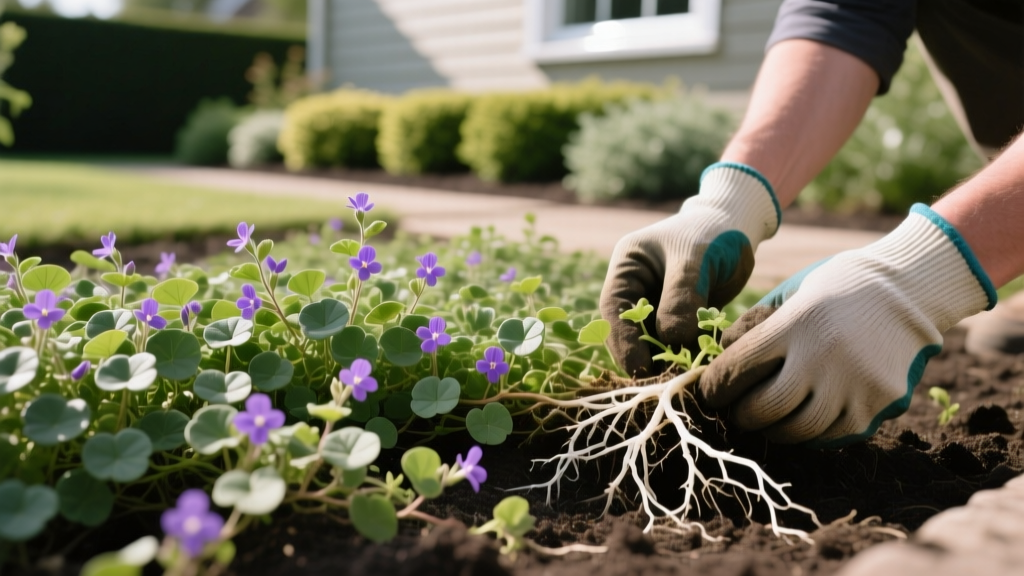
How to Identify and Remove Creeping Charlie in Landscape Beds
James MillerPublished
Understanding Creeping Charlie (Glechoma hederacea)
Creeping Charlie, scientifically known as Glechoma hederacea and often referred to as ground ivy, is one of the most persistent and frustrating weeds that invade residential landscape beds, garden borders, and turfgrass. Originally introduced to North America by European settlers for its medicinal properties and as a shade-tolerant groundcover, it has since become a highly aggressive invasive species in many regions.
In landscaping beds, Creeping Charlie is particularly problematic because it weaves itself tightly around the stems and root systems of your prized ornamental plants, perennials, and shrubs. It thrives in the exact conditions that many garden plants love: moist, fertile soil with partial to full shade. Once established in a mulched garden bed, it forms a dense, mat-like canopy that chokes out emerging spring bulbs, competes heavily for soil nutrients, and ruins the aesthetic appeal of carefully designed hardscape borders.
Successfully eradicating this weed requires a deep understanding of its biology, accurate identification, and a multi-pronged approach combining manual extraction, targeted chemical applications, and long-term cultural prevention.
The Biology of an Invader: Why It Is So Hard to Kill
To defeat Creeping Charlie, you must understand how it grows. Unlike weeds that spread primarily by deep taproots or airborne seeds, Creeping Charlie spreads aggressively via stolons (above-ground creeping stems). These stolons creep along the soil surface, under mulch, and through groundcovers. At every point where a stolon touches the soil—a structure called a node—the plant puts down new fibrous roots and sends up new vertical shoots.
If you pull the plant and accidentally leave even a single node or a tiny fragment of the stolon behind in the soil, the weed will rapidly regenerate. Furthermore, while it does produce small, funnel-shaped purple flowers in the spring that yield seeds, the primary method of expansion in landscape beds is vegetative. This is why superficial hoeing or string-trimming often makes the problem worse, as it chops the stolons into dozens of individual pieces, effectively planting new weeds across your garden bed.
Identification Guide: Spotting the Culprit
Accurate identification is the first step in any integrated pest management (IPM) strategy. Creeping Charlie is a broadleaf evergreen perennial that belongs to the mint family (Lamiaceae). Because it is in the mint family, it shares several key characteristics with other mints:
- Stems: The stems are distinctly square-shaped when rolled between your fingers.
- Leaves: Leaves are kidney-shaped to round, with heavily scalloped (crenated) edges. They are typically a vibrant, glossy green and feature a prominent, depressed venation pattern.
- Aroma: When crushed or mowed, the foliage emits a strong, distinct minty or oregano-like odor.
- Flowers: In early to mid-spring, it produces clusters of small, tubular, bluish-purple flowers.
Because it grows in similar conditions, Creeping Charlie is often confused with other common landscape weeds. Use the comparison table below to ensure you are targeting the correct plant.
| Characteristic | Creeping Charlie (Ground Ivy) | Henbit (Lamium amplexicaule) | Common Speedwell (Veronica) |
|---|---|---|---|
| Leaf Shape | Kidney-shaped, scalloped edges, glossy | Rounded, deeply veined, clasping the stem | Small, oval to heart-shaped, toothed edges |
| Stem Structure | Square, creeping stolons root at nodes | Square, upright, lower leaves have petioles | Round or slightly square, upright or matting |
| Scent When Crushed | Strong minty / oregano aroma | Faint, earthy, or no distinct scent | No distinct scent |
| Flower Color | Bluish-purple, tubular, clustered | Pink to purple, tubular, whorled | Bright blue with white centers |
Manual and Mechanical Eradication Strategies
In landscape beds filled with delicate perennials and shrubs, manual removal is often the safest first line of defense, provided the infestation is caught early or is relatively localized.
Timing is Everything
The best time to hand-pull Creeping Charlie is in the early spring or late autumn when the soil is naturally moist. Moist soil allows the fibrous root systems to release their grip, reducing the likelihood of snapping the stolons. Avoid pulling during dry summer months, as the brittle stems will break off at the soil line, leaving the nodes intact to resprout.
The Proper Pulling Technique
- Soak the Bed: Water the landscape bed deeply the night before you plan to weed, or wait until after a heavy rainfall.
- Trace the Stolons: Do not just grab the top of the plant. Use a hand weeder or a hori-hori knife to gently lift the stolon and trace it through the mulch and soil.
- Extract Every Node: Carefully lift each node out of the soil. If the weed is缠绕 (wrapped) around the base of a desirable shrub, use scissors to carefully cut the weed stem rather than pulling it, which could damage the shrub's shallow feeder roots.
- Dispose Properly: Never put Creeping Charlie in your home compost bin. Most residential compost piles do not reach the sustained 140°F (60°C) required to kill the nodes. Bag the weeds and dispose of them in your municipal yard waste bin or trash.
Chemical Control in Sensitive Landscape Beds
When manual removal fails or the infestation has overtaken large sections of a hardscape border or mulch bed, chemical intervention becomes necessary. However, applying herbicides in landscape beds is highly complex because most broadleaf herbicides (like 2,4-D or Triclopyr, commonly used for lawns) will severely damage or kill your desirable ornamental broadleaf plants, shrubs, and perennials.
According to the University of Wisconsin-Madison Extension, managing ground ivy near desirable plants requires extreme precision and the use of non-selective herbicides applied with caution.
Targeted Glyphosate Application
Glyphosate (commonly known by the brand name Roundup) is a non-selective, systemic herbicide. It will kill any plant it touches, but it translocates down into the root system, making it highly effective against the deep nodes of Creeping Charlie. To use it safely in a landscape bed:
- The Wicking Method: Put on a rubber glove, and then a cotton work glove over it. Dip your cotton-gloved finger into a concentrated glyphosate solution and physically wipe the leaves of the Creeping Charlie. This ensures zero drift onto your ornamentals.
- The Painting Method: Use a small foam paintbrush to carefully paint the herbicide directly onto the leaves of the weed.
- Shielded Spraying: If spraying, use a physical cardboard shield or a specialized herbicide cone to protect nearby plants. Only spray when the wind is completely calm (under 3 mph) to prevent microscopic drift.
Pro Tip: Systemic herbicides are most effective when applied in the early fall. During autumn, perennial weeds are actively pulling nutrients (and the herbicide) down into their root systems to prepare for winter, resulting in a much higher kill rate of the hidden nodes.
Organic and Non-Toxic Alternatives
For organic gardeners, horticultural vinegar (20% to 30% acetic acid) or herbicidal soaps can be used. However, the Penn State Extension notes that these are contact-only burn-down herbicides. They will destroy the top growth of the Creeping Charlie but will not translocate to kill the roots. You will need to reapply organic sprays every time the weed resprouts, eventually exhausting the plant's root reserves over several months.
Cultural Prevention and Bed Maintenance
Once you have eradicated the existing Creeping Charlie, you must alter the landscape environment to prevent its return. Creeping Charlie exploits bare soil, thin mulch, and weak groundcovers.
Optimize Your Mulch Layer
Maintain a consistent 2 to 3-inch layer of high-quality organic mulch (such as shredded hardwood bark or pine straw) over the soil in your landscape beds. Mulch blocks the sunlight that creeping stolons need to establish new nodes. Be careful not to pile mulch directly against the trunks of trees and shrubs (avoiding 'mulch volcanoes'), as this invites rot and pests.
Install Physical Edging Barriers
Creeping Charlie often invades garden beds by creeping under the soil surface from an adjacent infested lawn. Install rigid metal or heavy-duty plastic landscape edging that extends at least 6 inches below the soil surface and 2 inches above it. This physical barrier stops the underground stolons from migrating from the turf into your pristine garden beds.
Plant Aggressive, Shade-Tolerant Groundcovers
Nature abhors a vacuum. If you have a shady landscape bed where turfgrass struggles and Creeping Charlie thrives, outcompete the weed by planting a desirable, dense groundcover. Excellent alternatives include:
- Ajuga (Bugleweed): Forms a dense, attractive mat with spring flower spikes.
- Pachysandra: A classic, evergreen shade groundcover that chokes out weeds once established.
- Liriope (Monkey Grass): Highly durable, grass-like clumps that shade the soil effectively.
Frequently Asked Questions
Does the Borax home remedy actually work?
For decades, a popular internet myth suggested that mixing Borax (sodium borate) with water and spraying it on Creeping Charlie would selectively kill the weed without harming surrounding plants. While boron is toxic to plants in high doses, soil tests have shown that applying Borax severely alters the soil pH and leaves toxic levels of boron in the landscape bed. This residual toxicity will prevent desirable ornamentals, bulbs, and shrubs from growing in that bed for years. Modern extension offices strongly advise against using Borax in any landscaping capacity.
Can I just smother it with landscape fabric?
Smothering is an option, but Creeping Charlie is incredibly persistent. If you lay down woven landscape fabric, you must cover it entirely with 3 inches of mulch or stone. Even then, the weed may attempt to grow on top of the fabric, sending roots down through the tiny weave gaps. Cardboard sheet-mulching (lasagna gardening) is generally more effective for total bed renovation, provided you leave the cardboard in place for an entire growing season before replanting.
By combining vigilant identification, meticulous manual removal, targeted chemical applications, and proactive landscape design, you can reclaim your garden beds from Creeping Charlie and maintain a pristine, thriving outdoor living space.

