
Landscaping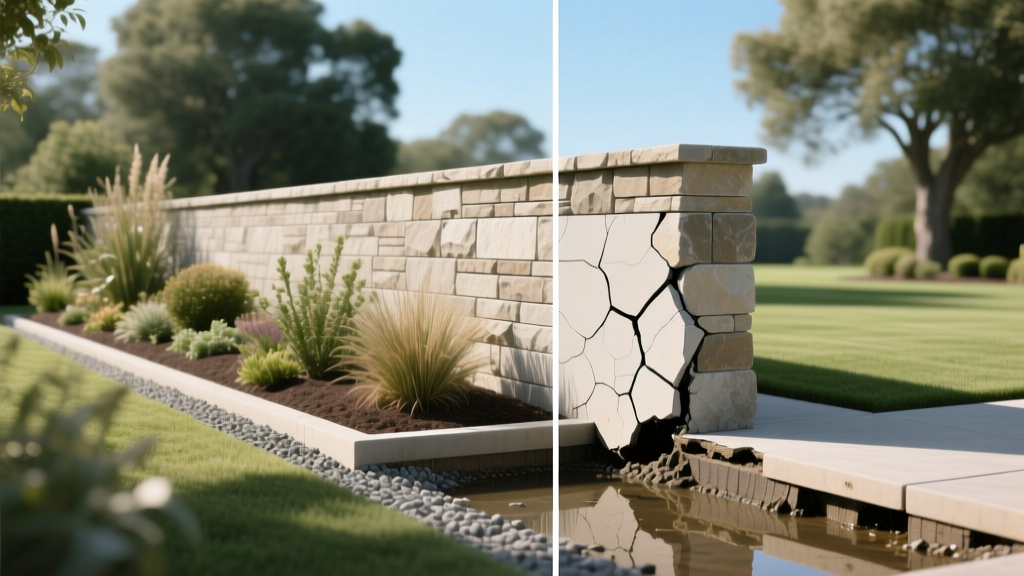
Top 5 Retaining Wall Mistakes and How to Fix Them Right
Mike RodriguezPublished
Why Retaining Walls Fail: The Hidden Costs of Poor Hardscaping
Retaining walls are far more than just decorative landscape features; they are vital structural elements designed to hold back tons of soil, manage elevation changes, and protect outdoor living spaces from erosion. When designed and built correctly, they enhance curb appeal and create beautiful terraced garden beds. However, when built incorrectly, they can bulge, crack, or completely collapse, leading to thousands of dollars in property damage and ruined landscaping.
According to the National Concrete Masonry Association (NCMA), the vast majority of retaining wall failures are not due to a lack of structural strength in the concrete or stone blocks themselves. Instead, failures almost always stem from improper installation, specifically regarding base preparation, material selection, and drainage management. Gravity and hydrostatic pressure are relentless forces. If your hardscaping project does not account for them, your wall will eventually fail.
Whether you are planning a small 2-foot garden bed border or a massive 6-foot terraced slope, avoiding common pitfalls is essential. Here are the top five retaining wall mistakes homeowners and inexperienced landscapers make, along with the actionable, professional fixes to ensure your hardscape stands the test of time.
Mistake 1: Skimping on Base Preparation and Excavation
The most common point of failure for any hardscaping project is below ground. Many DIYers and budget contractors dig a shallow trench, throw down a thin layer of sand or native dirt, and start stacking blocks. This is a catastrophic error. Native soil shifts with moisture changes and freeze-thaw cycles. If your base moves, your wall moves.
The Fix: Build a Compacted, Aggregate Sub-Base
You must excavate a trench that is deep enough to bury the first course of blocks completely, plus an additional 6 to 8 inches for a compacted gravel base. For a wall retaining 3 feet of soil, your base trench should be at least 12 to 14 inches deep.
- Material: Use 3/4-inch minus crushed stone (also known as crusher run). The 'minus' means it contains stone dust and smaller particles that lock together like concrete when compacted.
- Compaction: Do not just tamp it by hand. Rent a mechanical plate compactor (typically $85 to $100 per day) and compact the base in 2-inch 'lifts' (layers).
- Leveling: The final 1-inch layer should be leveled using a screed board and a 4-foot carpenter's level. A perfectly level base course dictates the structural integrity of every course above it.
Mistake 2: Ignoring Hydrostatic Pressure and Drainage
Water is the undisputed enemy of hardscaping. When soil behind a retaining wall becomes saturated with rainwater or melting snow, it expands and exerts immense lateral force known as hydrostatic pressure. This pressure can easily push a multi-ton wall outward, causing it to bow and collapse.
If you do not give water a clear, unobstructed path to escape from behind your wall, it will eventually push your wall down.
The Fix: Install a Perforated Drain Pipe System
Every retaining wall over 2 feet high requires a dedicated drainage system. You must install a 4-inch perforated PVC or flexible corrugated drain pipe at the very base of the wall, directly behind the first course of blocks.
- Slope: The pipe must be installed with a minimum slope of 1% (1/8 inch of drop per foot of pipe) to ensure water flows away from the wall.
- Daylighting: The pipe must 'daylight' (exit to the surface) at the lowest end of the wall or drain into a purpose-built dry well or French drain system.
- Protection: Wrap the perforated pipe in a geotextile sock to prevent fine soil particles from washing in and clogging the holes over time.
Mistake 3: Backfilling with Native Soil
One of the most expensive landscaping mistakes is using the soil you just excavated to backfill behind your new retaining wall. Native soil, especially if it is heavy in clay, acts like a sponge. Clay retains water, swells when wet, and creates the exact hydrostatic pressure your drain pipe is trying to eliminate.
The Fix: Use Clear Washed Stone for the Drainage Zone
The first 12 inches of space directly behind the retaining wall blocks must be backfilled with 3/4-inch clear washed crushed stone. Unlike the 3/4-inch minus stone used in your base, 'clear' stone has been washed and contains no stone dust or fines. This creates a highly permeable void space that acts as a vertical French drain, allowing surface water to percolate rapidly down to your drain pipe at the base. Only after this 12-inch drainage zone is established should you backfill the remainder of the trench with native soil.
Mistake 4: Forgetting Geotextile Separation Fabric
Even if you use the correct clear washed stone for drainage, placing it directly against the native soil trench wall is a major mistake. Over time, the natural migration of wet soil will infiltrate the voids in your clean gravel. This process, known as 'piping' or 'migration,' will eventually clog your drainage stone, rendering it useless and leading to wall failure.
The Fix: Line the Trench with Non-Woven Geotextile Fabric
Before laying your base stone and drainage pipe, line the excavated trench with a high-quality, non-woven geotextile separation fabric (rated at 4 oz to 6 oz per square yard). The International Geosynthetics Society emphasizes that separation fabrics are critical for maintaining the long-term permeability of aggregate drainage layers in civil and landscape engineering. Drape the fabric over the back and top of the trench, place your stone, and fold the excess fabric over the top of the stone before adding your final layer of topsoil. This creates a 'burrito' effect that completely encapsulates the drainage zone.
Mistake 5: Building Too High Without Terracing or Geogrid
Gravity alone can only hold back so much earth. Most residential segmental retaining wall blocks are engineered to rely solely on their mass and batter (the backward lean) for walls up to 3 or 4 feet high. If your landscape design requires a taller wall, or if there is a 'surcharge load' above the wall—such as a driveway, patio, or swimming pool—gravity is not enough.
The Fix: Implement Terracing or Geogrid Reinforcement
If you need to retain 6 feet of soil, do not build a single 6-foot gravity wall. Instead, build two 3-foot terraced walls. The top wall must be set back at least twice the height of the lower wall (e.g., 6 feet back) so the surcharge load of the top wall does not bear down on the bottom wall's failure plane.
If terracing is not an option and you must build a single wall over 4 feet, you must use geogrid. Geogrid is a synthetic mesh material that is layered into the compacted backfill soil and wrapped into the lip or pins of the wall blocks. According to Allan Block engineering guidelines, geogrid effectively ties the wall face to the earth mass behind it, creating a single, cohesive gravity structure capable of retaining massive loads. Always consult a licensed structural engineer for walls exceeding local municipal height limits (often 3 to 4 feet).
Retaining Wall Material Comparison Guide
Choosing the right materials for specific zones of your retaining wall project is critical for longevity and structural integrity. Use the table below to ensure you are ordering the correct aggregates and supplies.
| Material | Best Use Case | Permeability | Estimated Cost |
|---|---|---|---|
| 3/4-Inch Minus Crushed Stone | Base trench sub-grade and leveling pad | Low (Packs solid) | $35 - $50 per ton |
| 3/4-Inch Clear Washed Stone | Drainage zone (12 inches behind wall) | High (Voids allow flow) | $40 - $60 per ton |
| Non-Woven Geotextile Fabric | Separation layer between soil and stone | High (Allows water, stops dirt) | $150 - $250 per roll |
| Biaxial Geogrid Mesh | Soil reinforcement for walls over 4 feet | N/A (Structural tie-back) | $1.50 - $3.00 per sq ft |
| Native Soil / Clay | Final backfill BEHIND the drainage zone | Low (Retains water) | Free (Site excavated) |
Conclusion: Invest in the Unseen Infrastructure
Successful landscape design and hardscaping require looking beyond the beautiful face of the stone. The true strength of a retaining wall lies in the unseen infrastructure: the compacted base, the perforated drain pipe, the clear washed stone, and the geotextile fabric. By avoiding these five common mistakes and adhering to proper engineering principles, you will protect your outdoor living spaces, prevent costly future repairs, and ensure your landscape remains beautiful and structurally sound for decades to come.

