Tree Care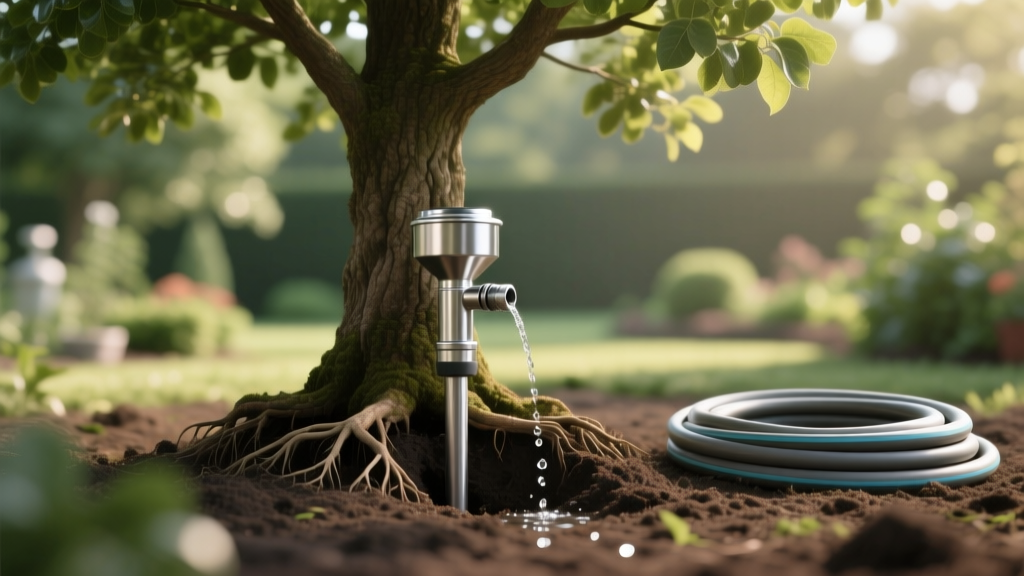
Deep Root Fertilizing 2026: Ross Root Feeder vs Soaker Hose
James MillerPublished
The Evolution of Tree Care in 2026
As we navigate the shifting climate patterns of 2026, municipal water restrictions and prolonged summer droughts have made traditional surface watering and fertilizing obsolete for mature trees. Homeowners and arborists alike are recognizing that simply scattering granular fertilizer on the lawn and running a sprinkler is no longer sufficient. The grass and topsoil microbes intercept the majority of the nutrients and water long before they reach a tree's critical feeder roots. To maintain vigorous growth, stave off opportunistic pests, and ensure structural integrity during severe weather events, deep root fertilization and hydration are mandatory. In this comprehensive 2026 guide, we will compare the two most effective methods for delivering water and nutrients directly to the root zone: the targeted injection of the Ross Root Feeder and the broad, slow-release hydration of premium soaker hoses. By understanding the nuances of fertilizer types and seasonal schedules, you can optimize your tree care regimen for the current year.
Why Deep Root Fertilization Matters
Most of a tree's absorbing roots—commonly known as feeder roots—are located 12 to 18 inches below the soil surface, extending outward to and slightly beyond the drip line (the outer edge of the tree's canopy). When you apply fertilizer to the surface, heavy clay soils or thick thatch layers can prevent the nutrients from penetrating deeply. Furthermore, surface fertilization encourages shallow root growth, making trees highly susceptible to drought stress and windthrow during the increasingly volatile storm seasons we are experiencing in 2026. Deep root fertilization bypasses the competitive turfgrass layer, delivering essential macronutrients (Nitrogen, Phosphorus, Potassium) and micronutrients directly to where the tree can absorb them immediately. This process also helps alleviate soil compaction, a common issue in urban and suburban landscapes, by introducing pressurized water and liquid nutrients into the subsoil.
The Ross Root Feeder: Precision Liquid Injection
The Ross Root Feeder (specifically the updated 2026 Model 10024 featuring an integrated anti-siphon check valve and ergonomic T-handle) remains a staple for targeted arboriculture. This tool attaches directly to your garden hose and features a long, hollow metal probe that you push into the ground. By depressing the trigger, you inject a pressurized stream of water mixed with water-soluble fertilizer 12 to 18 inches deep into the soil profile.
Best Fertilizer Types for the Ross Root Feeder
Because the Ross Root Feeder relies on water to carry the nutrients, you must use completely water-soluble fertilizers. In 2026, top-performing liquid concentrates and soluble powders include Espoma Organic Liquid Tree Food, FoxFarm Grow Big Liquid, and Miracle-Gro Water Soluble Tree & Shrub Plant Food. These formulations dissolve entirely, preventing clogs in the feeder's internal screen while providing an immediate nutrient boost to stressed trees. Avoid using granular slow-release fertilizers or heavy organic emulsions like raw fish emulsion in the root feeder, as they will inevitably clog the probe and damage the internal valve.
Pros and Cons of the Root Feeder Method
The primary advantage of the Ross Root Feeder is precision. You can target specific quadrants of a tree's root zone, making it ideal for treating localized nutrient deficiencies or breaking up compacted soil pockets. It also allows you to control the exact volume of water and fertilizer applied per injection site. However, the method is highly labor-intensive. Properly treating a mature oak or maple requires dozens of probe insertions spaced 2 to 3 feet apart along the drip line, which can be physically demanding and time-consuming for large properties.
The Soaker Hose: Broad, Slow-Release Hydration
For gardeners who prefer a set-it-and-forget-it approach, premium soaker hoses like the Flexzilla Flat Soaker or the Gilmour Flat Soaker Hose offer an excellent alternative. A soaker hose 'weeps' water slowly along its entire length, allowing moisture to percolate gently into the soil without causing runoff or erosion. When paired with surface-applied granular fertilizers, the slow, steady drip of the soaker hose acts as a delivery mechanism, pulling the dissolved nutrients down into the deep root zone over several hours.
Best Fertilizer Types for the Soaker Hose Method
When using a soaker hose, you should apply granular slow-release fertilizers or organic tree spikes to the soil surface just before turning on the water. Top choices for 2026 include Milorganite (an excellent slow-release nitrogen source that won't burn roots), Espoma Tree-tone, and Arborist Supply Co-Op deep root granular blends. As the soaker hose runs, it creates a consistent downward moisture front that carries the dissolving granular nutrients deep into the soil profile, mimicking a long, steady, nutrient-rich rainstorm.
Pros and Cons of the Soaker Hose Method
The soaker hose method is vastly superior for covering large areas with minimal physical effort. You simply lay the hose in concentric circles around the tree's drip line, turn on the spigot, and let it run for 3 to 6 hours. It is highly water-efficient and complies with strict 2026 municipal drought ordinances that prohibit overhead spraying. The main drawback is the lack of localized precision; you are treating the entire area under the hose equally. Additionally, soaker hoses can be easily damaged by lawn mowers or UV degradation if left exposed to the sun year-round, requiring careful placement under a layer of mulch.
Feature Comparison: Ross Root Feeder vs. Soaker Hose
| Feature | Ross Root Feeder | Premium Soaker Hose |
|---|---|---|
| Application Depth | 12 to 18 inches (Direct Injection) | Surface to 12 inches (Percolation) |
| Compatible Fertilizer | Water-Soluble Liquids & Powders | Granular Slow-Release & Spikes |
| Labor Intensity | High (Manual probing required) | Low (Set and forget) |
| Time Required (Mature Tree) | 1 to 2 hours | 3 to 6 hours (unattended) |
| Soil Compaction Relief | Excellent (Pressurized fracture) | Poor (No physical soil disruption) |
| Estimated 2026 Cost | $25 - $35 (Tool only) | $35 - $55 (50ft to 100ft hose) |
Seasonal Fertilizing Schedules for 2026
Timing is just as critical as the delivery method. Trees have distinct biological cycles, and your fertilizing schedule must align with their natural growth phases to avoid stimulating vulnerable late-season growth or wasting nutrients.
Early Spring Schedule (March - April)
As soil temperatures cross the 50°F threshold in early spring, trees break dormancy and push energy into canopy expansion and leaf production. This is the time for Nitrogen-heavy fertilizers. If using the Ross Root Feeder, apply a water-soluble, high-nitrogen liquid blend (e.g., a 20-5-10 NPK ratio) to give the tree an immediate boost. If using a soaker hose, broadcast a slow-release granular fertilizer and let the hose wash it into the root zone. Spring applications should be completed before the intense heat of late May sets in.
Late Fall Schedule (October - November)
After the first hard frost but before the ground freezes solid, trees shift their energy from canopy growth to root development and carbohydrate storage for the winter. Fall fertilization should focus on Phosphorus and Potassium (e.g., a 5-10-10 or 0-10-10 NPK ratio) to promote root hardiness and disease resistance. The Ross Root Feeder is highly effective in the fall for injecting liquid mycorrhizal fungi and root-stimulating compounds directly into the subsoil, helping the tree establish a robust root network before winter dormancy.
Step-by-Step Application Guides
Method 1: Using the Ross Root Feeder with Liquid Fertilizer
- Mix the Solution: In a 5-gallon bucket, dissolve your chosen water-soluble fertilizer according to the 2026 manufacturer label rates. Do not over-concentrate, as this can cause root burn.
- Attach and Prime: Connect the Ross Root Feeder to your garden hose. Turn on the water and squeeze the trigger to flush out any air and ensure the anti-siphon valve is functioning.
- Map the Drip Line: Identify the tree's drip line. Plan your injection sites in a grid pattern, spacing each probe insertion 2 to 3 feet apart, starting just inside the drip line and working outward.
- Inject: Push the metal probe into the soil to a depth of 12 to 15 inches. Squeeze the trigger for 10 to 15 seconds per hole, then pull the probe out and move to the next grid point. The pressurized water will naturally fracture compacted clay soils.
- Water Flush: Once all fertilizer solution is injected, run plain water through the feeder at each site for an additional 5 seconds to wash any residual fertilizer off the probe and deeper into the soil.
Method 2: Using a Soaker Hose with Granular Fertilizer
- Clear the Zone: Rake back any heavy leaf litter or thick woodchip mulch from the immediate soil surface along the drip line to ensure direct soil contact for the granular fertilizer.
- Apply Granular Fertilizer: Evenly broadcast your slow-release granular tree fertilizer across the soil surface under the drip line. Use a hand spreader for uniform coverage.
- Lay the Soaker Hose: Arrange the soaker hose in concentric circles over the fertilized area. Space the loops 18 to 24 inches apart. Ensure the hose is not kinked.
- Run the Water: Turn the spigot on to a low-to-medium pressure. You want the hose to 'sweat' and weep, not spray or gush. Let it run for 3 to 5 hours, depending on your soil type (clay soils require longer, slower run times to prevent runoff).
- Cover and Protect: Turn off the water, disconnect the hose, and gently rake your mulch back over the treated area to retain moisture and protect the soil biology from UV rays.
Expert Insights and Citations
Proper deep watering and fertilization techniques are heavily supported by ongoing arboricultural research. According to the Arbor Day Foundation's Watering Guide, deep, infrequent watering is vastly superior to shallow, frequent watering, as it trains tree roots to grow downward into cooler, moister soil layers, significantly increasing drought tolerance. Furthermore, extension research highlighted by the University of Minnesota Extension emphasizes that slow, deep watering methods—such as soaker hoses and root probes—are critical for establishing new trees and maintaining the health of mature specimens in compacted urban soils. By aligning your 2026 fertilizer schedules with these proven delivery methods, you ensure your trees remain resilient, vibrant, and structurally sound for decades to come.
