Lawn Care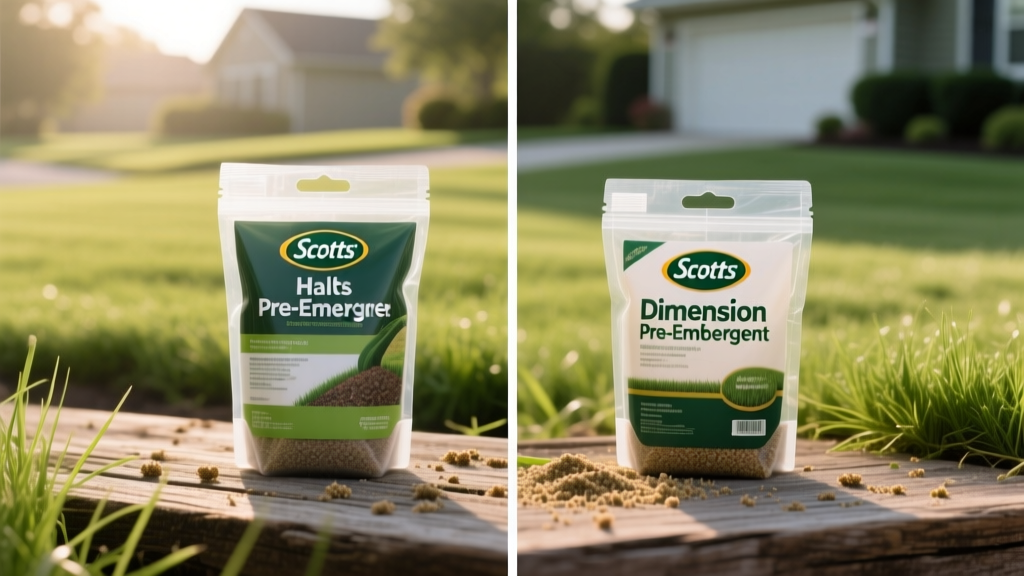
Scotts Halts vs Dimension: Best Pre-Emergent Herbicide
David ParkPublished
The Pre-Emergent Dilemma: Prodiamine vs. Dithiopyr
When it comes to maintaining a pristine, weed-free lawn, the battle against crabgrass is won or lost in the early spring. Homeowners and turf professionals alike rely on pre-emergent herbicides to stop this invasive annual grass before it can choke out desirable turf. However, choosing the right product can be overwhelming. The two undisputed heavyweights in the residential and commercial lawn care market are Scotts Halts (powered by Prodiamine) and Lesco Dimension (powered by Dithiopyr). While both are highly effective at preventing crabgrass, their chemical behaviors, application windows, and long-term impacts on your lawn care schedule differ significantly.
In this comprehensive comparison, we will break down the science, cost, and practical application of Scotts Halts versus Dimension to help you decide which pre-emergent herbicide deserves a spot in your spreader this season.
Understanding the Science: How Pre-Emergents Actually Work
Before comparing the products, it is crucial to debunk a common lawn care myth. Pre-emergents do not prevent seeds from germinating, nor do they form a physical, impenetrable plastic-like barrier over the soil. Instead, they create a chemical zone in the top half-inch of the soil profile. When a weed seed germinates and sends out its first root (the radicle), the root absorbs the herbicide. The chemical then disrupts microtubule formation, halting cell division and effectively killing the seedling before it ever breaks the soil surface.
Because of this mechanism, uniform application and proper watering are non-negotiable. If the chemical barrier is broken by heavy foot traffic, aeration, or uneven spreading, crabgrass will find a way through.
Contender 1: Scotts Halts (Prodiamine)
Scotts Halts Crabgrass & Grassy Weed Preventer is the most widely recognized pre-emergent on the shelves of big-box home improvement stores. Its active ingredient, Prodiamine, is a dinitroaniline herbicide known for its incredible longevity and reliability.
Pros of Scotts Halts
- Extended Residual Control: Prodiamine binds tightly to soil organic matter, providing a residual barrier that can last anywhere from 4 to 6 months, depending on the application rate and environmental conditions.
- Cost-Effective: It is significantly cheaper per square foot of coverage compared to professional-grade Dithiopyr products.
- Accessibility: Available at almost any local garden center or hardware store, making it easy to pick up on a weekend.
Cons of Scotts Halts
- Zero Post-Emergent Activity: Prodiamine only works on seeds that have not yet germinated. If you apply it even a few days after crabgrass has sprouted, it will be entirely ineffective against those existing plants.
- Overseeding Restrictions: Because it lingers in the soil for so long, Prodiamine will also inhibit the germination of desirable grass seeds. You must wait a minimum of 4 months (often longer for higher application rates) after applying before you can safely overseed your lawn in the fall.
Contender 2: Lesco Dimension (Dithiopyr)
Dimension, often sold under the Lesco brand or through specialty turf suppliers like Yard Mastery, utilizes the active ingredient Dithiopyr. It is a pyridine carbothioate herbicide that has revolutionized the lawn care industry due to its unique chemical properties.
Pros of Dimension
- Early Post-Emergent "Kickback": This is Dimension's superpower. Unlike Prodiamine, Dithiopyr has early post-emergent activity. It can kill crabgrass seedlings that have already germinated and are in the 1-tiller to 2-tiller stage of growth. This provides a much wider, more forgiving application window.
- Shorter Residual: Dimension breaks down faster in the soil. While it still provides excellent summer control, its shorter half-life means you can safely overseed your lawn much earlier in the late summer or early fall (typically 6 to 8 weeks after application).
- Root Pruning Effect: Dithiopyr causes a mild root-pruning effect on existing turf, which can actually stimulate lateral growth and tillering in desirable grasses like Bermuda and Zoysia when used at specific rates.
Cons of Dimension
- Higher Price Point: Dimension is noticeably more expensive than Scotts Halts, often costing double or triple the price for the same coverage area.
- Availability: You generally will not find Dimension at standard hardware stores. It usually requires ordering from specialized online turf retailers or local landscape supply yards.
Head-to-Head Comparison Chart
| Feature | Scotts Halts (Prodiamine) | Lesco Dimension (Dithiopyr) |
|---|---|---|
| Active Ingredient | Prodiamine | Dithiopyr |
| Application Window | Strictly Pre-Emergent (Early Spring) | Pre-Emergent & Early Post-Emergent |
| Post-Emergent "Kickback" | None | Yes (up to 1-2 tiller stage) |
| Overseeding Wait Time | 4 to 6 Months | 6 to 8 Weeks |
| Relative Cost | $ (Budget-Friendly) | $$$ (Premium) |
| Best Suited For | Early planners, budget-conscious homeowners | Procrastinators, fall overseeding plans |
Timing is Everything: Soil Temperatures and Application
The success of any pre-emergent hinges entirely on timing. According to Rutgers Cooperative Extension, crabgrass typically begins to germinate when soil temperatures at a one-inch depth reach 55°F to 60°F for several consecutive days. Relying on calendar dates or the blooming of forsythia bushes is an outdated method that often leads to misapplication.
For Scotts Halts, you must apply the product when soil temperatures are consistently in the low 50s, ensuring the barrier is established before the 55°F threshold is crossed. For Dimension, you have the luxury of waiting until soil temperatures push into the low 60s. Because of its post-emergent kickback, Dimension can eradicate the first flush of crabgrass that germinates while simultaneously preventing the second and third flushes.
Cost Analysis and Coverage Breakdown
Let us look at the financial investment for a standard 5,000 square foot lawn. A bag of Scotts Halts designed to cover 5,000 square feet typically retails for around $25 to $30. This translates to roughly $0.005 per square foot. It is an incredibly economical choice for preventative maintenance.
Conversely, a bag of Lesco Dimension (0.15% Dithiopyr) covering the same 5,000 square feet will cost between $60 and $80, pushing the cost to roughly $0.014 per square foot. While nearly three times the price, the ability to salvage a lawn after a late spring warm-up, or the flexibility to overseed in late August, makes the premium worthwhile for turf enthusiasts and professionals.
The Verdict: Which Should You Choose?
The decision between Scotts Halts and Dimension ultimately comes down to your specific lawn care calendar and your willingness to invest in premium products.
Choose Scotts Halts If:
- You are highly disciplined and always apply your pre-emergent in early to mid-March (or your local equivalent) before soil temperatures rise.
- You are on a strict budget and have a large property to cover.
- You do not plan on overseeding your cool-season lawn in the early fall, or you are maintaining a warm-season lawn that does not require fall seeding.
Choose Dimension If:
- You tend to procrastinate and often miss the narrow early-spring application window.
- You want the insurance policy of early post-emergent control to wipe out any crabgrass that sneaks through during an unexpected early heatwave.
- You have a thin, damaged lawn and plan to heavily aerate and overseed in late summer or early fall.
Application Best Practices for Maximum Efficacy
Regardless of whether you choose Prodiamine or Dithiopyr, the University of Missouri Extension emphasizes that uniform application and immediate watering are critical to activating the chemical barrier. Follow these best practices to ensure your investment pays off:
The Golden Rule of Pre-Emergents: A pre-emergent that sits on the surface of the lawn is useless. It must be watered into the top half-inch of the soil to create the active root zone barrier.
- Calibrate Your Spreader: Do not guess your spreader settings. Check the product label for the exact setting corresponding to your specific broadcast spreader model. Walk at a consistent, moderate pace.
- Use the Edge Guard: Engage your spreader's edge guard near garden beds and water features to prevent herbicide runoff and protect ornamental plants from root uptake.
- Apply in a Grid Pattern: For the most uniform coverage, apply half of your calculated product walking North-to-South, and the other half walking East-to-West. This cross-hatching eliminates striping and missed spots.
- Water In Immediately: Within 24 to 48 hours of application, your lawn must receive roughly 0.25 to 0.5 inches of water. If rain is not in the forecast, turn on your irrigation system or use a hose-end sprinkler to activate the product.
- Avoid Core Aeration: Do not core aerate your lawn after applying a pre-emergent. Pulling plugs of soil breaks the chemical barrier and creates open channels for crabgrass seeds to bypass the herbicide zone entirely.
Conclusion
Both Scotts Halts and Lesco Dimension are phenomenal tools in the fight against crabgrass. Prodiamine offers unbeatable value and long-lasting residual control for the proactive homeowner. Dithiopyr provides unparalleled flexibility, post-emergent forgiveness, and fall overseeding compatibility for the dedicated turf manager. By understanding the unique chemical properties of each, you can tailor your spring lawn care routine to guarantee a thick, green, and weed-free landscape all summer long.