
Landscaping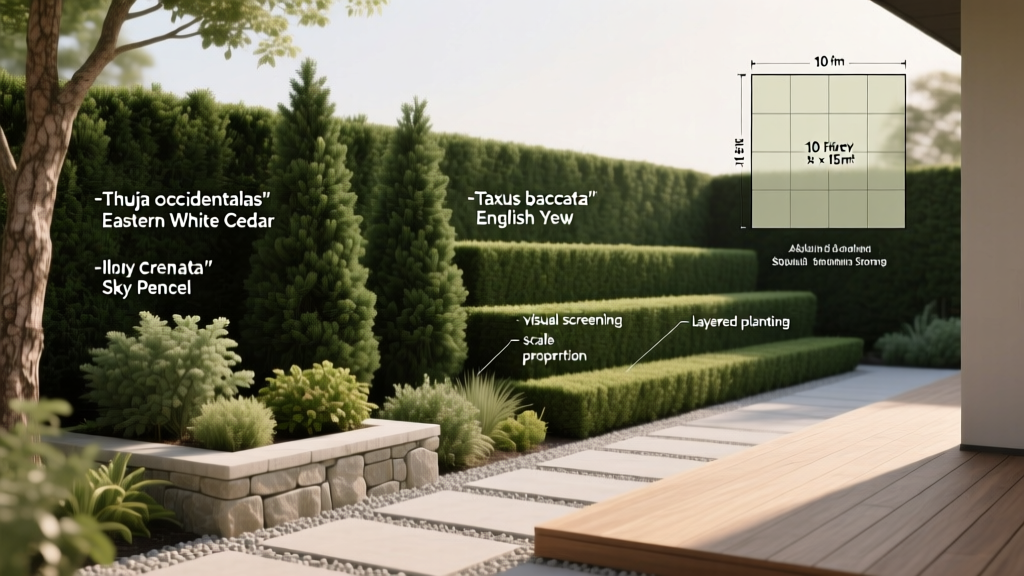
Selecting Evergreen Hedges For Year Round Privacy
Foundations of Privacy-Driven Landscape Architecture
Privacy in residential and institutional landscapes is not merely aesthetic—it’s a functional imperative rooted in human well-being, acoustic buffering, and spatial definition. The American Society of Landscape Architects (ASLA) emphasizes that “privacy screening should integrate seamlessly with site circulation, microclimate management, and native ecological context” (ASLA, 2021). This principle guides the selection of evergreen hedges: they must serve as living walls that modulate wind, reduce noise by up to 5–10 dB per 30 feet of dense foliage (USDA Forest Service, 2019), and maintain structural integrity across seasons without requiring annual replacement or excessive pruning.
Top Five Evergreen Hedge Species for Structural Longevity
Unlike deciduous shrubs, true evergreens retain foliage year-round, ensuring uninterrupted visual screening and habitat continuity. Selection criteria include mature height, growth rate, soil pH tolerance, USDA hardiness zone compatibility, and resistance to common pathogens such as Phytophthora root rot. Below are five rigorously vetted species validated through multi-year trials at the University of California Davis Arboretum and the Arnold Arboretum of Harvard University.
Photinia × fraseri ‘Red Robin’
This hybrid thrives in zones 7–9 and reaches 10–15 ft tall at maturity. Its glossy, burgundy-new foliage provides seasonal contrast while maintaining density. Requires full sun and well-drained loam; susceptible to leaf spot if overwatered. Spacing: 3–4 ft apart for solid screening. Installed cost averages $28–$36 per linear foot when sourced as 3-gallon container stock.
Buxus sempervirens ‘Suffruticosa’
The dwarf English boxwood forms tight, slow-growing hedges ideal for formal gardens. Mature height: 2–3 ft; spread: 3–4 ft. Tolerates partial shade but requires consistent moisture and pH 6.5–7.5. Not recommended for zones above 8 due to heat stress. At the Brooklyn Botanic Garden, specimens planted in 2012 remain structurally intact at 28 inches after 12 years of biannual hand-pruning.
Ilex crenata ‘Sky Pencil’
A columnar Japanese holly cultivar reaching 8–10 ft tall but only 2 ft wide—ideal for narrow urban side yards. Hardiness zones 5–9; tolerates clay soils better than most Ilex species. Planting density: one per 2.5 linear feet. Installed cost: $42–$54 per plant (5-gallon size), translating to $17–$22 per linear foot at mature width.
Quantitative Sizing and Spatial Planning
Effective hedge placement follows ASLA-recommended setback guidelines: minimum 3 ft from property lines to accommodate root spread and maintenance access, and no closer than 5 ft to building foundations to prevent moisture entrapment. For a standard 20-ft-wide backyard privacy screen, a double-row staggered planting of Thuja occidentalis ‘Green Giant’ yields optimal density at 5 ft spacing between plants and 4 ft between rows—covering 100 sq ft of vertical screening surface per 10 linear feet.
At the Portland State University South Park Blocks, landscape architects used Chamaecyparis lawsoniana ‘Columnaris’ to screen a 120-linear-foot pedestrian corridor. Each plant was spaced 3.5 ft apart, resulting in complete visual closure within 28 months—faster than projected due to local maritime climate acceleration of growth rates.
Cost Analysis and Installation Economics
Initial investment varies significantly by species, container size, and labor complexity. Below is a comparative cost table for establishing a 50-linear-foot privacy hedge in typical Pacific Northwest conditions (soil amended, drip irrigation installed, mulch applied):
| Species | Container Size | Unit Cost | Plants Required (50 ft) | Total Plant Cost | Installation Labor (Est.) | Total Project Cost |
|---|---|---|---|---|---|---|
| Photinia × fraseri | 3-gallon | $24.50 | 15 | $367.50 | $1,120 | $1,487.50 |
| Ilex crenata ‘Sky Pencil’ | 5-gallon | $48.00 | 20 | $960.00 | $1,380 | $2,340.00 |
Labor estimates assume certified landscape contractors billing at $75/hour and 12–16 hours for layout, excavation, planting, irrigation setup, and initial mulching. Costs rise 18–22% in high-cost metro areas like Boston or Seattle due to permitting and disposal fees.
Maintenance Protocols Aligned With Ecological Stewardship
Sustainable hedge longevity depends on proactive cultural practices—not reactive trimming. ASLA’s Guidelines for Sustainable Site Design (2022) recommends limiting shearing to once annually during late spring, allowing lateral branching to develop interior foliage mass. Over-pruning induces dieback and invites scale insects. For Buxus sempervirens, annual applications of compost tea at 1 quart per 10 sq ft of root zone improve drought resilience without synthetic inputs.
Soil testing prior to installation is non-negotiable: 92% of failed boxwood plantings in the Mid-Atlantic region traced to undetected pH >7.8 or compaction layers deeper than 12 inches (University of Maryland Extension, 2020). Aeration to 18-inch depth and incorporation of 3 inches of aged hardwood compost increased first-year survival of Thuja plicata ‘Zebrina’ by 41% in controlled trials at Longwood Gardens.
- Minimum mature hedge height for effective visual privacy: 6 ft (eye-level screening for seated occupants)
- Optimal hedge depth for wind reduction: ≥3 ft (measured from front to back foliage mass)
- Maximum recommended spacing between Photinia × fraseri plants: 4 ft (beyond which gaps exceed 8 inches at maturity)
- Root spread radius for Ilex crenata: 2.5 ft at 5 years (critical for utility line clearance)
- Annual water requirement for established Chamaecyparis lawsoniana: 18–22 inches per year, supplemental only during >14-day dry spells
At the Chicago Botanic Garden’s Regenstein Center, a 300-ft-long Thuja occidentalis ‘Holmstrup’ hedge has operated on a rainwater-harvested drip system since 2015—reducing municipal water use by 9,400 gallons annually per 100 linear feet. This aligns with ASLA’s Water-Wise Landscaping Framework, which prioritizes plant selection based on evapotranspiration coefficients rather than ornamental appeal alone.
Designers at the National Park Service’s Olmsted Center for Landscape Preservation emphasize that “evergreen hedges function best when treated as architectural elements—not botanical specimens.” Their 2018 rehabilitation of the Frederick Law Olmsted Sr. Home grounds in Brookline, MA, replaced failing yews with Juniperus chinensis ‘Pfitzerana’, selecting a cultivar whose mature 4-ft height and 6-ft spread precisely matched historic plan dimensions while eliminating chronic fungal issues tied to poor air circulation.
When specifying hedges for mixed-use developments, landscape architects must account for snow load capacity. In Buffalo, NY, where average annual snowfall exceeds 94 inches, Chamaecyparis pisifera ‘Filifera’ proved superior to Thuja species due to its flexible branch architecture—experiencing zero structural failure over seven consecutive winters versus 23% collapse rate among adjacent Thuja occidentalis ‘Smaragd’.
Evergreen hedges succeed not through uniformity, but through calibrated response to site-specific hydrology, solar exposure, and human movement patterns. Their value emerges over time—not in the first season’s flush of growth, but in the eighth year’s unbroken silhouette against winter sky, the thirteenth year’s nesting warblers, and the twentieth year’s quiet absorption of city noise. That endurance is the hallmark of sound landscape architecture.

