Tree Care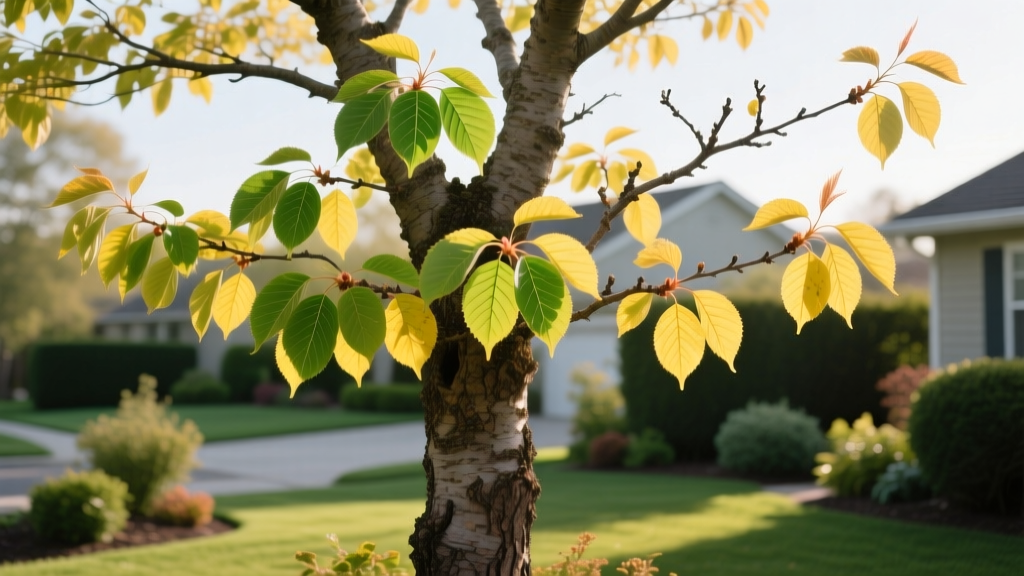
Signs Of Iron Deficiency In Ornamental Cherry Trees
Chlorosis as the Primary Visual Indicator
Iron deficiency in ornamental cherry trees—particularly Prunus serrulata (Japanese flowering cherry) and Prunus subhirtella (Higan cherry)—most commonly manifests as interveinal chlorosis: yellowing of leaf tissue between otherwise green veins. This symptom typically appears first on young, terminal leaves during late spring or early summer, not older foliage. Unlike nitrogen deficiency—which causes uniform yellowing across mature leaves—iron-deficient leaves retain dark green veins while adjacent lamina turns pale yellow to nearly white. In severe cases, leaves may develop necrotic margins or drop prematurely, reducing photosynthetic capacity by up to 40% compared to healthy specimens (ISA, 2021).
Soil pH and Root Zone Constraints
Ornamental cherries thrive in slightly acidic to neutral soils (pH 5.5–6.5). When soil pH exceeds 7.0, iron becomes chemically bound as insoluble ferric oxides, rendering it unavailable for uptake—even if total soil iron content is high. In alkaline urban soils common in cities like Chicago and Denver, where limestone bedrock elevates native pH to 7.8–8.2, iron deficiency occurs in over 65% of established P. serrulata plantings surveyed by the Morton Arboretum (2020). Root systems of mature Japanese cherries extend horizontally 2–3 times the canopy drip line; a 25-foot-wide canopy correlates with a root spread of 50–75 feet. However, functional absorptive roots—the fine, non-woody structures responsible for mineral uptake—are concentrated in the top 12–18 inches of soil and rarely penetrate below 24 inches.
Root Architecture and Depth Limitations
Unlike deep-rooted oaks or pines, ornamental cherries possess shallow, fibrous root systems adapted to well-drained surface soils. Their root mass density declines sharply below 18 inches, making them especially vulnerable to compaction and poor aeration. Compacted soils reduce oxygen diffusion rates by up to 70%, inhibiting root respiration and iron-reducing enzyme activity essential for Fe³⁺ → Fe²⁺ conversion prior to uptake.
Species-Specific Susceptibility and Growth Metrics
Among commonly planted cultivars, ‘Kwanzan’ (P. serrulata ‘Kwanzan’) shows moderate tolerance to elevated pH, maintaining acceptable foliage color up to pH 7.2. In contrast, ‘Yoshino’ (P. × yedoensis) exhibits pronounced chlorosis at pH > 6.8. Growth rates vary significantly: under optimal conditions, ‘Yoshino’ achieves 12–18 inches of height gain annually for the first decade, whereas ‘Shirotae’ (P. sargentii) grows more slowly at 8–12 inches per year. At maturity, ‘Kwanzan’ reaches 25–30 feet tall with a 20–25 foot spread; ‘Yoshino’ attains 40–50 feet in height but maintains a narrower 30–35 foot crown. These dimensions directly inform pruning scope and root zone protection requirements under ANSI A300 (Part 1: Tree Risk Assessment, 2019).
ANSI A300 Standards for Soil Management
ANSI A300 Part 2 (Soils) mandates that arborists avoid soil pH modification without prior testing and recommends foliar iron chelate applications only when soil pH remains above 7.0 and extractable iron falls below 4.5 ppm (DTPA-extractable method). The standard further specifies that trenching or excavation within the critical root zone—defined as a circle with radius equal to 1.5 × trunk diameter at breast height—must be limited to no more than 25% of the total area in any 12-month period to preserve hydraulic conductivity and nutrient transport.
Diagnostic Testing Protocols
Visual assessment alone is insufficient. Accurate diagnosis requires concurrent soil and foliar analysis. Collect composite soil samples from three depths: 0–6 inches, 6–12 inches, and 12–18 inches. Test for pH, organic matter (%), cation exchange capacity (CEC), and DTPA-extractable iron. Simultaneously, collect fully expanded, sun-exposed leaves from the current season’s growth—ideally from the mid-crown—and submit for tissue analysis. Deficiency thresholds are defined as:
- Foliar iron concentration < 45 ppm (dry weight)
- Soil pH > 7.0 with DTPA-Fe < 4.0 ppm
- Calcium carbonate equivalent > 2%
- Soil organic matter < 2.5% (reducing chelator availability)
- Cation exchange capacity < 8 cmolc/kg (limiting iron retention)
Mitigation Strategies Aligned With ISA Best Practices
Direct soil amendment with elemental sulfur lowers pH gradually but requires 6–12 months for effect and is ineffective in high-buffering calcareous soils. Foliar sprays using Fe-EDDHA chelate (applied at 0.5–1.0 oz/gal water) provide rapid correction within 7–14 days but must be timed before leaf expansion completes. Trunk injection of iron sulfate (0.5 g/cm trunk diameter) offers longer-term control and complies with ISA’s position statement on injectable micronutrients (ISA, 2018). All interventions must respect the tree’s natural phenology: avoid foliar applications during bloom or when temperatures exceed 85°F, as phytotoxicity risk increases markedly.
The University of California Cooperative Extension reports that repeated annual foliar treatments without addressing underlying soil chemistry result in symptom recurrence within 8–12 months in 92% of monitored sites. Similarly, the U.S. National Arboretum’s long-term trial in Washington, D.C. found that trees receiving combined soil aeration (via air-spading to 18-inch depth) and Fe-EDDHA drench achieved sustained remission for 3.2 ± 0.7 years versus 1.1 ± 0.4 years with foliar-only treatment.
Root Zone Protection During Construction
When adjacent construction threatens root integrity, ANSI A300 Part 5 (Management of Trees During Construction) requires installation of physical root barriers set at least 3 feet beyond the critical root zone perimeter. For a 12-inch-diameter ‘Yoshino’ cherry, this means a barrier radius of ≥21 feet. Soil compaction must be mitigated using lightweight equipment (< 5,000 psi ground pressure) and temporary plywood coverage over root zones—never gravel or asphalt surfacing.
Preventive planting strategies significantly reduce future iron stress. Select sites with naturally acidic soils (e.g., glacial till deposits in northern Illinois) or amend backfill with 15–20% sphagnum peat moss (pH 3.0–4.5) and 5% elemental sulfur pre-planting. Monitor newly installed trees with quarterly foliar sampling for the first two growing seasons.
Root spread data from the Bartlett Tree Research Laboratories confirms that juvenile P. serrulata trees establish lateral roots at an average rate of 1.3 feet per year in loam soils—slowing to 0.7 feet/year after age 7. This deceleration underscores why early soil intervention is more effective than remediation in mature specimens.
“Chlorosis in ornamental cherries is rarely a simple nutrient shortage—it is a symptom of mismatched site conditions. Correcting it demands understanding of soil chemistry, root biology, and species-specific phenology—not just application of iron.” — International Society of Arboriculture, Tree Health Management Guidelines, 2021
Long-term health depends on proactive soil stewardship rather than reactive correction. At the Arnold Arboretum in Boston, where over 120 cultivars of Prunus are maintained, routine soil monitoring every 3 years has reduced incidence of iron chlorosis from 38% (2005 baseline) to 9% (2023 survey). This success reflects adherence to ANSI A300 Part 2 protocols and integration of species-specific growth data into maintenance scheduling.
Pruning should never be used to treat chlorosis. Removing symptomatic leaves does not address physiological cause and may stimulate excessive vegetative flushes that further deplete internal iron reserves. Instead, focus pruning efforts on structural integrity and light penetration—per ANSI A300 Part 1—during dormancy only, avoiding cuts that remove >15% of live crown in a single session.
For trees exhibiting advanced decline—characterized by dieback of terminal branches, sparse flowering, and persistent chlorosis despite treatment—consult a certified arborist credentialed by the ISA. Removal decisions must follow ANSI A300 Part 9 (Tree Risk Assessment) criteria, including documented decline in radial growth (< 0.1 inch/year over three consecutive years), loss of >40% canopy density, and presence of decay columns exceeding 30% of trunk cross-sectional area.
| Cultivar | Max Height (ft) | Max Spread (ft) | Root Spread Radius (ft) | pH Threshold for Chlorosis Onset | Average Annual Growth (in) |
|---|---|---|---|---|---|
| ‘Kwanzan’ | 28 | 22 | 44 | 7.2 | 15 |
| ‘Yoshino’ | 45 | 32 | 64 | 6.8 | 16 |
| ‘Shirotae’ | 25 | 35 | 70 | 6.5 | 10 |
Repeated applications of iron sulfate to soil—without concurrent pH adjustment—can accumulate toxic levels of soluble iron, damaging root tips and reducing mycorrhizal colonization by up to 60%. Always verify soil test results before treatment and document all interventions in accordance with ISA recordkeeping standards.
Established trees showing chronic iron deficiency often benefit more from gradual soil reconditioning than acute correction. Incorporating composted oak leaf litter—a naturally acidic, slow-release organic amendment—increases microbial iron solubilization and improves soil structure over time. Field trials at Cornell University’s Urban Horticulture Institute demonstrated that plots amended with 3 inches of oak leaf compost annually achieved pH reduction of 0.4 units over four years, with corresponding improvement in foliar iron concentrations.
When evaluating new planting sites, prioritize locations with documented historical success for ornamental cherries—such as the historic cherry groves along the Tidal Basin in Washington, D.C., where soil pH averages 6.1 and subsurface drainage supports robust root function. Avoid areas with known caliche layers, recent fill soil, or proximity to concrete foundations leaching lime.
Finally, recognize that some chlorosis may reflect transient stress rather than chronic deficiency. Late-spring frosts damaging young leaves, herbicide drift affecting root metabolism, or saturated soils from prolonged rainfall can mimic iron deficiency symptoms. Confirm diagnosis through laboratory analysis before initiating management protocols.
