Tree Care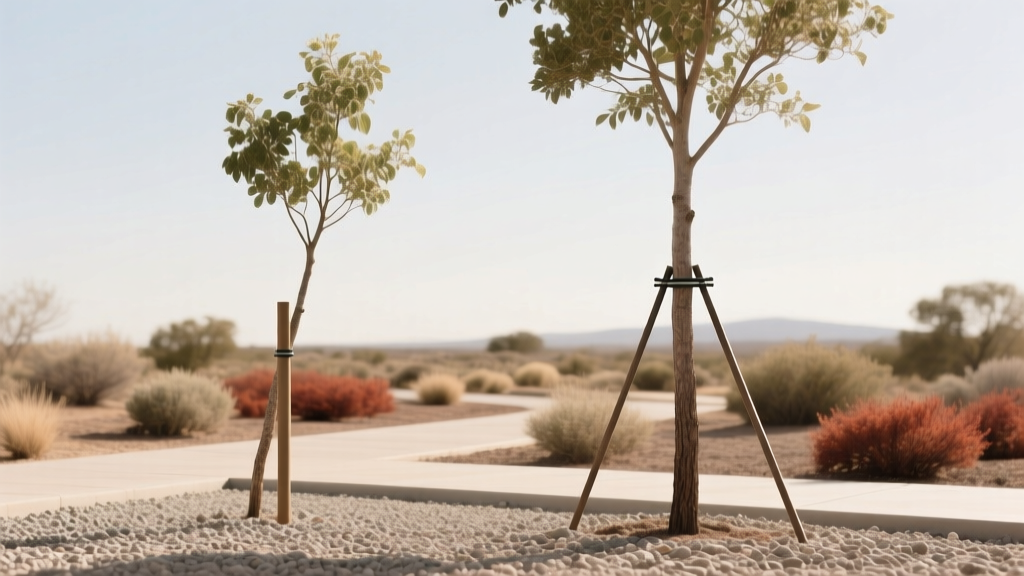
Young Tree Staking Guide 2026: Single vs Double Stake for Fire Zones
Emily WatsonPublished
The Hidden Link Between Staking and Fire Resilience
As we navigate the 2026 wildfire season, homeowners in the Wildland-Urban Interface (WUI) are fundamentally rethinking their defensible space strategies. While clearing dry brush, maintaining roof gutters, and installing ember-resistant vents remain critical, the structural integrity of the trees within your home ignition zone is equally paramount. A tree with a weak, spindly trunk is highly susceptible to snapping during the intense, fire-induced windstorms that accompany major blazes. Furthermore, a tree that fails to develop thick, insulating bark will quickly succumb to radiant heat, turning into a towering torch that threatens your property.
This is where the art and science of young tree staking intersect with fire-resistant landscaping. Staking is not merely about keeping a sapling upright; it is a vital intervention that dictates how the tree's trunk develops over its first few years. In this comprehensive 2026 guide, we break down the single stake versus double stake debate, specifically through the lens of cultivating fire-resilient tree architecture that aligns with modern defensible space codes.
The Physiology of Fire-Resilient Trees: Why Trunk Taper Matters
To understand why staking methods matter in fire-prone regions, we must look at a botanical process called thigmomorphogenesis—the way plants alter their growth patterns in response to physical touch or wind. When a young tree sways in the wind, it triggers the allocation of resources toward radial growth (increasing the trunk's caliper or thickness) rather than just vertical height. This results in "trunk taper," a structural profile where the base is significantly wider than the top.
Trunk taper provides immense structural stability against 60+ mph fire winds. Crucially, increased radial growth means thicker bark. Thick bark acts as a thermal insulator, protecting the vital vascular cambium layer from the intense radiant heat of a passing surface fire. According to the NFPA Firewise USA program, maintaining healthy, structurally sound trees with robust architecture is a core component of reducing home ignition risks. Over-staking a young tree, or leaving stakes in for too long, prevents this vital wind sway. The result is a "pencil-straight" trunk with thin bark that is highly vulnerable to both mechanical snapping and fire damage.
Single Stake vs. Double Stake: A 2026 Comparison
Choosing the right staking method depends on your specific microclimate, the tree species, and the wind patterns typical of your fire corridor. Below is a detailed comparison of the two primary methods.
| Feature | Single Stake Method | Double Stake Method |
|---|---|---|
| Primary Goal | Allow moderate sway to build trunk taper and reaction wood. | Prevent root ball displacement in high-wind or sloped environments. |
| Wind Sway Allowed | High (upper trunk flexes freely). | Moderate to Low (trunk is stabilized between two points). |
| Trunk Taper Development | Excellent (promotes thick, fire-resistant bark). | Poor to Moderate (can restrict caliper growth if left too long). |
| Best Environment | Flat terrain, moderate winds, standard residential yards. | Canyon edges, wind tunnels, steep slopes, top-heavy evergreens. |
| Fire-Resilience Impact | Builds natural thermal insulation via bark thickening. | Prevents uprooting in fire-induced downdrafts; requires careful monitoring. |
| 2026 Material Standard | Galvanized steel T-post with silicone trunk tie. | Two fiberglass stakes with broad Kevlar-reinforced cross-ties. |
Deep Dive: Single Staking for Maximum Taper
The single stake method is the gold standard for most deciduous trees and smaller evergreens planted in standard residential defensible spaces. By placing a single stake on the windward side of the tree (the direction from which the prevailing winds blow), you anchor the root ball while allowing the upper trunk and canopy to flex. This flexing is the exact stimulus required for the tree to build reaction wood and thicken its bark.
When installing a single stake in 2026, drive a 60-inch galvanized steel T-post approximately 18 inches into the ground, positioned about 12 inches away from the trunk. The tie should be placed at the lowest point on the trunk that still allows the tree to stand upright when gently tested. This low-tie approach maximizes the length of the trunk that is free to sway, directly correlating to better caliper development and superior fire resistance over the tree's lifespan.
Deep Dive: Double Staking for Windy Fire Corridors
Double staking is necessary when planting in extreme environments, such as canyon edges or mountain ridges where fire-induced wind tunnels are common. It is also required for top-heavy evergreen species (like certain pines or cedars) that act as wind sails and risk having their root balls ripped from the soil before they can establish.
To double stake, place two stakes on opposite sides of the tree, perpendicular to the prevailing wind direction. The critical mistake many landscapers make is pulling the ties completely taut. In a fire-resistant landscape, a rigidly locked trunk will fail to develop the thick bark needed to survive radiant heat. You must use broad, flexible ties and leave enough slack to allow the trunk to move slightly in a two-inch radius. This micro-movement is enough to signal the tree to begin thickening its bark without risking catastrophic root ball failure during a winter storm or a summer fire event.
Eliminating "Fire Ladders": Choosing Non-Combustible Staking Materials
Historically, landscapers relied on 2x2 wooden stakes and natural hemp twine. In a modern fire-resistant landscape, wooden stakes are a severe liability. As they weather, they dry out and act as miniature wicks. If a surface fire sweeps through your yard, a wooden stake can ignite and carry the flames directly up into the lower canopy of the tree, creating a "fire ladder" that turns a manageable ground fire into a devastating crown fire.
For 2026, WUI building codes and fire safety experts strongly recommend transitioning to non-combustible staking materials. Use powder-coated galvanized steel U-posts or heavy-duty fiberglass stakes. These materials will not ignite, rot, or harbor wood-boring pests. Furthermore, avoid cheap polypropylene tree ties that melt in high heat and permanently girdle the tree. Instead, invest in UV-stabilized silicone tree ties or basalt-fiber reinforced straps, which can withstand extreme temperature fluctuations without degrading or cutting into the expanding bark.
Integrating Staking with Defensible Space Pruning
Staking does not exist in a vacuum; it must be coordinated with your annual fire-prep pruning schedule. According to CAL FIRE defensible space guidelines, trees within 30 feet of a structure should have their lower branches pruned to a height of 6 to 10 feet off the ground to prevent surface fires from climbing into the canopy. When placing your stakes and ties, ensure they do not interfere with this critical pruning zone. Stakes should be low-profile, and ties should be positioned below the lowest permanent scaffold branches so that you can maintain a clean, fire-resistant trunk without your pruning saw getting tangled in staking hardware.
The Most Critical Step: Knowing When to Remove Stakes
The greatest threat to a tree's fire resilience is human forgetfulness. Leaving stakes in the ground for more than one to two growing seasons creates a dependent, weak tree. If a tree is supported artificially for too long, it will not develop the structural taper necessary to withstand the violent updrafts and downdrafts generated by a nearby wildfire.
2026 Expert Tip: To test if your tree is ready for stake removal, grasp the trunk halfway up and gently push it. If the root ball remains firmly planted in the soil while the trunk flexes and bends, the tree has developed sufficient anchorage and reaction wood. Remove the stakes immediately, and recycle the steel or fiberglass for future landscaping projects.
Conclusion
Fire-resistant landscaping is a holistic discipline that extends far beyond simply planting drought-tolerant shrubs. By understanding the biomechanics of tree growth, you can use staking not just as a temporary support system, but as a strategic tool to forge stronger, thicker, and more fire-resilient trees. Whether you opt for the taper-building single stake method or the wind-defying double stake approach, prioritizing non-combustible materials and timely removal will ensure your trees stand as robust defenders of your property for decades to come. For more foundational advice on establishing resilient root systems, consult the Arbor Day Foundation planting resources before breaking ground on your next defensible space project.