Tree Care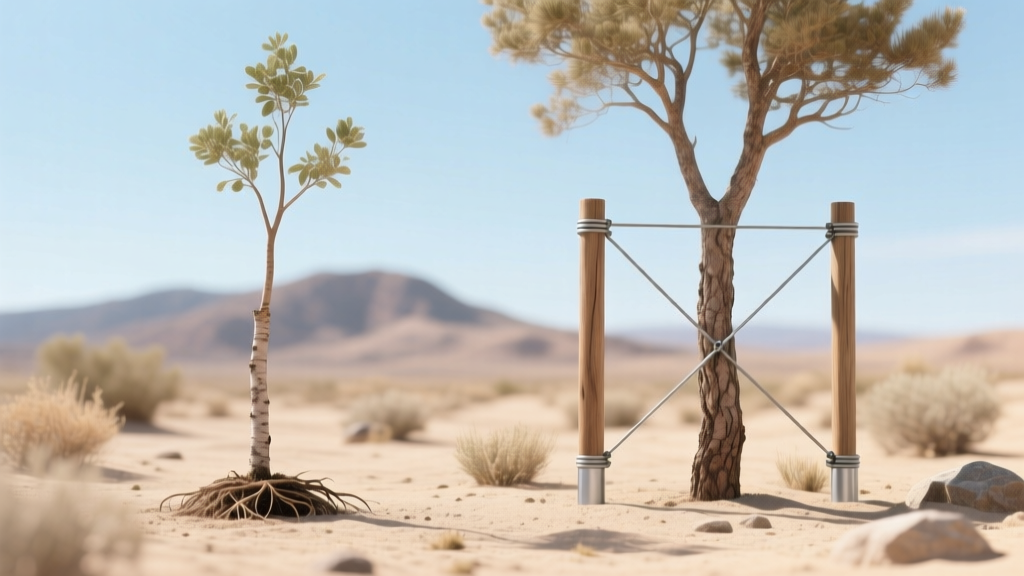
Young Tree Staking Guide 2026: Single vs Double Stake Xeriscape
Robert HayesPublished
The Evolution of Xeriscape Tree Care in 2026
As prolonged drought conditions and municipal water restrictions continue to shape landscaping trends in 2026, xeriscaping has evolved from a regional necessity into a national standard for sustainable property management. Homeowners and landscape architects are increasingly turning to drought-tolerant, low-water tree species such as the Desert Willow (Chilopsis linearis), Palo Verde (Parkinsonia spp.), and various Oak and Olive cultivars. However, establishing these young trees in arid, often sandy or heavily compacted clay soils presents unique structural challenges. One of the most critical, yet frequently misunderstood, aspects of xeric tree establishment is proper staking. In low-water landscapes, the goal of staking is not to rigidly support the tree, but rather to temporarily anchor the root ball while the tree develops the necessary trunk taper and root mass to withstand harsh, sweeping desert winds.
Why Xeric Trees Have Unique Staking Needs
Trees native to arid environments often possess brittle wood or flexible, weeping canopies that react differently to wind loads compared to traditional temperate shade trees. Furthermore, xeriscapes typically lack the dense, wind-breaking undergrowth or turfgrass found in conventional landscapes, leaving young trees fully exposed to high-velocity microbursts and seasonal monsoons. According to research published by the University of Florida IFAS Extension, improper staking can actually weaken a tree by preventing the development of reaction wood. This physiological response, known as thigmomorphogenesis, requires the trunk to experience gentle, natural swaying. When a tree is staked too tightly, it grows taller but significantly thinner, making it highly susceptible to snapping at the stake line during a severe wind event. Therefore, choosing between a single stake and a double stake configuration in 2026 requires a nuanced understanding of the tree's caliper, species flexibility, and the specific wind dynamics of your low-water landscape.
The Single Stake Method: Ideal for Flexible Natives
The single stake method is the most common and least intrusive staking technique, making it ideal for the majority of young xeric trees planted in 2026. This method is best suited for trees with a smaller trunk caliper (under 2 inches) and species that possess naturally flexible trunks, such as the Chitalpa or Vitex.
Step-by-Step Single Stake Installation
- Placement: Drive a single 6-foot fiberglass or cedar stake into the ground approximately 12 to 18 inches away from the trunk. In xeric environments where prevailing winds are predictable, place the stake on the windward side of the tree to act as a buffer against the heaviest gusts.
- Depth: Ensure the stake is driven at least 18 inches into the soil to anchor it below the active, shallow root zone. In rocky desert soils, you may need to use a rock bar or a steel post driver to achieve this depth without damaging the stake.
- Tying the Tree: Use a single, wide (at least 2 inches) UV-stabilized elastomer strap. Loop the strap in a figure-eight pattern around the trunk and the stake. This prevents the bark from rubbing against the hard stake surface, which is especially critical for thin-barked xeric species like the Palo Verde that are highly susceptible to sunscald and mechanical girdling.
- The Sway Factor: Tie the tree at the lowest point necessary to keep the root ball from shifting—usually about one-third of the way up the canopy. Leave enough slack in the strap to allow the top two-thirds of the tree to sway freely in the wind.
The Double Stake Method: Anchoring Heavy Evergreens
While the single stake is sufficient for most deciduous xeric trees, the double stake method is essential for larger, top-heavy, or broadleaf evergreen species commonly used in modern low-water designs. Trees such as the Arizona Cypress (Cupressus arizonica), Southern Live Oak (Quercus virginiana), and fruiting or fruitless Olive trees (Olea europaea) often arrive from the nursery with dense, heavy canopies and relatively small, container-bound root balls. In open xeriscapes, these trees act like sails, catching immense wind resistance.
Step-by-Step Double Stake Installation
- Placement: Drive two 6-foot stakes into the ground on opposite sides of the tree, approximately 18 to 24 inches from the trunk. Crucially, the line connecting the two stakes must be perpendicular to the prevailing wind direction. This provides lateral support against the primary force of nature.
- Strapping: Use two separate, wide tree ties. Attach one from the trunk to each stake, again utilizing a figure-eight loop to protect the bark. Ensure both straps are at the exact same height to distribute the wind load evenly across the trunk.
- Tensioning: The straps should be taut enough to prevent the root ball from rocking in the soil, but loose enough to allow a slight, elastic give. If the tree is completely immobilized, the roots will fail to establish a wide, drought-resistant footprint.
Comparison Chart: Single vs. Double Staking for Xeriscapes
| Feature | Single Stake Method | Double Stake Method |
|---|---|---|
| Best For | Small caliper (under 2"), flexible deciduous natives | Large caliper (2"-4"), top-heavy evergreens |
| Xeric Species Examples | Desert Willow, Chitalpa, Crape Myrtle | Arizona Cypress, Olive, Southern Live Oak |
| Wind Exposure | Moderate, sheltered courtyards, or predictable breezes | High, open desert landscapes, monsoon corridors |
| Material Cost (2026) | ~$15 (1 stake, 1 UV-strap) | ~$28 (2 stakes, 2 UV-straps) |
| Root Ball Anchor | Moderate (allows some rotational pivot) | High (prevents multi-directional rocking) |
Choosing the Right Hardware for Harsh Sun
The intense UV radiation present in arid, low-water climates rapidly degrades cheap landscaping materials. In 2026, the use of wire wrapped in old garden hose is universally condemned by arborists. This outdated method traps moisture against the trunk, inviting fungal pathogens, and inevitably cuts into the cambium layer as the tree grows, causing fatal girdling. Instead, invest in UV-stabilized polyurethane tree straps or biodegradable coir ropes designed specifically for high-sun environments. Modern elastomeric arbor ties with integrated spacers are highly recommended for xeric zones, as they maintain elasticity despite extreme temperature fluctuations between blistering days and freezing desert nights. The Colorado State University Extension emphasizes that any tie material must be checked monthly during the growing season to ensure it is not restricting the trunk's natural expansion. Wide, flat straps distribute pressure over a larger surface area, protecting the delicate, photosynthetic bark of many desert-adapted trees.
Integrating Stakes with Low-Water Irrigation
A unique challenge in xeriscape tree care is ensuring that staking hardware does not interfere with deep-root watering systems. Xeric trees require infrequent but profoundly deep watering to encourage roots to dive below the hot, dry surface layer. When installing drip emitters or soaker hoses, route the irrigation lines outside the immediate stake zone. If a stake is driven directly through a drip line, it can crush the tubing or create a channel for water to pool at the base of the stake, leading to localized soil erosion and root rot. Position your emitters in a concentric ring just beyond the stake perimeter, expanding the ring outward each year as the tree's root ball expands. For newly planted 15-gallon nursery specimens, utilizing slow-release drip bladders or deep-root PVC waterers placed safely between the stakes ensures that moisture reaches the bottom of the root ball without destabilizing the soil around your anchors.
The Most Critical Step: Knowing When to Remove Stakes
The most common mistake homeowners make is leaving stakes in the ground indefinitely. Stakes are temporary training wheels, not permanent crutches. For most xeric species, stakes should be removed after one full growing season, or as soon as the tree can stand upright on its own when the ties are removed. To test this, perform the 'push test': gently untie the straps and push the trunk. If the root ball remains firmly planted and only the flexible trunk bends, the tree is ready to be free. Leaving stakes in place for multiple years prevents the lower trunk from developing the necessary caliper and reaction wood, resulting in a tree that is permanently dependent on artificial support. By 2026, advanced soil moisture sensors and root-growth trackers can help landscape professionals determine the exact moment a tree's root system has fully anchored into the native soil, signaling that it is time to remove the stakes and let the tree thrive independently in its low-water environment.