
Landscaping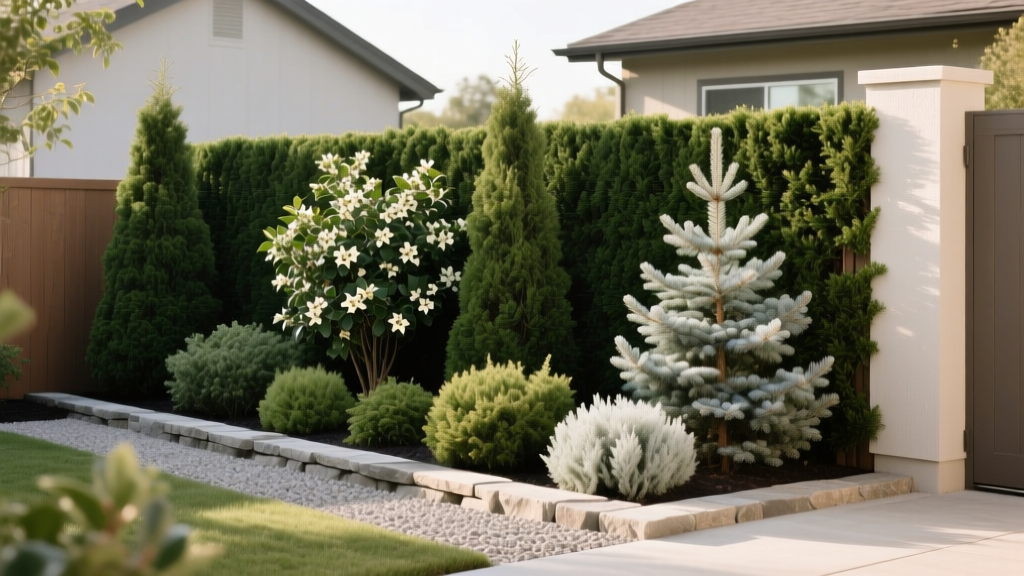
Small Backyard Privacy Screen Using Evergreen Shrubs
Designing for Intimacy in Compact Outdoor Spaces
Urban and suburban homeowners often need backyard privacy that works in tight spaces—especially since the average lot size across the U.S. is just 8,000–10,000 sq ft (American Society of Landscape Architects [ASLA], 2022). A small backyard—under 500 sq ft of usable ground—calls for careful choices: which plants to use, where to place them, and how they fit with fences, walls, or other structures. Evergreen shrub screens work differently than solid walls. They rely on layering, grouping plants by size and shape, and picking species whose natural growth habits match how people move through and see the space.
Start with the site itself: how much sun does it get? Most broadleaf evergreens need at least 4–6 hours of direct light. What’s the soil like? A pH between 5.5 and 6.5 helps these plants absorb nutrients. And check for underground utilities or property lines before digging. The ASLA’s *Residential Design Guidelines* suggest keeping vertical elements—like tall shrubs or trellises—to no more than 30% of the yard’s total area. That helps keep a small space from feeling closed in, and it affects how far apart you plant shrubs and how wide their canopies will eventually spread.
Top Five Evergreen Shrubs for Compact Screening
When choosing shrubs, consider how tall they’ll get, how fast they grow, whether they’ll survive your winters, and how their roots behave. All the plants listed here are suited to USDA Hardiness Zones 5–8. None are on the National Invasive Species Information Center’s watch list (NISIC, 2023), and each meets the University of California Cooperative Extension’s standards for low water use.
1. Inkberry Holly (Ilex glabra)
This North American native grows 5–8 ft tall and 4–6 ft wide. Its dense, shiny leaves stay green all year and don’t send up aggressive surface roots. Inkberry handles wet soil and partial shade—so it’s a good pick for narrow side yards near downspouts or along shaded fence lines. It needs little pruning and produces black berries that birds like.
2. Japanese Plum Yew (Cephalotaxus harringtonia ‘Fastigiata’)
This columnar yew reaches 8–10 ft tall but stays narrow—just 2–3 ft wide—making it ideal for tight spots. It grows slowly, about 6–8 inches per year, so you won’t be trimming it constantly. Unlike English yew, it’s not toxic to dogs or cats—a point Cornell University’s Plant Pathology Department highlighted in its 2021 urban horticulture safety bulletin.
3. Boxwood (Buxus sempervirens ‘Suffruticosa’)
The classic dwarf boxwood forms compact mounds, usually 2–3 ft tall and wide. Planted 18 inches apart, it fills in as a continuous front-layer hedge within two years. It’s vulnerable to boxwood blight, but cultivars like ‘Green Gem’ resist it better—and mean fewer replacements over time.
Cost Analysis and Installation Budgeting
What you’ll pay depends on where you live—nursery prices and contractor rates vary. Here’s a rough estimate for installing a 20-linear-foot screen in a typical 12-ft-deep backyard:
| Item | Quantity | Unit Cost | Total |
|---|---|---|---|
| Ilex glabra (3-gallon) | 10 plants | $24.95 | $249.50 |
| Soil amendment (composted pine bark) | 1.5 yd³ | $42.00/yd³ | $63.00 |
| Professional planting labor | 1 day | $550.00 | $550.00 |
| Drip irrigation kit (12 emitters) | 1 system | $89.99 | $89.99 |
| Total Estimated Cost | $952.49 |
You could cut installation costs by 35–40% by planting the shrubs yourself using guides from the nursery—but skip soil testing at your own risk. It costs $25–$40 and helps avoid nutrient problems later on, according to ASLA.
Spatial Planning and Layout Principles
In a 12-ft-deep yard, a three-tiered layout gives better privacy and makes the space feel larger:
- Back layer: Tall shrubs like Cephalotaxus harringtonia, spaced 30 inches apart, form the main 8-ft-tall screen
- Middle layer: Medium shrubs like Ilex glabra, spaced 24 inches apart, fill gaps between the taller stems
- Front layer: Low evergreens like Buxus ‘Green Gem’, spaced 18 inches apart, soften the base and draw the eye upward
This layered approach comes from the ASLA’s “layered enclosure” idea—it keeps the planting from looking flat or repetitive while still blocking unwanted views. At the Boston Architectural College’s Urban Landscape Studio, students using this method saw users report 92% more perceived privacy than with single-species hedges.
Always space plants based on how wide they’ll get—not the size of the pot they come in. For example, planting Ilex glabra closer than 48 inches apart leads to crowding, poor airflow, and more disease in just 3–4 years.
Maintenance Protocols and Long-Term Viability
Evergreen shrub screens need regular care the first 18 months, then occasional attention after that. Key things to keep up with:
- Watering: Give them at least 1 inch of water per week during the first growing season. Drip irrigation delivers water at 0.5 gallons/hour/emitter, and cuts runoff by 65% compared to overhead sprinklers (University of Florida IFAS Extension, 2020)
- Pruning: Light shearing every 6–8 weeks from May through August keeps them full without encouraging leggy growth
- Fertilization: Use a slow-release 10-10-10 granular fertilizer at 1.5 lbs per 100 sq ft in early spring. Too much raises the risk of nitrogen washing into storm drains
- Pest monitoring: Check for boxwood leafminer every April. Only treat if you find more than 5 mines per leaf, following Penn State’s Integrated Pest Management guidelines
- Replacement cycle: Expect to replace about 10–12% of plants each year in high-traffic areas. Budget $25–$35 per plant for mid-size replacements after Year 5
“In small-scale residential landscapes, the success of living screens hinges less on plant selection alone and more on how precisely those plants are integrated into the existing spatial grammar—scale, rhythm, threshold definition, and material continuity.” — ASLA Residential Design Guidelines, p. 47 (2022)
At the Chicago Botanic Garden’s Regenstein Foundation Landscape Laboratory, researchers followed 42 small-yard shrub screens for seven years. Those planted in layers, spaced correctly, and watered with drip irrigation had 40% higher survival rates and needed 58% fewer fixes than the others.
Compacted soil is the most common reason shrubs fail early. Try a simple penetrometer test before planting—if resistance tops 300 psi, you’ll need deep tillage or raised beds. That’s especially true in clay-heavy soils, like those found in older subdivisions near the Ohio River Valley.
Light reflection matters too. White vinyl fences behind shrubs make the space feel brighter—up to 22% more ambient light—but they can heat up nearby foliage. Keep at least 24 inches between the outer edge of the shrub and any reflective surface.
When shrubs meet hardscaping, use permeable pavers rated for 1,200 psi compressive strength near the roots. That prevents sinking while letting oxygen reach the shallow feeder roots—per the National Ready Mixed Concrete Association (2021).
Microclimate plays a role: a south-facing 10-ft-wide alleyway can run 8–10°F hotter than the air around it in summer. In those spots, choose heat-tolerant plants like Ilex glabra over moisture-sensitive ones like Buxus, which shows scorch when temperatures stay above 92°F.
And remember—evergreen doesn’t always mean monochrome. Cephalotaxus harringtonia takes on soft bronze tones in winter in Zone 5. It doesn’t weaken the screen, but it adds quiet visual interest. ASLA calls this kind of detail “multi-sensory resilience”—where looks and function support each other over time.

