Lawn Care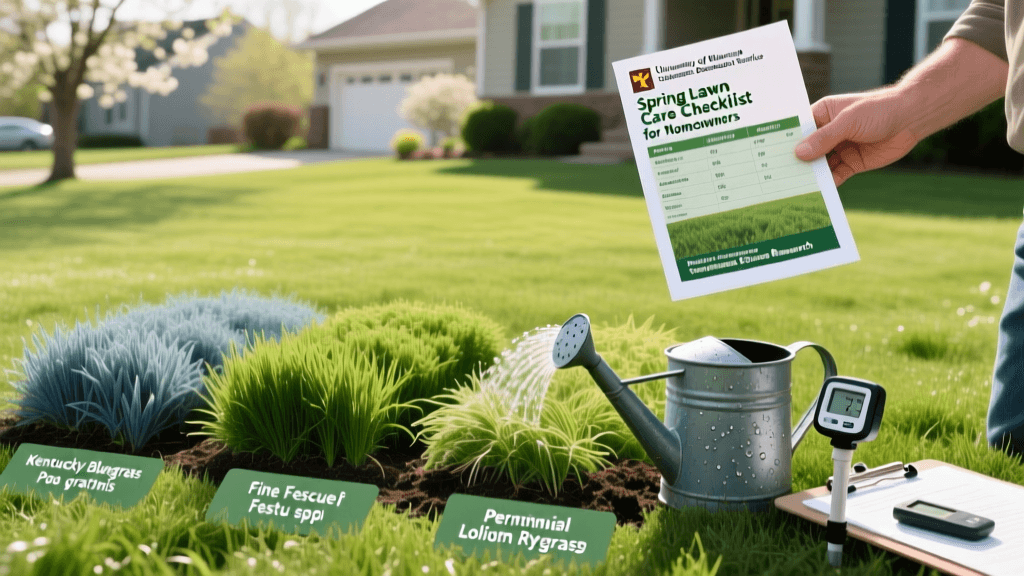
Spring Lawn Care Checklist For Homeowners
Getting Your Lawn Ready After Winter
Between late March and early May is when your lawn needs the most attention — it’s the window that sets the tone for the rest of the growing season. What you do (or don’t do) in these weeks affects how well your grass handles summer heat, dry spells, and regular use.
Spring lawn care isn’t one job — it’s a series of steps timed to soil temperature, grass growth, and local weather. Applying fertilizer too early, before the soil has warmed up, or mowing too low before roots have recovered from winter dormancy, can slow things down by weeks. The checklist below follows the order these tasks should happen, with rates, timing windows, and product suggestions based on university turfgrass research.
Assess Soil Conditions Before Doing Anything Else
Before you reach for the mower or any product, walk the whole lawn. Look for spots where grass didn’t come back, thick layers of thatch, compacted soil, or areas where water pools. These observations tell you what needs fixing now and what can wait until fall.
A soil test is one of the most useful things you can do for your lawn. The University of Massachusetts Amherst Soil and Plant Tissue Testing Laboratory suggests testing every two to three years — and spring, before adding anything, is the best time. A standard test costs $15–$30 and gives you pH, organic matter, and levels of phosphorus, potassium, calcium, and magnesium. Without those numbers, applying fertilizer or lime is mostly guesswork.
Understanding Soil pH and Its Effect on Nutrient Availability
Most cool-season grasses — Kentucky bluegrass (Poa pratensis), tall fescue (Festuca arundinacea), and perennial ryegrass (Lolium perenne) — grow best when soil pH is between 6.0 and 7.0. Warm-season grasses like bermudagrass (Cynodon dactylon) and zoysiagrass (Zoysia japonica) do fine between 5.8 and 7.0. Outside those ranges, nutrients stay locked in the soil and aren’t available to roots — even if you add plenty of fertilizer.
If your test shows pH below 6.0, apply pelletized calcitic limestone at the rate listed on your report — usually 25 to 50 lbs per 1,000 sq ft for moderate adjustments. If pH is above 7.5, elemental sulfur at 5 to 10 lbs per 1,000 sq ft can lower it gradually, though it takes several months to see results.
Thatch Measurement and Dethatching Thresholds
Thatch is the layer of stems, roots, and other organic material that builds up between the soil and green grass blades. A thin layer — up to half an inch — helps hold moisture and buffer soil temperature. Once it hits 0.75 inches or more, it blocks water, shelters disease-causing fungi, and encourages shallow roots that struggle in dry weather.
To check thatch depth, cut a small plug out of the lawn with a knife or trowel and measure the spongy brown layer between the soil and green growth. If it’s over 0.75 inches, power rake or vertical mow in early spring — when cool-season grasses are growing but before summer heat arrives. Don’t dethatch warm-season grasses this time of year; wait until late May or June, after they’re fully green.
Spring Fertilization: Timing, Products, and Application Rates
Fertilizer timing is a common point of confusion, but research points to a clear pattern: for cool-season grasses, a light spring feeding followed by a heavier fall application works better than loading up on nitrogen in spring. The North Carolina State University Turfgrass Program (2022) recommends no more than 0.5 to 1.0 lb of nitrogen per 1,000 sq ft in spring for cool-season lawns, saving the bigger 1.0 to 1.5 lb dose for September and October — when root growth peaks.
Warm-season grasses follow the opposite schedule. Bermudagrass and zoysiagrass shouldn’t get their first fertilizer until the lawn is fully green and soil temperatures at 4 inches deep hit 65°F consistently — usually late April to mid-May across the transition zone and Deep South. Feeding dormant warm-season grasses just encourages weeds without helping the turf.
Choosing the Right Fertilizer Formulation
Fertilizer labels list three numbers: nitrogen (N), phosphorus as P₂O₅, and potassium as K₂O. A 32-0-10 product, for example, has 32% nitrogen, 10% potassium, and no phosphorus — a good fit for lawns where soil tests show enough phosphorus, which is typical for established residential lawns.
Slow-release nitrogen — like polymer-coated urea (PCU), sulfur-coated urea (SCU), or methylene urea — feeds grass steadily over 8 to 16 weeks and lowers the risk of sudden growth spurts, burning, or nitrogen washing into groundwater. Products such as Scotts Turf Builder with SummerGuard or Lebanon Pro Fertilizers’ 24-0-11 (with 50% slow-release nitrogen) are widely available and suitable for spring. For organic options, Milorganite (6-4-0) applied at 32 lbs per 1,000 sq ft delivers about 2 lbs of nitrogen per 1,000 sq ft with little chance of burn.
Always calibrate your spreader before using it. Drop spreaders and rotary spreaders distribute fertilizer differently, and the wrong setting can leave stripes or dump too much in one spot. Most bags include spreader settings for common models like Scotts EdgeGuard and Earthway.
Mowing Practices That Protect Turf Health
The first mow of the season matters. Cutting too short — known as scalping — removes leaf tissue needed for photosynthesis and leaves the plant crown exposed to temperature swings and drying out. Waiting too long means cutting off more than one-third of the blade height at once, which stresses the grass and can cause temporary yellowing.
Stick to the one-third rule: never take off more than one-third of the current blade height in a single mow. If your target height for Kentucky bluegrass is 3 inches and the grass has grown to 4.5 inches, mow down to 3 inches. If it’s grown to 6 inches, cut it to 4 inches first, then mow again a few days later to reach 3 inches.
Recommended mowing heights by species:
- Kentucky bluegrass: 2.5 to 3.5 inches in spring; raise to 3.5 to 4 inches in summer
- Tall fescue: 3 to 4 inches year-round
- Perennial ryegrass: 2 to 3 inches
- Bermudagrass: 0.75 to 1.5 inches for common types; 0.5 to 1 inch for hybrid varieties
- Zoysiagrass: 1 to 2 inches
- St. Augustinegrass (Stenotaphrum secundatum): 3 to 4 inches
Keep mower blades sharp. Dull blades tear grass instead of cutting cleanly, leaving frayed edges that turn brown and open the door for fungal infections. Sharpen blades at least twice a year — once before the first spring mow and again in midsummer.
Watering Schedules and Irrigation Efficiency
Spring rain often covers most of your lawn’s water needs, but dry springs — especially in the Great Plains, Southwest, and parts of the Southeast — mean you’ll need to water starting in April. Aim to wet the soil to 6 inches deep, which encourages deeper roots, then let the surface dry before watering again.
Most established lawns need about 1 to 1.5 inches of water per week during active growth, including rainfall. To check how much your system puts out, set several straight-sided cans (tuna cans work well) across the lawn while watering and measure how much collects. This tells you both total output and whether your coverage is even.
Water in the early morning — between 4 a.m. and 9 a.m. — to cut down on evaporation and give grass time to dry before nightfall. Wet grass overnight raises the risk of dollar spot (Clarireedia jacksonii), brown patch (Rhizoctonia solani), and other fungal diseases. According to the Irrigation Association (2023), smart controllers that adjust for weather can cut outdoor water use by 15 to 30% compared to basic timer systems — a practical upgrade in areas with water restrictions.
Weed Control and Pre-Emergent Herbicide Timing
Pre-emergent herbicides stop weed seeds from sprouting by interfering with root cell division. They won’t kill existing weeds or affect seeds that have already germinated. Timing is key: apply too early and the product breaks down before weeds start to grow; apply too late and the weeds are already up.
For crabgrass (Digitaria sanguinalis), the standard trigger is when soil temperature at 2 inches deep reaches 50 to 55°F for three to five days straight. In the Mid-Atlantic and Midwest, that’s usually late March to mid-April. In the Deep South, it can happen as early as late February. Forsythia blooming is a handy visual cue — crabgrass germination often lines up with that bloom.
Common pre-emergent active ingredients and their characteristics:
| Active Ingredient | Common Products | Application Rate (per 1,000 sq ft) | Residual Control |
|---|---|---|---|
| Prodiamine | Barricade, Lebanon Pro Pre-M | 0.5 to 1.5 oz (varies by formulation) | 3 to 5 months |
| Pendimethalin | Scotts Halts, Pre-M | 2 to 4 lbs product | 2 to 4 months |
| Dithiopyr | Dimension | 0.25 to 0.5 oz active ingredient | 3 to 4 months; early post-emergent activity on crabgrass |
| Corn gluten meal (organic) | Preen Natural, various | 20 lbs | 4 to 6 weeks; variable efficacy |
Don’t apply pre-emergent herbicides to areas you plan to overseed in spring. They block all seed germination — including grass seed. If you need to overseed, skip the pre-emergent and manage crabgrass later, or wait until fall when the pre-emergent has broken down.
Overseeding Thin or Damaged Areas
Spring overseeding makes sense for warm-season lawns or cool-season lawns with serious winter damage that can’t wait until fall. For cool-season grasses, fall is still the best time — soil temps are ideal, fewer weeds compete, and new seedlings get the whole fall and spring to settle in before summer stress. Spring overseeding is a backup option, not the top choice.
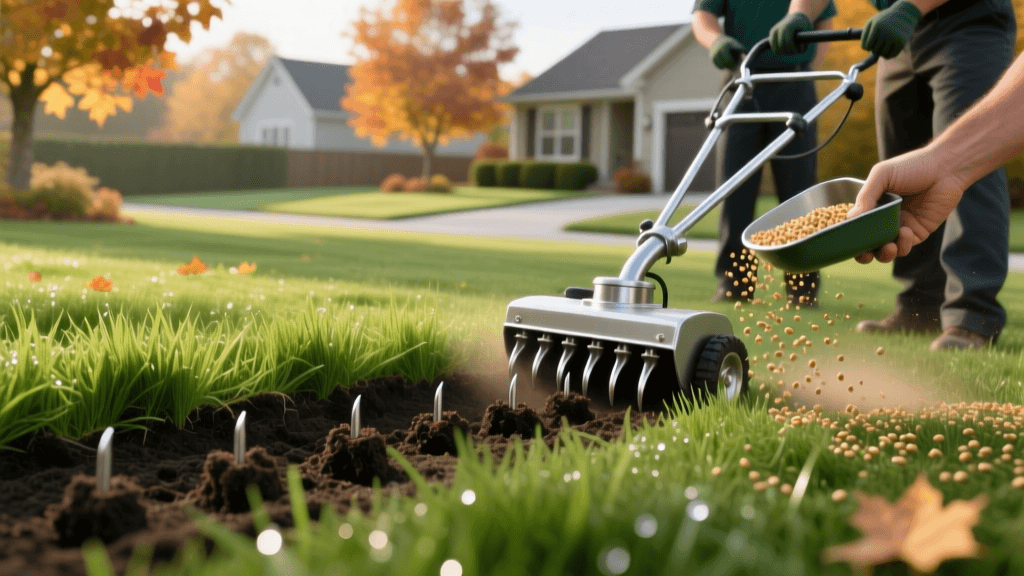
When overseeding in spring, clear away dead material with a rake, loosen the soil surface with a slit-seeder or core aerator, and apply seed at the recommended rate. For tall fescue, use 4 to 6 lbs per 1,000 sq ft in thin spots; for Kentucky bluegrass, use 1 to 2 lbs per 1,000 sq ft. Keep the seedbed moist with light, frequent watering two or three times a day until seeds sprout, then shift to deeper, less frequent sessions.
The Penn State Extension Turfgrass Program suggests using certified seed varieties listed in the National Turfgrass Evaluation Program (NTEP) trials. These varieties are ranked for disease resistance, color, density, and regional performance. Choosing one proven in your area improves establishment and long-term quality.
"Soil temperature, not calendar date, should drive the timing of nearly every spring lawn care decision — from pre-emergent application to fertilization to overseeding. A soil thermometer is one of the most useful tools a homeowner can own." — Turfgrass Science Extension, Virginia Tech, 2021
Core Aeration and Its Role in Spring Recovery
Core aeration — pulling small plugs of soil from the lawn — eases compaction, helps air reach the roots, and lets water and fertilizer soak in better. Fall is the usual time for cool-season grasses, but spring aeration fits when compaction is bad or the lawn is recovering from major damage.
Aerate when the soil is damp but not soggy — usually one or two days after rain or watering. Hollow-tine aerators pull cores 0.5 to 0.75 inches wide and 2 to 3 inches deep, spaced 2 to 4 inches apart. Leave the plugs on the lawn; they break down in two to three weeks and add organic matter back into the soil. Adding a 0.25-inch layer of compost or a sand-compost mix right after aeration speeds up breakdown and improves soil structure over time.
Steps for a complete spring lawn care sequence:
- Conduct a soil test and review results before purchasing any amendments
- Apply lime or sulfur if pH correction is needed, then wait two to four weeks before fertilizing
- Dethatch if thatch layer exceeds 0.75 inches
- Apply pre-emergent herbicide at the appropriate soil temperature threshold
- Core aerate compacted areas
- Overseed bare or thin spots, skipping pre-emergent in those areas
- Apply spring fertilizer at 0.5 to 1.0 lb nitrogen per 1,000 sq ft
- Begin mowing at the correct height for your grass species once growth resumes
- Establish an irrigation schedule based on weekly water needs and rainfall tracking
- Monitor for early signs of disease, insect activity, and broadleaf weed emergence
Following these steps in order — and timing them to soil conditions, not the calendar — gives your lawn its best shot at a strong growing season. Spending a few hours in early spring can mean less weeding, less watering, and a thicker, healthier lawn all summer and into fall.