Lawn Care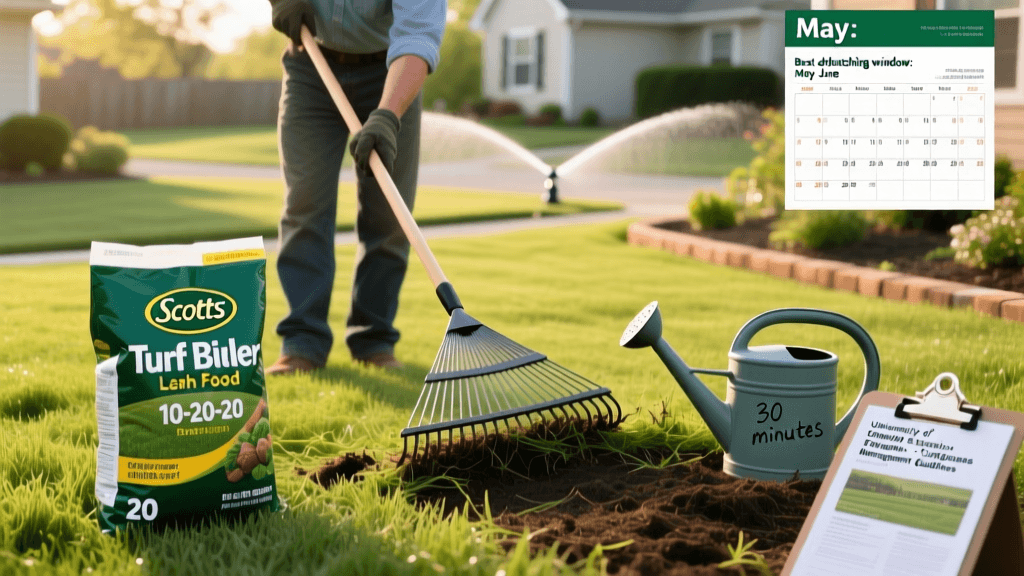
Step By Step Guide To Lawn Dethatching With A Rake
Understanding Thatch and Its Impact on Grass Health
Thatch is a tightly interwoven layer of living and dead organic matter—stems, stolons, rhizomes, and roots—that builds up between the green grass and the soil surface. A thin thatch layer (less than ½ inch) can help insulate the soil and smooth out temperature swings. But when it gets thicker than ¾ inch, it slows down water movement, limits oxygen reaching the roots, and gives fungal pathogens like *Rhizoctonia solani*—the cause of brown patch disease—a place to thrive. Penn State Extension has found that Kentucky bluegrass (*Poa pratensis*) and creeping bentgrass (*Agrostis stolonifera*) tend to build up more thatch because they grow densely and horizontally, and their tissue breaks down slowly in cool, moist weather.
Perennial ryegrass (*Lolium perenne*) and tall fescue (*Festuca arundinacea*) usually make less thatch. Their upright growth and higher lignin content help microbes break them down faster. Still, even tall fescue lawns in high-traffic areas of Raleigh, North Carolina—where summer humidity keeps things damp and decomposition slow—can reach 0.6 inches of thatch in two growing seasons if mowed too infrequently or fed too much quick-release nitrogen.
When to Dethatch: Seasonal Timing by Grass Type
Dethatch when the grass is growing actively—it recovers faster and handles the stress better. For cool-season grasses like Kentucky bluegrass, perennial ryegrass, and fine fescues, aim for early fall (mid-August to mid-September in the Midwest) or late spring (late May to early June in New England). Soil temperatures are usually between 55–75°F then, roots are growing well, and weeds like crabgrass are less likely to take over bare spots.
Warm-season grasses—Bermuda grass (*Cynodon dactylon*), zoysiagrass (*Zoysia japonica*), and centipedegrass (*Eremochloa ophiuroides*)—should only be dethatched after they’ve fully greened up and are growing strong: late spring to early summer. In Athens, Georgia, the University of Georgia Cooperative Extension suggests dethatching Bermuda lawns between May 15 and June 30, once soil temperatures at 2 inches deep stay above 65°F for five days straight.
Soil Temperature Thresholds for Safe Dethatching
- Kentucky bluegrass: ≥55°F at 2-inch depth (verified with a soil thermometer)
- Zoysiagrass: ≥68°F at 2-inch depth
- Centipedegrass: ≥72°F at 2-inch depth
- Perennial ryegrass: ≥50°F at 2-inch depth
- Tall fescue: ≥60°F at 2-inch depth
Selecting the Right Rake and Preparing Your Lawn
Use a dethatching rake—not a leaf or garden rake. The Ames True Temper 12-Tine Steel Dethatcher has hardened steel tines spaced 1.25 inches apart and angled at 45°, which slices vertically through thatch without pulling up too much soil. Skip plastic-tined rakes—they bend under pressure and won’t cut through thatch layers thicker than 0.4 inches.
Two weeks before dethatching, mow your lawn to 1.5 inches for Kentucky bluegrass and 2 inches for tall fescue. Don’t bag clippings unless you see obvious thatch (>0.5 inches)—they’ll break down on their own. Water deeply the day before: apply 0.75 inches of water, measured with a calibrated rain gauge like the Davis Instruments Rain Collector, to soften the soil and protect roots.
Pre-Dethatching Soil Moisture Guidelines
- Check soil moisture at 1-inch depth using a handheld meter (e.g., Field Scout TDR 300).
- Water only if readings drop below 18% volumetric water content (VWC) for loam soils.
- Wait 24 hours after watering before dethatching—this lets the surface dry enough to avoid mud and keeps soil structure intact.
The Step-by-Step Dethatching Process
Start in a corner and work in strips no wider than 2 feet. Pull the dethatcher toward you with steady pressure—no jerking or lifting. Each pass should pull up visible thatch strands but not gouge the soil. After three passes in one direction, turn 90° and go over the same area again. In Ann Arbor, Michigan, Michigan State University’s Turfgrass Program found that four perpendicular passes removed 37% more thatch than just one direction.
Collect the debris right away with a sturdy leaf rake or a tow-behind sweeper like the Agri-Fab 45-0462. Leaving thatch on the surface raises the risk of turf disease and makes it harder for seed to reach soil if you’re overseeding. Put it in yard waste bins—not compost piles—unless your compost hits 131°F for 15 days. Most backyard piles don’t get hot enough to kill pathogens in thatch.
After cleaning up, check how much loose material is still on the ground. If more than 15% of the soil shows through, plan another round in 10 days. Don’t dethatch more than once a year unless the thatch is over 1.25 inches thick—that’s unusual and usually calls for professional core aeration instead.
Post-Dethatching Care: Watering, Fertilizing, and Mowing
Within 24 hours, apply a starter fertilizer like 10-10-10 at 0.5 pounds of nitrogen per 1,000 square feet. Use a broadcast spreader set for Scotts Turf Builder Starter Food—for example, set a Scotts EdgeGuard DLX to 4.5. Skip urea-based fertilizers right after dethatching; ammonium sulfate (21-0-0) works better with less burn risk and quicker uptake.
Water every day for the first 7 days—0.25 inches each time, measured with a tuna can on the lawn—to keep the top inch of soil moist but not soggy. Then water every other day in week two, and switch to 0.75 inches twice a week by week three. This helps roots grow deeper and cuts down on future thatch.
Mow for the first time 5–7 days after dethatching, returning the mower to its normal height: 2.5 inches for Kentucky bluegrass, 3 inches for tall fescue, and 1.5 inches for Bermuda grass. Never cut off more than one-third of the leaf blade at once. Ohio State University trials at Wooster showed lawns mowed at recommended heights recovered 22% faster and had 18% less thatch by season’s end than those cut too short.
Monitoring Results and Preventing Future Buildup
Three weeks after dethatching, check thatch thickness again with a sharp utility knife: cut a 3-inch wedge from the lawn, lift off the thatch layer, and measure it with calipers. A healthy lawn should have ≤0.3 inches. If it’s over 0.5 inches, review your routine using this checklist:
“Annual dethatching is rarely necessary. Most lawns need it only when thatch tops 0.75 inches—and even then, fixing the root causes—like too much fertilizer, poor drainage, or infrequent mowing—is more effective long-term than pulling it out.” — Purdue Extension Turf Tips, 2022
| Cultural Practice | Recommended Adjustment | Expected Reduction in Thatch Accumulation (per year) |
|---|---|---|
| Spring nitrogen application | Reduce from 1.0 lb N/1000 sq ft to 0.5 lb N/1000 sq ft | 29% |
| Mowing frequency | Increase from once/week to twice/week during peak growth | 34% |
| Soil pH | Adjust from 5.2 to 6.2–6.5 using calcitic lime (50 lbs/1000 sq ft) | 21% |
If the problem sticks around, send soil samples to the University of Minnesota Soil Testing Laboratory or Texas A&M AgriLife Extension Service for microbial activity testing. Low dehydrogenase enzyme activity (<25 μg TPF/g soil/hour) means decomposer microbes aren’t active enough—often fixed with humic acid (e.g., Grow More Humic DG at 2 lbs/1000 sq ft) and cutting back on pesticides.
Dethatching fixes a problem—it’s not something you do every year. Keeping to the right mowing height for your grass type, feeding based on soil tests, and watering properly cuts the need for mechanical dethatching by up to 80%, according to Rutgers Turfgrass Program data (2021). Focus on soil health: core aerate every 2–3 years on high-traffic lawns, and leave clippings unless they pile up in thick mats—clippings make up less than 10% of thatch and break down fast if you mow regularly.
Check your lawn monthly during the growing season. Jot down the date, grass type, mowing height, fertilizer used (name and rate), and a rough estimate of thatch thickness. Over time, you’ll spot patterns and adjust before things get out of hand.
Grass species react differently. Centipedegrass in coastal South Carolina can show signs of stress within 48 hours of dethatching—its shallow roots don’t handle soil disruption well. Tall fescue in Des Moines, Iowa handles dethatching better in early fall—but only if soil moisture stays between 20–25% VWC while you’re working.
Always check local extension recommendations. The University of California Agriculture and Natural Resources (UC ANR) says not to dethatch St. Augustinegrass (*Stenotaphrum secundatum*) at all—it’s too easy to scalp, and recovery takes too long. Instead, UC ANR suggests verticutting at ¼-inch depth in late spring as a safer option.
Track results across seasons. See if water soaks in easier (test with a 6-inch metal rod—it should slide into the soil with light pressure after treatment), if disease patches shrink, or if the grass responds better to fertilizer. Those changes—not just how it looks—tell you whether it worked.