Tree Care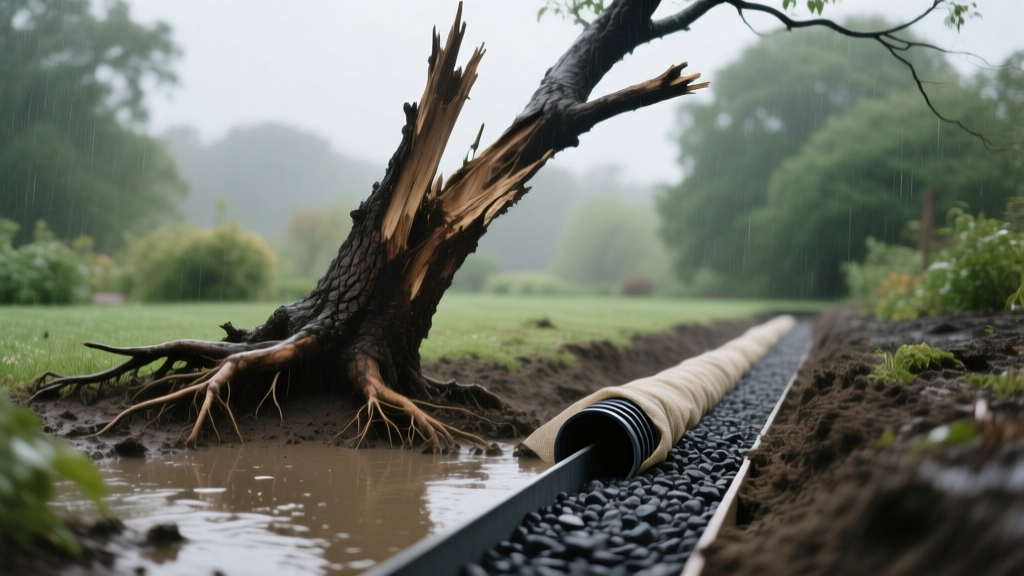
Storm Damaged Tree Triage 2026: French Drain Rescue Guide
Lisa ThompsonPublished
The Hidden Danger of 2026 Storms: Soil Saturation and Tree Failure
As we navigate the increasingly volatile weather patterns of 2026, homeowners and property managers are facing a surge in severe microbursts, atmospheric rivers, and prolonged torrential rains. When we think of storm damage to trees, we typically picture snapped trunks or shredded canopies caused by high winds. However, arborists are reporting a massive spike in a different type of failure: uprooting and severe leaning caused by soil liquefaction and hydrostatic pressure. When the ground becomes completely saturated, the soil loses its structural integrity, turning the critical root zone into a slippery, unstable matrix. In these scenarios, the wind doesn't have to be exceptionally strong to push a mature tree over.
Proper storm damage tree triage is the process of rapidly assessing a compromised tree to decide whether it can be saved, requires immediate mitigation, or must be removed entirely. For trees suffering from waterlogged soil and minor leaning, the decision to remove is often made prematurely. In many cases, a strategic French drain installation can rescue a leaning tree by rapidly evacuating subsurface water, restoring soil stability, and allowing the root system to re-anchor. This comprehensive guide will walk you through the 2026 triage protocol, helping you make the critical assess, repair, or remove decision.
The 2026 Storm Damage Triage Protocol
Before grabbing a chainsaw or calling an emergency tree removal service, you must conduct a thorough triage assessment. According to guidelines from the International Society of Arboriculture, a tree's survivability post-storm depends on three main factors: the integrity of the trunk, the extent of crown loss, and the condition of the root plate. When water is the primary culprit, the root plate is our main focus.
Walk the perimeter of the tree and look for the following indicators:
- Soil Heaving: Is the soil on the windward side of the tree cracking or lifting? This indicates the root ball is pulling out of the ground.
- Lean Angle: Has the tree developed a new lean? A lean of less than 15 degrees in a saturated landscape is often correctable, whereas a lean exceeding 30 degrees usually means the structural roots have snapped.
- Standing Water: Is water pooling around the base of the trunk or in the surrounding lawn 24 to 48 hours after the storm has passed? This is a primary indicator of a failed drainage profile.
- Trunk Integrity: Are there vertical cracks, fresh seams, or signs of fungal conks at the base? If the trunk is compromised, drainage repair will not save the tree.
Triage Decision Matrix: Assess, Repair, or Remove
Use the following matrix to determine the best course of action for your storm-damaged trees. This 2026 updated framework factors in modern drainage solutions and current arboricultural standards.
| Tree Condition | Soil & Root Status | Triage Decision | Primary Action Required |
|---|---|---|---|
| Slight Lean (<15°) | Saturated, poor drainage, root ball intact | Repair | French drain installation, guy-wire cabling, soil aeration |
| Severe Lean (>30°) | Heaved root plate, snapped structural roots | Remove | Professional felling, stump grinding, soil remediation |
| Trunk Split / Cracked | Any (drainage irrelevant to trunk failure) | Remove | Hazard mitigation and immediate removal |
| Crown Loss (<50%) | Well-drained, stable base | Repair | Targeted pruning, wound care, monitor for 12 months |
| Uprooted (Rootball out) | Complete soil failure, shallow roots | Remove | Heavy machinery removal, regrading, new planting |
The French Drain Solution for Waterlogged Trees
If your triage assessment lands in the 'Repair' category, addressing the hydrostatic pressure is non-negotiable. A tree cannot re-anchor itself in mud. By installing a French drain, you create a path of least resistance for subsurface water, pulling it away from the critical root zone (CRZ) and allowing the soil to dry, compact, and grip the roots once again.
The Arbor Day Foundation emphasizes that preserving mature trees is ecologically and financially superior to removal, provided the tree's structural integrity can be safely maintained. In 2026, advanced geotextiles and lightweight aggregate materials have made French drain installations less invasive to existing root systems than traditional gravel-filled trenches.
Step-by-Step French Drain Installation for Tree Rescue
Warning: Never trench directly through the critical root zone (defined as 1 foot of radius for every 1 inch of trunk diameter). Trenching must occur on the periphery to intercept water before it reaches the root ball, or utilize radial trenching techniques if approved by a certified arborist.
- Map the Water Flow and Trench Route: Identify where the water is pooling. Plan a trench that sits uphill or adjacent to the waterlogged root zone, routing the water toward a storm drain, dry well, or lower elevation daylight point. Maintain a minimum slope of 1 inch per 8 feet.
- Excavate with Root Care: Dig a trench 12 to 18 inches deep and 8 to 10 inches wide. When you encounter roots smaller than 2 inches in diameter, use sharp, sterilized bypass pruners to make clean cuts. Do not tear or rip the roots with a shovel, as this invites fungal pathogens.
- Line with Modern Geotextile Fabric: Line the trench with a high-quality, non-woven permeable geotextile fabric. In 2026, advanced fabrics like Typar or NDS Pro are preferred because they allow rapid water permeation while completely blocking fine silt and clay from clogging the system.
- Install the Perforated Pipe: Place a 4-inch corrugated perforated pipe (such as the NDS EZ-Drain system) at the bottom of the trench. Ensure the perforations are facing downward or to the sides. Modern hydro-engineering shows that water enters the pipe more efficiently from the bottom as the trench bed saturates, preventing sediment from washing directly into the holes.
- Backfill and Close: Instead of heavy gravel which can compact soil and damage shallow roots, use a lightweight, permeable drainage aggregate or wrap the pipe entirely in the geotextile and cover with a coarse sand mixture. Fold the excess fabric over the top to create a 'burrito' wrap, then cover with 2 inches of native topsoil and sod.
Cost Analysis: Repair vs. Remove in 2026
Financial considerations often drive the triage decision. Here is a breakdown of average 2026 landscaping and arboriculture costs to help you weigh your options:
- French Drain Installation: $35 to $55 per linear foot. A typical 50-foot rescue trench costs between $1,750 and $2,750.
- Tree Cabling and Bracing: $400 to $800 to temporarily support a leaning tree while the soil dries and roots re-establish.
- Mature Tree Removal: $1,200 to $3,500, heavily dependent on crane access and proximity to structures.
- Stump Grinding: $400 to $800.
- Replanting a 15-Gallon Replacement Tree: $600 to $1,200 (including soil amendments and labor).
As the data shows, investing $2,500 into a French drain and cabling system to save a 50-year-old shade tree is vastly more cost-effective than spending $4,000 to remove it, grind the stump, and plant a sapling that will take three decades to provide equivalent canopy cover and property value.
When Removal is the Only Safe Option
While French drains are miraculous for soil stabilization, they cannot fix broken wood. If your triage reveals a heaved root plate—where the entire mass of roots and soil has lifted out of the ground on the windward side—the structural roots have catastrophically failed. No amount of drainage correction will pull that root plate back down. Furthermore, if the storm has caused a vertical split in the trunk, or if you notice the presence of Ganoderma or other wood-decay fungi at the base, the tree is a ticking time bomb. In these scenarios, immediate removal by a licensed, insured arborist is the only responsible choice to protect your home and family.
Post-Storm Soil Recovery and Mulching
Once your French drain is installed and the soil begins to dry, the tree will enter a recovery phase. The stress of the storm and the temporary waterlogging will have depleted the tree's energy reserves. Avoid the temptation to apply heavy synthetic fertilizers immediately, as this can force weak, rapid growth that is susceptible to pests. Instead, apply a 2-to-3-inch layer of organic hardwood mulch in a wide ring around the tree, keeping it strictly away from the trunk flare to prevent collar rot. This mulch will regulate soil temperature, retain optimal moisture during dry spells, and slowly feed the soil microbiome, ensuring your rescued tree thrives for the rest of 2026 and beyond.
