Tree Care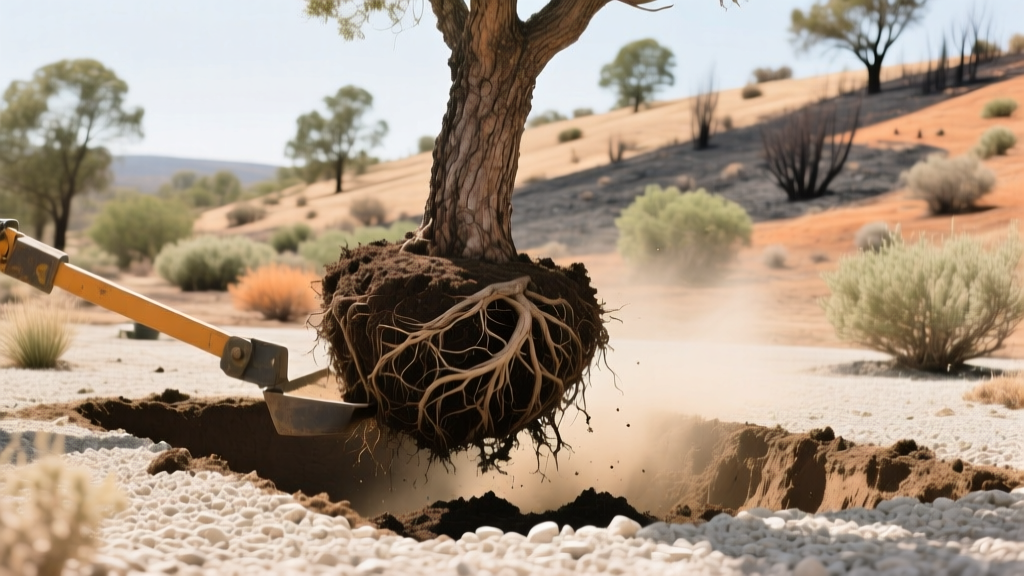
Transplanting Mature Trees in 2026: Root Pruning & Fire Zones
Anna KowalskiPublished
The Intersection of Tree Transplanting and Wildfire Defense in 2026
As homeowners and landscape architects face increasingly unpredictable wildfire seasons in 2026, creating a defensible space around your property is no longer optional—it is a critical necessity. While much of the conversation around fire-resistant landscaping focuses on hardscaping, non-combustible mulches, and low-growing groundcovers, the strategic placement and successful transplantation of mature, fire-resistant trees play an equally vital role. Mature trees can act as radiant heat shields and windbreaks, but only if they are healthy, properly spaced, and vigorously growing. A stressed or dying tree resulting from a poorly executed transplant quickly becomes a dangerous source of dry fuel.
Successfully relocating a mature tree requires a deep understanding of root pruning techniques and precise root ball size ratios. In 2026, arborists emphasize that transplanting is not just about moving dirt; it is about preserving the tree's vascular system and ensuring it can uptake enough water to maintain the high moisture content necessary to resist ignition. This guide details the exact mathematics, preparation steps, and fire-smart placement strategies required for transplanting mature trees in high-risk fire zones.
Selecting Fire-Resistant Mature Trees for Transplanting
Before you calculate root ball ratios or rent a hydraulic tree spade, you must ensure the tree species you are transplanting is appropriate for a defensible space. According to CalFire's Ready for Wildfire program, fire-resistant trees generally have high moisture content, lack resinous or volatile oils, and possess broad, deciduous leaves rather than needles.
Top Fire-Resistant Species for 2026 Landscaping
- Coast Live Oak (Quercus agrifolia): Thick, fire-resistant bark and high moisture retention.
- Bigleaf Maple (Acer macrophyllum): Deciduous, high water content, and drops leaves that compost rather than creating highly flammable thatch.
- Honey Locust (Gleditsia triacanthos): Open canopy structure that prevents the accumulation of ladder fuels.
- European Beech (Fagus sylvatica): Smooth bark that resists surface scorching and retains moisture well into the late summer dry season.
Avoid transplanting mature conifers such as pines, spruces, or junipers into Zones 1 or 2 of your defensible space. Their high sap and resin content make them highly susceptible to rapid ignition, regardless of how well-hydrated they are.
Understanding the Root Ball Size Ratio
The most common reason transplanted mature trees fail—and subsequently become fire hazards—is an undersized root ball. When a tree is dug up, the vast majority of its water-absorbing fibrous roots are left behind. To compensate, the American National Standards Institute (ANSI A300) establishes strict root ball size ratios based on the trunk caliper.
The industry standard dictates that for every 1 inch of trunk caliper (measured 6 inches above the soil line for trees up to 4 inches in diameter, or 12 inches above for larger trunks), the root ball must have a diameter of 12 inches. This ratio ensures enough root mass remains to sustain the canopy's transpiration rate during the critical first two years of establishment.
Root Ball Dimensions and Weight Estimates
| Trunk Caliper | Root Ball Diameter | Root Ball Depth | Estimated Soil Weight |
|---|---|---|---|
| 2 inches | 24 inches | 18 inches | ~450 lbs |
| 4 inches | 48 inches | 30 inches | ~1,600 lbs |
| 6 inches | 72 inches | 42 inches | ~3,900 lbs |
| 8 inches | 96 inches | 54 inches | ~7,200 lbs |
Note: Weights are estimates based on average loam soil moisture. Clay-heavy soils can weigh up to 30% more, necessitating heavy machinery like cranes or specialized 2026-model excavators for the lift.
Pre-Transplant Root Pruning Techniques
To maximize the survival rate of your mature tree, root pruning must begin 6 to 12 months before the actual transplant. This process forces the tree to generate new, dense, fibrous roots inside the intended root ball perimeter, rather than relying on long, structural taproots that will be severed during the move. The University of Minnesota Extension highlights that staged root pruning significantly reduces transplant shock, ensuring the tree remains a healthy, fire-resistant asset rather than a dry liability.
Step-by-Step Root Pruning Process
- Mark the Perimeter: Using the 12:1 caliper ratio, mark a perfect circle around the trunk indicating the final root ball diameter.
- Trenching: Using a mechanical trencher or a hand shovel, dig a trench just outside the marked line. The trench should be 12 to 18 inches deep, depending on the tree size.
- Clean Cuts: Use sharp bypass pruning shears or a reciprocating saw with a pruning blade to make clean, flush cuts on any roots thicker than 1 inch. Ragged, torn roots are highly susceptible to fungal pathogens and rot, which will compromise the tree's structural integrity and health.
- Backfilling: Backfill the trench with a highly porous, compost-rich soil mix. This encourages the severed root tips to branch out into a dense mat of feeder roots within the ball.
- Hydration: Deep-water the tree immediately after pruning and maintain a consistent moisture schedule using smart soil-moisture sensors to prevent drought stress leading up to the move.
Executing the Transplant in a Defensible Space
When the day of the transplant arrives, the goal is to move the tree to its new fire-smart location with minimal disruption to the newly formed fibrous root network. In 2026, many professional arborists utilize compressed air excavation tools (air spades) to gently remove soil from the outer edges of the root ball without tearing the delicate feeder roots.
Fire-Smart Placement and Spacing
Where you place the mature tree is just as important as how you dig it. Defensible space is divided into three zones:
- Zone 1 (0-5 feet from structure): Keep this area entirely free of mature trees. Use only hardscaping, gravel, or low-moisture succulents. Embers can easily lodge in tree bark or ignite dry leaves resting against a home's siding.
- Zone 2 (5-30 feet from structure): This is the ideal location for transplanting fire-resistant, deciduous mature trees. Ensure the canopy is pruned so that the lowest branches are at least 6 to 10 feet off the ground. This eliminates "ladder fuels" that allow a surface fire to climb into the tree's canopy.
- Zone 3 (30-100 feet from structure): Mature trees can be placed closer together here, but maintain a minimum of 10 feet between canopy edges to prevent fire from jumping from tree to tree.
Post-Transplant Care and Fire-Smart Mulching
A transplanted tree is under immense physiological stress. If it drops its leaves or suffers dieback, it becomes a prime candidate for ignition. Post-transplant care in a fire zone requires a delicate balance between providing adequate moisture and avoiding the introduction of combustible materials near the trunk.
Irrigation Strategies for 2026
Install a sub-surface drip irrigation system radiating outward from the root flare to the edge of the root ball. Sub-surface systems are highly recommended in fire zones because they eliminate the plastic tubing and emitters on the soil surface that can melt during a surface fire or create tripping hazards during emergency evacuations. Pair the system with a Wi-Fi-enabled smart controller that adjusts watering based on local evapotranspiration (ET) data and soil moisture probes.
Fire-Resistant Mulching Protocols
Traditional shredded bark mulch is highly flammable and should never be used around trees in Zones 1 or 2 of a defensible space. Instead, use the following alternatives to retain soil moisture and regulate root temperature:
- Composted Woodchips: Unlike raw, shredded bark, fully composted woodchips have a high moisture content and lack the volatile oils that cause rapid ignition. They smolder rather than burst into flame.
- Crushed Gravel or Decomposed Granite: Apply a 2-inch layer of inorganic mulch over the root ball. While it does not add organic matter to the soil, it is 100% fireproof and excellent for retaining subterranean moisture.
- The Bare Soil Buffer: Maintain a 12-inch radius of completely bare, cultivated soil directly around the tree trunk. This prevents any mulch material from touching the bark, protecting the tree's vascular cambium from surface heat.
Conclusion
Transplanting a mature tree is a significant investment of time, labor, and capital. When executed with precise attention to root ball ratios and meticulous root pruning, these trees become the cornerstone of a beautiful, shaded, and highly effective fire-resistant landscape. By adhering to the 2026 standards for defensible space spacing, utilizing smart irrigation, and choosing non-combustible or composted mulches, you ensure your mature transplants remain a protective shield against wildfire, rather than a hidden hazard.
