Tree Care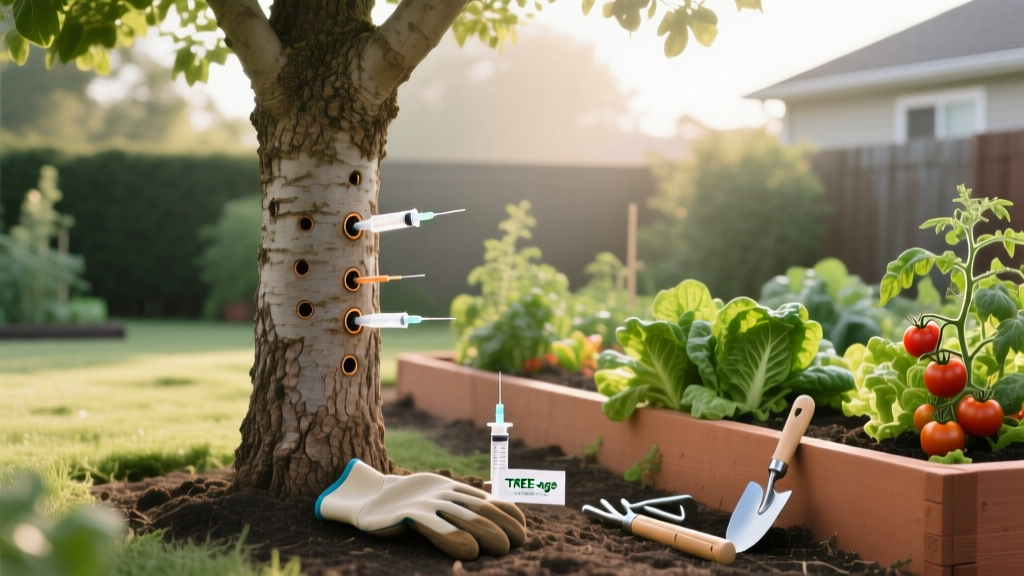
TREE-age EAB Trunk Injection Near Raised Vegetable Beds (2026)
Lisa ThompsonPublished
As we plan our outdoor spaces and crop rotations for the 2026 growing season, the intersection of tree care and edible landscaping has never been more critical. For home gardeners who rely on mature ash trees to provide essential dappled shade over their raised bed vegetable gardens, the Emerald Ash Borer (EAB) remains a severe and persistent threat. Losing a mature ash tree doesn't just mean losing a beautiful landscape feature; it means the sudden destruction of a carefully curated garden microclimate. However, treating these trees requires extreme caution when edible crops and organic soil food webs are involved.
The Microclimate Magic of Ash Trees Over Raised Beds
Ash trees (Fraxinus species) possess a unique, pinnately compound leaf structure that filters harsh midday sunlight into a gentle, dappled shade. For raised bed vegetable gardeners, this specific light profile is invaluable. It protects cool-season crops from bolting prematurely during the heat of early summer and reduces moisture evaporation from the soil surface of your raised beds. Crops like spinach, arugula, cilantro, and Swiss chard thrive under the protective canopy of a healthy ash tree. Furthermore, the extensive root systems of mature ash trees act as powerful windbreaks, protecting delicate seedlings and trellised crops like tomatoes and peas from damaging spring gusts.
When the Emerald Ash Borer infests a tree, it girdles the cambium layer, effectively choking off the flow of water and nutrients to the canopy. According to the USDA APHIS, EAB has devastated tens of millions of ash trees across North America, and as of 2026, it continues to spread into new territories. If your ash tree dies, the sudden influx of full, unfiltered sun can scorch your shade-acclimated vegetables and radically alter the moisture dynamics of your raised beds.
The Soil Safety Factor: Why TREE-age is Mandatory for Edible Gardens
When treating EAB, the method of application is just as important as the chemical used. This is where TREE-age (emamectin benzoate) trunk injection becomes the absolute gold standard for properties with raised bed vegetable gardens. TREE-age is a systemic insecticide that is injected directly into the xylem tissue at the base of the tree's trunk. Once inside, it is drawn upward with the tree's natural transpiration stream, distributing the protective compound evenly throughout the canopy.
The Hidden Danger of Soil Drenches Near Raised Beds
Historically, many homeowners and budget-conscious tree services relied on soil drenches (typically imidacloprid) to treat EAB. This involves pouring a chemical solution into the soil around the tree's drip line. For a raised bed vegetable gardener, this is a catastrophic mistake. Tree roots do not respect the wooden or stone borders of your raised beds; they actively seek out the rich, aerated, and consistently moist soil you have created for your vegetables. If an ash tree's roots have infiltrated your raised beds, a soil drench applied to the tree can be taken up by your vegetable crops. Furthermore, broad-spectrum soil applications can decimate the beneficial mycorrhizal fungi, earthworms, and microscopic bacteria that form the foundation of a productive organic vegetable garden.
By utilizing TREE-age trunk injection, the chemical completely bypasses the soil environment. There is zero risk of leaching into your raised beds, zero risk of root-uptake by your edibles, and zero disruption to your carefully built soil food web.
Comparison Chart: EAB Treatment Methods for Garden Safety
To understand why trunk injection is the only viable option for properties with edible landscaping, review the comparison of 2026 EAB treatment protocols below:
| Treatment Method | Active Ingredient | Application Zone | Risk to Raised Beds | 2026 Efficacy Rating |
|---|---|---|---|---|
| Trunk Injection (TREE-age) | Emamectin Benzoate | Directly into trunk xylem | None (Bypasses soil entirely) | Excellent (2+ years protection) |
| Soil Drench | Imidacloprid | Soil around drip line | Extreme (Root uptake, soil toxicity) | Poor to Moderate (Large trees) |
| Trunk Injection (Imidacloprid) | Imidacloprid | Directly into trunk xylem | None | Moderate (Requires annual treatment) |
| Basal Bark Spray | Dinotefuran | Lower trunk bark | Low (Risk of runoff to beds) | Moderate (Annual treatment needed) |
2026 Treatment Protocols: Aligning Arborist Visits with Garden Chores
Timing your TREE-age injection is crucial for both the tree's health and your gardening schedule. According to the University of Minnesota Extension, the optimal window for emamectin benzoate injection is from mid-May through June, when the tree is actively transpiring and the spring flush of leaves has fully expanded.
For the raised bed gardener, this timing aligns perfectly with the post-spring-frost planting window. By scheduling your certified arborist in late May, you can coordinate the treatment just after you have finished your heavy spring soil amending, compost top-dressing, and the transplanting of warm-season crops like peppers and eggplants. This ensures that the arborist's equipment and foot traffic do not compact your freshly prepared, fluffy raised bed soil.
Protecting Your Raised Beds During the Injection Process
TREE-age G4 is a restricted-use pesticide that must be applied by a licensed, certified arborist using specialized equipment like the ArborJet QUIK-jet or TREE I.V. systems. While the injection process itself is localized to the trunk, the staging of the arborist's gear requires careful management to protect your garden.
- Equipment Staging: Ensure the arborist stages their pumps, water tanks, and drilling equipment on the lawn or driveway, never on the soil paths between your raised beds. The weight of commercial tree care equipment will severely compact the soil in your walking paths, which can negatively impact drainage and root respiration for adjacent beds.
- Drilling Debris: The arborist will drill small, angled holes into the root flare of the ash tree. Ask them to use a tarp or catch-bag to collect the wood shavings. While ash wood shavings aren't inherently toxic, introducing large volumes of fresh, un-composted wood carbon near the base of your raised beds can temporarily tie up soil nitrogen as it begins to decompose.
- Root Flare Excavation: To properly inject the tree, the arborist may need to use an air-spade to gently blow away soil covering the root flare. Ensure they do not pile this excavated soil onto the edges of your raised beds, as it may contain EAB larvae or compact heavily against your garden borders.
Post-Treatment Canopy Management and Crop Planning
Once the TREE-age injection is complete, the tree will begin to distribute the emamectin benzoate throughout its vascular system, halting EAB feeding within weeks. However, if the tree was already experiencing mild canopy dieback prior to the 2026 treatment, you may still need to manage the shifting light patterns over your vegetable beds.
Work with your arborist to selectively prune out deadwood (branches with less than 30% leaf cover) during the late fall or winter of 2026. This pruning serves two purposes for the vegetable gardener: it removes hazardous branches that could fall and crush your raised bed structures during winter storms, and it allows you to precisely map the sun exposure for the following spring. By understanding exactly where the dappled shade will fall, you can strategically plan your 2027 crop layout, placing your bolt-prone leafy greens in the protected zones and your sun-loving solanums (tomatoes, peppers) in the newly opened, fully sunlit gaps.
Watering and Mulching: Balancing Tree and Garden Needs
Following a trunk injection, the tree requires adequate soil moisture to facilitate the upward movement of the TREE-age solution. This is where the synergy between your ash tree and your raised beds truly shines. The deep, infrequent watering you provide to your vegetable beds during the heat of summer will naturally percolate outward, reaching the fine, absorbing roots of the ash tree that have migrated toward your garden's moisture.
When mulching the base of the ash tree to retain moisture, maintain a strict 3-inch mulch ring around the trunk, keeping it far away from the trunk bark to prevent rot. Do not allow the arborist or landscaping crew to use synthetic herbicides or 'weed-and-feed' products near the tree's root zone, as these can easily migrate into your raised beds and devastate your broadleaf vegetable crops. By relying on TREE-age trunk injections and mindful garden stewardship, you can preserve your ash tree's majestic canopy and protect the bountiful harvest of your raised bed vegetable garden for years to come.