Tree Care
Tree Chlorosis: Diagnosing and Treating Yellow Leaves
Understanding Tree Chlorosis: The Yellow Leaf Epidemic
Walking through your landscape and noticing your once-vibrant trees developing pale, yellowing leaves can be alarming. This condition, known as tree chlorosis, is one of the most common nutritional disorders affecting landscape trees, particularly species like pin oak, red maple, and river birch. Chlorosis is not a disease itself, but rather a symptom of an underlying problem that prevents the tree from producing adequate chlorophyll. If left untreated, severe chlorosis leads to leaf scorch, branch dieback, and eventually the death of the tree.
As a homeowner or landscape manager, diagnosing the exact cause of chlorosis is the critical first step. Applying the wrong treatment can waste time and money while the tree continues to decline. In this comprehensive guide, we will explore the root causes of tree chlorosis, provide a diagnostic framework, and outline actionable, step-by-step solutions to restore your trees to vibrant health.
Diagnosing the Root Cause of Yellowing Leaves
Chlorosis typically manifests as interveinal chlorosis, where the leaf tissue turns yellow while the veins remain green. However, the specific pattern, timing, and location of the yellowing can tell you exactly what is going wrong beneath the soil surface.
1. Nutrient Deficiencies vs. Soil pH Lockout
The most frequent culprits behind chlorosis are iron and manganese deficiencies. However, these nutrients are often present in the soil but are 'locked up' and unavailable to the tree's roots. This lockout is almost always caused by high soil pH (alkaline soil). When soil pH rises above 7.0, iron and manganese oxidize into forms that tree roots cannot absorb. Therefore, the problem is rarely a lack of iron in the soil, but rather a soil chemistry issue preventing iron uptake.
2. Environmental and Root Stressors
Before assuming a nutrient deficiency, you must rule out physical and environmental stressors. Poor soil drainage, compacted clay soils, and girdling roots can suffocate the root system. A compromised root system cannot uptake water or nutrients, leading to chlorotic symptoms that mimic nutrient deficiencies. Additionally, recent construction, trenching, or severe drought can damage the fine feeder roots responsible for nutrient absorption.
Diagnostic Table: Identifying Specific Nutrient Deficiencies
Use the following comparison chart to narrow down the specific nutrient deficiency based on visual symptoms and affected tree species.
| Nutrient | Visual Symptoms | Location on Tree | Most Susceptible Species |
|---|---|---|---|
| Iron (Fe) | Interveinal yellowing; veins stay distinctly green. Severe cases turn white/brown. | New growth at branch tips and top of canopy. | Pin Oak, Red Maple, River Birch, Sweetgum. |
| Manganese (Mn) | Interveinal yellowing; veins may slightly yellow. Less stark contrast than iron. | Scattered throughout canopy, often middle-aged leaves. | Norway Maple, Red Maple, Pecan, Citrus. |
| Magnesium (Mg) | Yellowing starts at leaf margins and moves inward; older leaves drop prematurely. | Lower, older branches and inner canopy. | Dogwood, Apple, Palm trees, Magnolia. |
| Nitrogen (N) | Uniform pale green to yellow leaves without interveinal contrast; stunted growth. | Entire tree, starting with older, lower leaves. | All species (usually indicates severe soil depletion). |
Proven Solutions: Treating Tree Chlorosis Effectively
Once you have identified the type of chlorosis and confirmed your soil pH using a reliable testing kit (such as the Luster Leaf Rapitest Soil Test Kit, costing around $15-$25), you can implement the appropriate treatment strategy. Treatments are generally categorized by their speed of results and longevity.
Short-Term Fix: Foliar Sprays
Foliar sprays involve applying a liquid iron or manganese solution directly to the leaves. This method provides rapid greening, often within 7 to 14 days, making it an excellent diagnostic tool and a quick cosmetic fix.
- Product Recommendation: Southern Ag Chelated Liquid Iron or Bonide Iron Tone.
- Application: Mix according to label rates (typically 1-2 tablespoons per gallon of water). Spray thoroughly until runoff, targeting the underside of the leaves where stomata are most abundant.
- Limitations: Foliar sprays do not fix the underlying soil issue. The results are temporary, and new growth will emerge chlorotic. It is also easy to burn leaves if applied during the heat of the day or in high concentrations.
Medium-Term Fix: Soil Drenches and Chelated Iron
Soil drenches involve applying water-soluble nutrients directly to the root zone. The secret to success in alkaline soils is using chelated iron. Chelation is a chemical process that wraps the iron molecule in an organic ring, protecting it from binding with soil particles and keeping it available for root uptake even in high-pH soils.
- Product Recommendation: Look for chelated iron containing EDDHA (ethylene diamine-N,N'-bis(2-hydroxyphenylacetic acid)). EDDHA remains stable in soils with a pH up to 9.0, whereas EDTA (a cheaper alternative) becomes useless above a pH of 7.0.
- Application & Cost: Apply as a soil drench in early spring just as buds break. Expect to spend $30-$60 for enough EDDHA chelated iron to treat a medium-sized landscape tree. Water the area deeply after application to move the chelates into the root zone.
Long-Term Fix: Trunk Injections and Soil Amendment
For large, mature trees or severe cases of chlorosis, trunk injections and long-term soil amendments are the most effective solutions.
- Trunk Injections: A certified arborist can inject iron or manganese capsules (such as Arborjet's QUIK-jet or TREE-age) directly into the tree's xylem. This bypasses the soil entirely, delivering nutrients straight to the canopy. Results last 2 to 3 years. Cost: Professional injection typically ranges from $150 to $350 per tree, depending on trunk diameter.
- Soil Amendment: To permanently lower soil pH, apply elemental sulfur or acidic organic matter. Products like Espoma Organic Soil Acidifier (containing 30% elemental sulfur) can be broadcast under the drip line. Apply 1 to 2 cups per inch of trunk diameter. Note that elemental sulfur takes 6 to 12 months to alter soil pH and requires reapplication every few years.
Cultural Practices to Support Tree Health
Chemical treatments will fail if the tree's physical environment is hostile. Implement these cultural practices to support recovery:
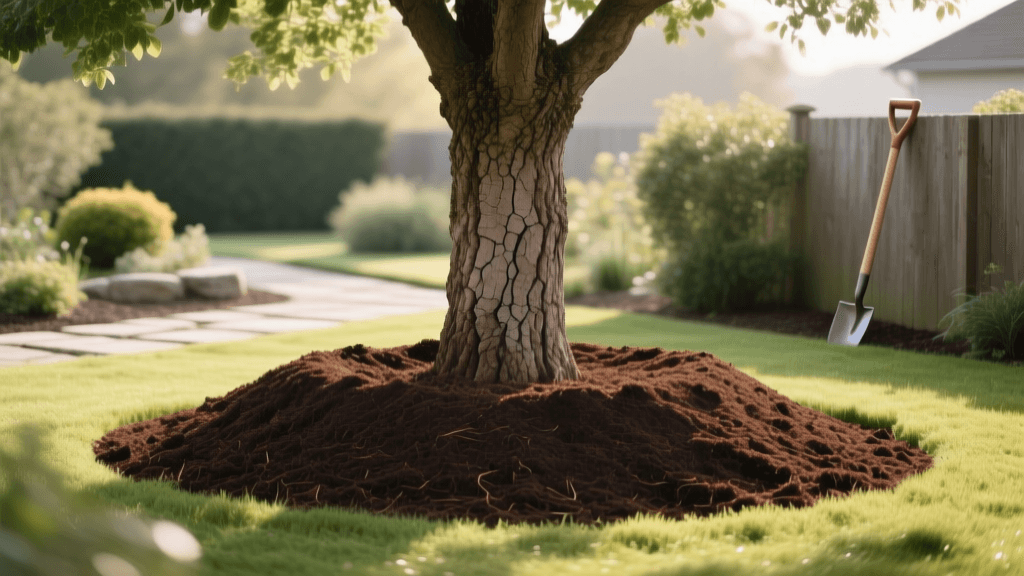
- Root Flare Excavation: Many landscape trees are planted too deeply or have mulch piled against the trunk ('mulch volcanoes'). Use an AirSpade or hand trowel to expose the root flare. This prevents girdling roots and allows the trunk to breathe.
- Radial Trenching/Aeration: In heavily compacted clay soils, drill 2-inch wide holes, 12 to 18 inches deep, in a radial pattern under the drip line. Fill these holes with a mix of compost and expanded shale to improve oxygen and water infiltration to the feeder roots.
- Proper Mulching: Apply a 2-to-3-inch layer of organic wood chip mulch under the drip line to retain moisture, moderate soil temperature, and slowly add organic acids to the soil as it decomposes. Keep mulch at least 3 inches away from the trunk.
Seasonal Treatment and Maintenance Schedule
Timing is critical when treating tree chlorosis. Follow this seasonal schedule for optimal results:
- Early Spring (Bud Break): Apply EDDHA chelated iron soil drenches. The tree's active upward sap flow will pull the nutrients into the canopy. This is also the ideal time for professional trunk injections.
- Late Spring/Early Summer: Monitor new growth. If interveinal chlorosis persists on new leaves, apply a mild foliar spray of chelated iron for a quick cosmetic boost. Avoid heavy soil applications during summer droughts to prevent root burn.
- Fall (Post-Leaf Drop): Apply elemental sulfur and organic compost to the soil surface. Winter moisture and microbial activity will begin breaking down the sulfur, slowly lowering the soil pH in time for the next spring's growth cycle.
Expert Insights on Chlorosis Management
Managing chlorosis requires patience and an understanding of local soil chemistry. According to the University of Minnesota Extension, 'Iron chlorosis is a major problem in the Midwest, particularly in areas with high pH soils. While adding iron to the soil may seem like the logical solution, it is often ineffective unless the iron is chelated or the soil pH is lowered. Long-term management requires a combination of selecting adapted tree species, improving soil conditions, and applying targeted treatments.'
Pro Tip from the Experts: The most cost-effective solution to tree chlorosis is prevention. Before planting new trees, conduct a comprehensive soil test. If your soil pH is consistently above 7.5, avoid planting highly susceptible species like Pin Oak or Red Maple. Instead, opt for alkaline-tolerant alternatives like Burr Oak, Honeylocust, or Hackberry, which are genetically adapted to extract nutrients from high-pH soils.
Conclusion
Tree chlorosis is a complex issue, but it is entirely manageable with the right diagnostic approach and treatment plan. By distinguishing between true nutrient deficiencies and soil pH lockout, utilizing EDDHA chelated iron for alkaline soils, and improving the physical soil environment through aeration and proper mulching, you can reverse yellowing leaves and restore your landscape trees to robust, vibrant health. Remember that soil chemistry changes take time; commit to a multi-year treatment schedule and consult a certified arborist for large or severely declining trees.