Tree Care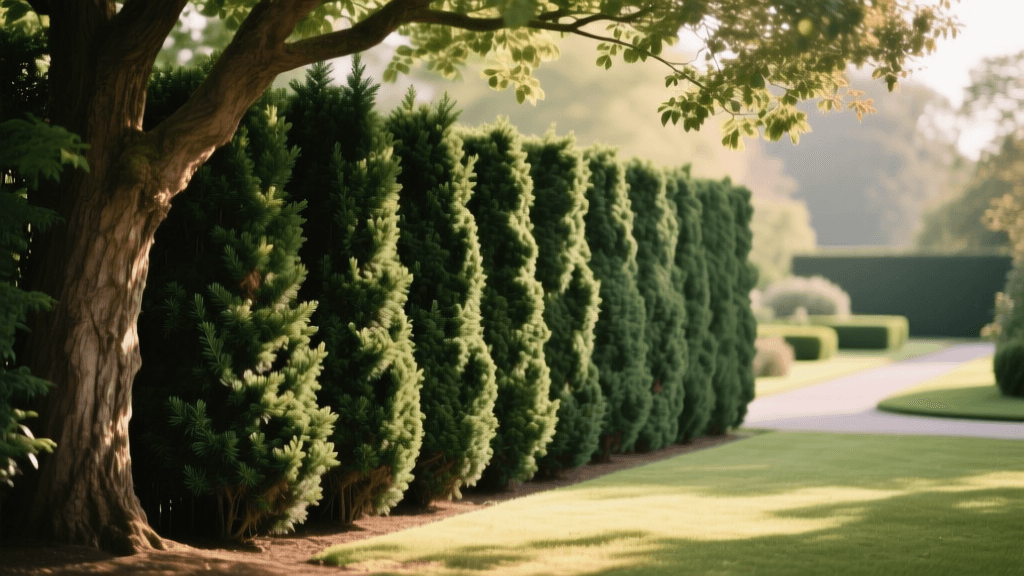
Designing a Tree Privacy Screen: Species and Spacing Guide
Why Choose a Living Privacy Screen?
When it comes to landscape design and planning, establishing a sense of seclusion is often a top priority for homeowners. While traditional wooden or vinyl fences provide immediate barriers, they lack the ecological benefits, aesthetic depth, and dynamic seasonal beauty of a living privacy screen. A well-designed tree privacy screen not only blocks unwanted views and reduces noise pollution but also acts as a vital windbreak, lowers ambient summer temperatures, and provides essential habitat for local wildlife. According to the Arbor Day Foundation, strategic tree placement can increase property values by up to 15 percent while significantly reducing home energy costs through wind and sun mitigation.
However, designing a living fence requires far more forethought than simply digging a trench and dropping in saplings. You must consider mature canopy spread, root system behavior, soil drainage, sunlight exposure, and long-term maintenance. This comprehensive guide will walk you through the planning, species selection, spatial mathematics, and installation strategies required to cultivate a thriving, impenetrable green wall.
The Master Plan: Assessing Your Landscape
Before selecting your tree species, you must thoroughly evaluate the planting site. A common mistake in landscape planning is ignoring the microclimate and underground infrastructure of the yard.
Sunlight and Soil Evaluation
Most fast-growing evergreens require full sun (at least six hours of direct sunlight daily) to maintain dense foliage from the ground up. If your property line is heavily shaded by existing structures or mature deciduous trees, you will need to select shade-tolerant species like the Canadian Hemlock or Yew, though these generally grow much slower. Next, assess your soil drainage. Dig a test hole roughly 12 inches deep and fill it with water. If it drains within an hour, your soil is well-draining. If water pools for several hours, you have heavy clay or poor drainage, which will suffocate the roots of species like the Leyland Cypress and lead to fatal root rot.
Utility and Property Line Awareness
Always call your local utility locating service (such as 811 in the United States) before breaking ground. Furthermore, verify your exact property lines with a recent survey. Planting trees directly on the boundary line can lead to legal disputes with neighbors regarding maintenance, overhanging branches, and root encroachment. It is highly recommended to plant your privacy screen at least three to five feet entirely within your own property lines.
Selecting the Right Tree Species
The backbone of any successful privacy screen is the selection of the right plant material. While it might be tempting to plant a single species for a uniform look, this monoculture approach leaves your entire screen vulnerable to species-specific pests and diseases. The Morton Arboretum strongly advocates for the 'Right Tree, Right Place' principle, emphasizing the importance of matching a tree's cultural requirements to the specific site conditions. Consider mixing two or three compatible evergreen species to create a more resilient and visually interesting landscape.
| Species | Mature Height | Mature Width | Growth Rate | USDA Zones | Best Use Case |
|---|---|---|---|---|---|
| Thuja 'Green Giant' | 40 - 60 ft | 12 - 18 ft | Fast (3-5 ft/yr) | 5 - 8 | Large spaces, fast screening, deer resistant |
| Leyland Cypress | 50 - 70 ft | 15 - 20 ft | Very Fast (3-4 ft/yr) | 6 - 9 | Warm climates, quick tall barriers |
| Norway Spruce | 40 - 60 ft | 25 - 30 ft | Moderate (1-2 ft/yr) | 3 - 7 | Cold climates, heavy windbreaks, wide spaces |
| Eastern Redcedar | 40 - 50 ft | 8 - 15 ft | Moderate (1-2 ft/yr) | 2 - 9 | Dry soils, narrow spaces, highly adaptable |
| Canadian Hemlock | 40 - 70 ft | 10 - 25 ft | Slow (1 ft/yr) | 3 - 7 | Shaded areas, elegant texture, shearing |
The Mathematics of Tree Spacing
Proper spacing is the most critical element of privacy screen design. Plant trees too close together, and they will compete fiercely for water, nutrients, and sunlight, leading to stunted growth, interior needle drop, and increased susceptibility to fungal diseases. Plant them too far apart, and you will wait decades for a solid visual barrier.
The Standard Single-Row Formula
For a single-row screen, the general rule of thumb is to divide the tree's mature width by two. For example, if a Thuja Green Giant has a mature width of 15 feet, you should space the trunks roughly 7 to 8 feet apart. This allows the canopies to intertwine and form a solid wall while leaving enough room for adequate air circulation, which is vital for preventing foliar diseases.
The Staggered Double-Row Technique
If you have the spatial luxury of a wide planting bed (10 to 15 feet wide), a staggered double-row design is vastly superior. By planting two parallel rows in a zig-zag or 'W' pattern, you create a denser screen much faster without forcing the trees to compete directly in the same linear plane.
Staggered Spacing Guidelines:
- Distance between rows: 6 to 8 feet.
- Distance between trees in the same row: 8 to 10 feet.
- Offset: Ensure each tree in the second row is planted exactly midway between two trees in the first row.
Step-by-Step Planting and Soil Prep
According to the University of Minnesota Extension, proper planting depth and hole preparation are the strongest predictors of long-term tree survival. Never dig the hole deeper than the root ball; planting too deep will bury the root flare and invite trunk rot.
- Digging the Hole: Dig a hole that is exactly as deep as the root ball but two to three times as wide. This wide, shallow bowl encourages lateral root expansion into the surrounding native soil.
- Root Preparation: Before placing the tree, gently tease out any circling or girdling roots. If the tree is severely root-bound, use a sterilized pruning saw to make vertical slices along the sides of the root ball to stimulate new outward growth.
- Backfilling: Use the native soil you just dug out to backfill the hole. Avoid amending the backfill heavily with rich potting compost, as this creates a 'bathtub effect' where water pools in the loose soil rather than draining into the native earth.
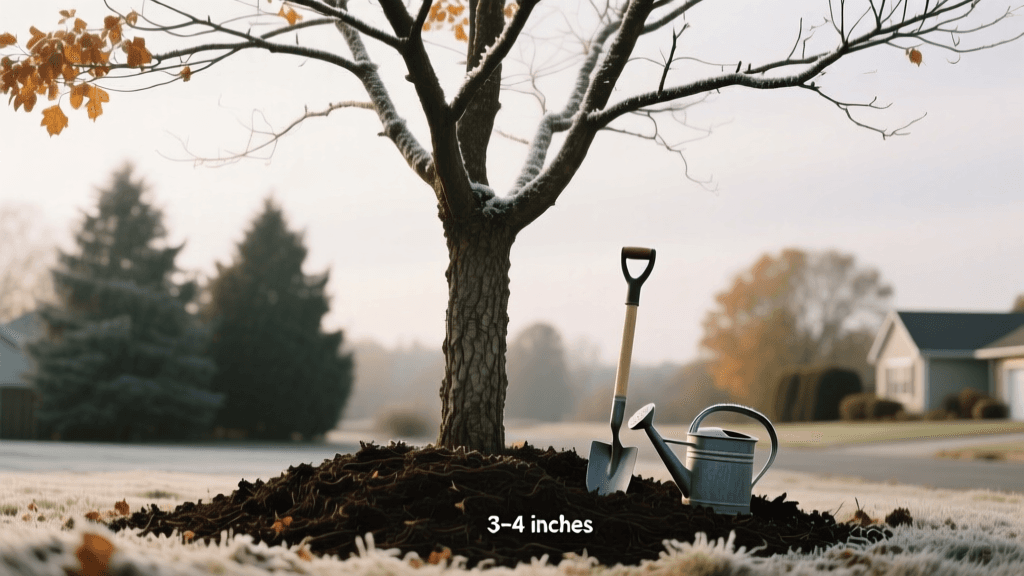
- Mulching: Apply a 2 to 3-inch layer of organic hardwood mulch in a wide 'donut' shape around the base of the tree. Keep the mulch at least 3 inches away from the trunk itself to prevent rodent damage and bark decay.
Cost Breakdown and Timeline
When planning your budget, it is helpful to compare the upfront and long-term costs of a living screen versus a traditional hardscape fence. While a wooden fence offers instant privacy, it begins to degrade the moment it is installed, requiring staining, repairs, and eventual replacement every 15 to 20 years.
Estimated Costs for a 50-Foot Privacy Screen:
- Trees (Six-foot balled-and-burlapped evergreens): $150 - $250 per tree. For a 50-foot run spaced at 8 feet apart, you need roughly 7 trees. Total: $1,050 - $1,750.
- Soil Amendments and Mulch: $100 - $150.
- Drip Irrigation System: $150 - $200 (Highly recommended for the first three years).
- Professional Labor (Optional): $500 - $1,000 depending on site access and soil conditions.
- Total DIY Estimated Cost: $1,300 - $2,100.
By contrast, a 50-foot cedar wood fence typically costs between $2,500 and $4,000 installed. While the living screen takes 3 to 5 years to achieve total visual opacity, it ultimately costs less, requires less structural maintenance, and appreciates in aesthetic value over time.
Long-Term Maintenance, Pruning, and Pest Management
A living privacy screen is a dynamic ecosystem that requires seasonal attention. During the first two growing seasons, deep, infrequent watering is paramount. Utilize a soaker hose or drip irrigation to deliver 1 to 1.5 inches of water per week directly to the root zone. Shallow, frequent sprinkling will encourage weak, surface-level roots that are prone to drought stress and windthrow.
Strategic Pruning
To maintain a dense, formal screen, light annual pruning is necessary. The best time to prune most evergreens is in late winter or early spring before the flush of new growth begins. Never cut back into the 'dead zone' (the brown, interior wood where no needles grow), as most conifers will not regenerate foliage from old wood. Instead, lightly shear the outer green tips to encourage lateral branching and a thicker canopy.
Monitoring for Pests
Dense screens can restrict airflow, creating a humid microclimate that attracts fungal pathogens and pests. Keep a vigilant eye out for bagworms, spider mites, and Seiridium canker. If you notice browning tips or web-like sacs on the foliage, treat the area promptly with targeted horticultural oils or consult a certified arborist. By planning your spacing correctly and diversifying your species, you drastically reduce the likelihood of a catastrophic pest outbreak wiping out your entire landscape investment.
'A well-planned tree privacy screen is not just a boundary line; it is a living, breathing architectural element that matures alongside your home, offering compounding returns in beauty, ecology, and property value.'
By taking the time to meticulously plan your species selection, calculate your spacing, and prepare your soil, you will establish a magnificent living fence that provides sanctuary, shade, and serenity for decades to come.