Tree Care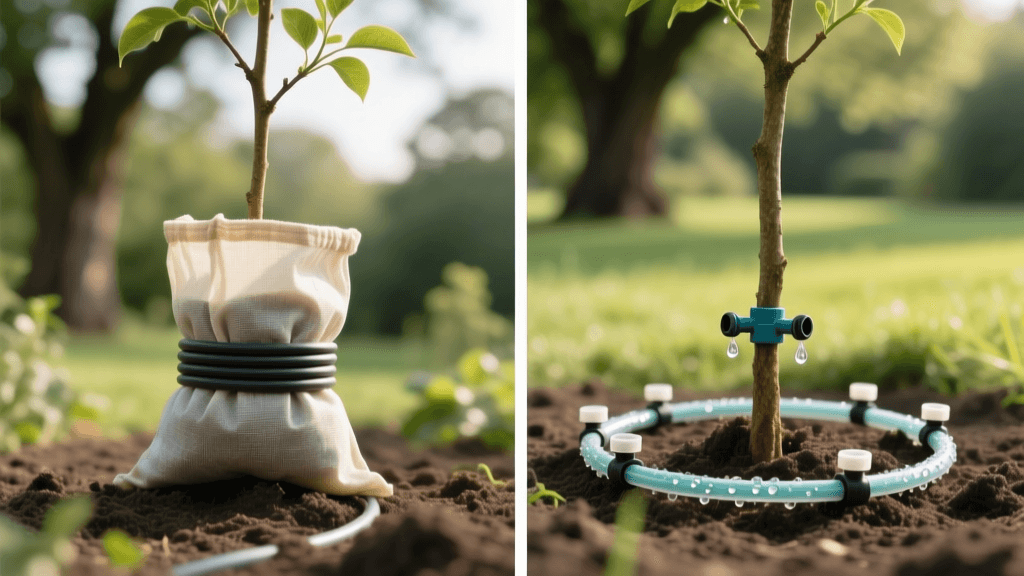
Tree Watering Bags vs Drip Irrigation: Expert Review
The Critical First Years: Why Watering Method Matters
Planting a new tree is a long-term investment in your landscape, but the first two to three years are the most precarious. During this establishment phase, a tree's root system is confined to the original root ball, making it highly susceptible to drought stress, transplant shock, and environmental fluctuations. Consistent, deep moisture is non-negotiable for survival and vigorous growth. However, standing outside with a garden hose for twenty minutes every other day is impractical for most homeowners and landscape professionals alike.
This has led to the rise of automated and slow-release watering solutions. The two dominant contenders in the tree care market are slow-release tree watering bags and drip irrigation rings. Both systems aim to deliver water directly to the root zone while minimizing evaporation and runoff, but they operate on entirely different principles, price points, and maintenance schedules. In this comprehensive product review and comparison, we will break down the top options in both categories, analyze their real-world performance, and help you decide which system is best for your specific tree care needs.
Understanding the Contenders
Slow-Release Tree Watering Bags
Tree watering bags are heavy-duty, UV-treated plastic bladders that wrap around the base of the tree trunk. Once filled with a garden hose, they slowly release water through microscopic perforations at the base over a period of 5 to 9 hours. The most recognized brand in this space is the Treegator, though competitors like DeWitt and Arblue offer similar designs. These bags typically hold between 15 and 20 gallons of water, providing a deep soak that mimics a slow, steady rainstorm.
Drip Irrigation Rings and Bubblers
Drip irrigation for trees involves laying flexible polyethylene tubing in a circular pattern around the tree's root ball or drip line. Emitters (drippers) are spaced along the tubing to release water at a highly controlled rate, usually measured in gallons per hour (GPH). Systems like the Rain Bird Xerigation Tree Ring Kit or custom setups using Netafim Techline EZ tubing connect to a central manifold or garden spigot, often governed by an automated digital timer.
Head-to-Head Comparison Chart
Before diving into the deep-dive reviews, let us look at how these two systems compare across critical metrics for landscape management.
| Feature | Tree Watering Bags | Drip Irrigation Rings |
|---|---|---|
| Initial Cost (Per Tree) | $22 - $35 | $50 - $120 (Zone dependent) |
| Setup Time | 2 - 3 minutes | 30 - 60 minutes |
| Automation Potential | Manual filling required | Fully automatable with timers |
| Water Delivery Rate | 15-20 gallons over 5-9 hours | 1-4 GPH continuous or scheduled |
| Aesthetics | Bulky, visible green/brown plastic | Hidden under mulch or low profile |
| Lifespan | 3 - 5 seasons (UV degradation) | 10 - 15+ years with maintenance |
| Winterization | Must be removed and stored | Must be blown out or drained |
Deep Dive: Slow-Release Tree Watering Bags
For homeowners planting one to five trees, or for landscaping crews who need a temporary establishment solution without tapping into the property's existing irrigation system, watering bags are incredibly popular. Let us look at the market leader and the practical realities of using them.
Product Spotlight: Treegator Original & DeWitt Tree Watering Bag
The Treegator Original is the industry standard. It features a heavy-duty zipper, a sturdy fill flap, and a capacity of up to 20 gallons for single-trunk trees up to 4 inches in caliper. The DeWitt Tree Watering Bag is a slightly more budget-friendly alternative, often priced around $22, offering similar 20-gallon capacity but with slightly thinner UV-resistant coating.
Pros of Watering Bags
- Zero Infrastructure Required: You do not need a sprinkler system, drip lines, or a dedicated irrigation zone. All you need is a standard garden hose to fill them.
- Deep Soil Penetration: Because the water releases slowly over several hours, it has time to percolate deeply into heavy clay soils rather than running off the surface.
- Portability: If you move a tree or plant in a remote corner of the property, the bag moves with you.
Cons of Watering Bags
- Manual Labor: You must physically carry a hose to every single tree and fill the bags every 5 to 7 days. For a property with 20 new trees, this becomes a chore.
- Pest and Mold Risks: The dark, damp environment between the bag and the tree bark can sometimes harbor pests, slugs, or fungal growth if left on continuously without checking.
- Trunk Girdling: If zipped too tightly against the trunk, the plastic can rub against the bark or restrict the trunk flare as the tree grows.
Actionable Advice for Bag Users
Always leave a two-inch gap between the zipper and the ground to prevent soil from clogging the micro-perforations. Furthermore, never leave the bags on the tree year-round. Remove them in late fall to prevent rodents from nesting inside the plastic during winter, and store them indoors to extend their lifespan.
Deep Dive: Drip Irrigation Rings & Bubblers
For larger planting projects, orchards, or homeowners who desire a 'set it and forget it' approach, integrating trees into a drip irrigation network is the superior choice. Drip systems deliver water exactly where it is needed, right at the soil level, minimizing wind drift and evaporation.
Product Spotlight: Rain Bird Xerigation & Netafim Techline EZ
The Rain Bird Xerigation Tree Ring Kit is an excellent off-the-shelf solution. It includes a pressure regulator, filter, distribution manifold, and pre-assembled tubing with emitters designed to circle a newly planted root ball. For a more custom, professional approach, Netafim Techline EZ tubing features built-in emitters spaced every 12 inches, allowing you to create concentric rings around the tree that expand as the root system grows.
Pros of Drip Irrigation
- Total Automation: When paired with a digital hose timer (like the Orbit B-hyve) or an in-ground irrigation controller, the system waters your trees perfectly on schedule, even when you are on vacation.
- Scalability: A single 1/2-inch mainline can support multiple tree rings, making it highly cost-effective for properties with dozens of trees.
- Invisible Aesthetics: Drip tubing can be easily concealed beneath a 2-to-3-inch layer of organic mulch, keeping the landscape looking pristine.
Cons of Drip Irrigation
- Complex Setup: Requires understanding of water pressure, flow rates, and emitter spacing. You must use a pressure regulator (typically 25 PSI) to prevent the drip lines from blowing apart.
- Clogging and Damage: Emitters can clog with mineral deposits if you have hard water and fail to use a mesh filter. Additionally, landscaping tools or aerators can easily puncture the tubing.
Actionable Advice for Drip Users
When installing drip rings, do not place the tubing directly against the trunk. Watering the trunk invites rot and disease. Instead, place the first ring at the edge of the root ball, and add a second, larger ring at the tree's drip line (the outer edge of the canopy) for the second and third years of growth. Use 1 GPH emitters and run the system for 2 to 3 hours per session to deliver the necessary volume.
What the Science and Experts Say
The debate between bags and drip lines often comes down to human convenience, but the tree's biology demands a specific type of hydration. Shallow, frequent sprinkling promotes weak surface roots that are vulnerable to drought and lawnmower damage. The goal is deep root establishment.
According to the Texas A&M Forest Service, 'Slow, deep watering is essential for newly planted trees. It ensures moisture penetrates deeply into the root ball and surrounding soil, encouraging roots to establish firmly and resist drought stress. Water should be applied at a rate that allows it to soak into the soil without runoff, typically requiring several hours of slow application.'
Both tree watering bags and properly calibrated drip rings achieve this scientific ideal. The University of Florida IFAS Extension also notes that delivering roughly 10 to 15 gallons of water per inch of trunk caliper per week is the benchmark for establishment. A 20-gallon tree bag delivers this in a single fill, while a drip ring with four 1-GPH emitters running for 4 hours delivers 16 gallons. Both methods are scientifically sound; the choice relies on your landscape infrastructure.
Seasonal Timing and Maintenance Schedules
Regardless of the product you choose, seasonal adjustments are mandatory for tree health and product longevity.
- Spring (Bud Break to Early Summer): Water newly planted trees every 5 to 7 days. Check soil moisture by digging a small test hole near the root ball; if the soil holds together in a ball without dripping water, moisture is adequate.
- Summer (Peak Heat): Increase frequency to every 3 to 5 days. If using watering bags, you may need to fill them twice a week. Ensure mulch is pulled 3 inches away from the trunk to prevent rot.
- Fall (Cooling Temperatures): Reduce watering to every 10 to 14 days. Continue watering until the ground freezes to prevent winter desiccation, especially in evergreens.
- Winterization: In late autumn, empty and dry tree watering bags, fold them, and store them in a garage or shed to prevent UV and frost damage. For drip systems, open the end caps and flush the lines, then use an air compressor to blow out residual water if you live in a hard-freeze climate to prevent cracked emitters.
Final Verdict: Which System Wins?
There is no single 'best' product; the winner depends entirely on the scale of your planting project and your existing landscape infrastructure.
Choose Tree Watering Bags if: You are planting a small number of trees (1 to 5), you do not have an existing irrigation system, you are on a tight initial budget, or you are planting in remote areas of your property where running drip lines would be unsightly or impractical. They are the ultimate temporary, low-tech solution for the critical first two years of establishment.
Choose Drip Irrigation Rings if: You are planting an orchard, a privacy screen, or more than 5 trees. If you already have a drip zone or are willing to invest in a smart hose timer, drip irrigation provides unparalleled peace of mind, superior aesthetics, and long-term cost efficiency. While the upfront cost and setup time are higher, the ability to automate the watering process ensures your trees receive consistent care even during the busiest parts of your life.
Ultimately, whether you zip up a Treegator or lay down Netafim tubing, the most important factor is your commitment to monitoring soil moisture and adapting to the weather. By choosing the right slow-release method for your lifestyle, you guarantee your new trees will thrive for decades to come.