Tree Care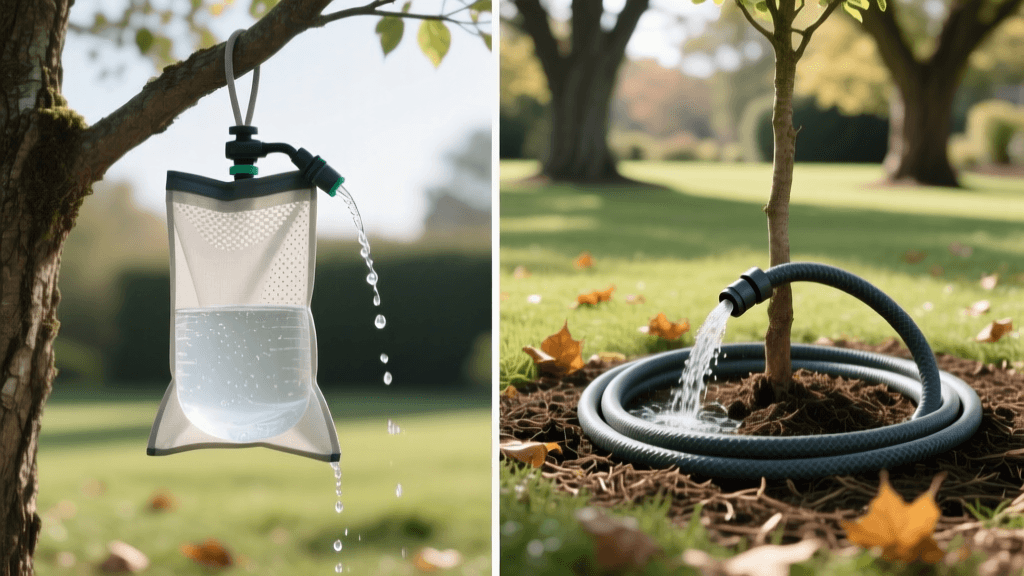
Tree Watering Bags vs Soaker Hoses: Best Deep Root Hydration
The Science of Deep Root Hydration
When it comes to tree care, proper hydration is the single most critical factor in ensuring long-term health, structural stability, and disease resistance. Surface watering with a standard oscillating sprinkler often leads to shallow root systems, making trees highly susceptible to windthrow, lawn mower damage, and severe drought stress. Deep root hydration encourages roots to grow downward, anchoring the tree and tapping into subterranean moisture reserves.
According to the Colorado State University Forest Service, slow, deep watering is the most effective method for promoting robust root architecture in both newly planted and mature trees. By delivering water directly to the root zone at a rate the soil can absorb, you eliminate wasteful runoff and evaporation. But what is the best tool for the job? In this product review and comparison, we break down the two most popular slow-release irrigation tools for homeowners and arborists: Tree Watering Bags and Soaker Hoses.
Contender 1: Tree Watering Bags (Slow-Release Bladders)
Tree watering bags, often referred to by the pioneering brand name Treegator, are heavy-duty plastic bladders that wrap around the base of a tree trunk. They are designed to hold a large volume of water and release it slowly through micro-perforations at the bottom seams.
Product Spotlight: The Original Treegator
- Capacity: 20 gallons
- Cost: $18 to $25 per bag
- Trunk Compatibility: Fits trunks up to 8 inches in diameter (larger trees require zipping two bags together for 40 gallons)
- Drip Rate: Empties in 5 to 9 hours depending on soil compaction and temperature
The primary advantage of tree watering bags is their extreme simplicity and visual reminder. When you see the bag deflated, you know it is time to water. A general rule of thumb provided by the University of Minnesota Extension is to apply 10 gallons of water per inch of trunk caliper. Therefore, a newly planted 2-inch caliper maple tree requires exactly one 20-gallon bag per watering session. Because the water is released over several hours, heavy clay soils have ample time to absorb the moisture without pooling or running off into the street.
Pros and Cons of Tree Watering Bags
Pros:
- Zero runoff; 100% of the water reaches the root ball.
- No hoses to trip over or move around the yard.
- Highly portable and easy to store flat during winter.
Cons:
- UV degradation limits lifespan to 1 to 3 seasons if left in direct sunlight constantly.
- Can harbor mosquito larvae or algae if not cleaned and dried between uses.
- Not practical for watering large, established trees with wide root zones.
Contender 2: Soaker Hoses (Porous Drip Irrigation)
Soaker hoses are made from recycled rubber or porous vinyl and are designed to 'sweat' water along their entire length. Instead of wrapping around the trunk, they are coiled in concentric circles around the tree's drip line, targeting the feeder roots where water uptake is most efficient.
Product Spotlight: Dramm ColorStorm Premium Soaker Hose
- Length Options: 25, 50, or 100 feet
- Cost: $25 to $45 per 50-foot roll
- Flow Rate: Approximately 1 gallon per minute per 10 feet at 10 PSI
- Material: Recycled rubber with a clog-resistant design
Soaker hoses are the undisputed champions of established trees and orchard rows. According to the University of Wisconsin-Madison Extension, the majority of a tree's absorbing roots are located in the top 12 to 18 inches of soil, extending well beyond the canopy edge. By coiling a 50-foot soaker hose in a spiral pattern starting 2 feet from the trunk and extending outward, you can deeply hydrate a massive root zone in a single session.
Pros and Cons of Soaker Hoses
Pros:
- Covers a massive surface area, ideal for mature trees and shrub borders.
- Can be permanently installed and hidden under 2 to 3 inches of organic mulch.
- Easily automated using a standard hose timer or smart irrigation controller.
Cons:
- Requires a pressure regulator; standard hose pressure (40-60 PSI) will burst the seams.
- Prone to calcium and mineral buildup in areas with hard water.
- Difficult to measure exact gallonage without installing an inline flow meter.
Head-to-Head Comparison Chart
| Feature | Tree Watering Bags (e.g., Treegator) | Soaker Hoses (e.g., Dramm) |
|---|---|---|
| Best For | Newly planted trees (0-2 years old) | Established trees, shrub rows, hedges |
| Water Delivery | 15-20 gallons directly to the root ball | Broad, even distribution across the drip line |
| Setup Time | 2 minutes per tree | 15+ minutes to coil and secure |
| Cost Efficiency | $20 per individual tree | $35 covers multiple trees or large zones |
| Automation | Manual filling required | Fully automatable with timers |
| Maintenance | Requires algae/mosquito prevention | Requires pressure regulation and winterizing |
How to Choose Based on Tree Age and Landscape
Newly Planted Trees (0-2 Years)
If you are managing a landscape installation or just planted a few shade trees, tree watering bags are the superior choice. Newly planted trees have not yet developed an extensive lateral root system. Their survival depends entirely on keeping the original nursery root ball consistently moist. A 20-gallon tree bag ensures that the water penetrates deep into the root ball rather than bypassing it through hydrophobic dry soil. Plan to fill the bag once or twice a week during the growing season, depending on rainfall.
Established Trees (3+ Years) and Drought Management
For mature trees, tree watering bags are virtually useless because the root ball is no longer the primary water uptake zone. Here, soaker hoses win easily. During severe summer droughts, established trees require deep watering once every 10 to 14 days. Connect your soaker hose to a timer, set it to run for 3 to 4 hours at low pressure, and let it saturate the soil to a depth of 12 inches.
Pro Arborist Tip: Never place soaker hoses or tree bags directly against the trunk. The University of Wisconsin-Madison Extension warns that constant moisture against the bark invites fungal pathogens, root collar rot, and rodent damage. Always leave a 2-to-3-inch gap between the trunk and your watering apparatus or mulch.
Pro Tips for Maintenance and Troubleshooting
To get the most out of your investment, proper maintenance is non-negotiable.
Maintaining Tree Watering Bags
At the end of every month, flush the inside of the bag with a mild bleach solution (1 part bleach to 10 parts water) to kill algae and mosquito larvae. Ensure the micro-perforations at the bottom are not clogged with dirt by gently scrubbing the base with a soft brush. Crucial: Remove and store bags indoors before the first freeze, as trapped water will expand and tear the plastic seams.
Maintaining Soaker Hoses
Hard water is the enemy of porous hoses. If you notice dry spots along the hose line, calcium deposits are likely blocking the pores. Submerge the hose in a bathtub filled with warm water and two cups of white vinegar for four hours to dissolve the mineral buildup. Always use a 10-PSI pressure regulator at the spigot, and blow out the lines with an air compressor before winter to prevent freeze-thaw cracking.
Final Verdict: Which Should You Buy?
There is no single 'best' product; the right choice depends entirely on the age of your trees and your landscape layout. For homeowners who have just invested in expensive nursery stock and need a foolproof, low-effort way to guarantee survival, Tree Watering Bags are worth every penny. However, for those looking to drought-proof mature shade trees, manage fruit orchards, or automate their landscape irrigation via smart timers, a high-quality rubber Soaker Hose paired with a pressure regulator is the ultimate tree care tool. By matching the tool to the tree's growth stage, you ensure deep root hydration, structural resilience, and a lush canopy for decades to come.