Lawn Care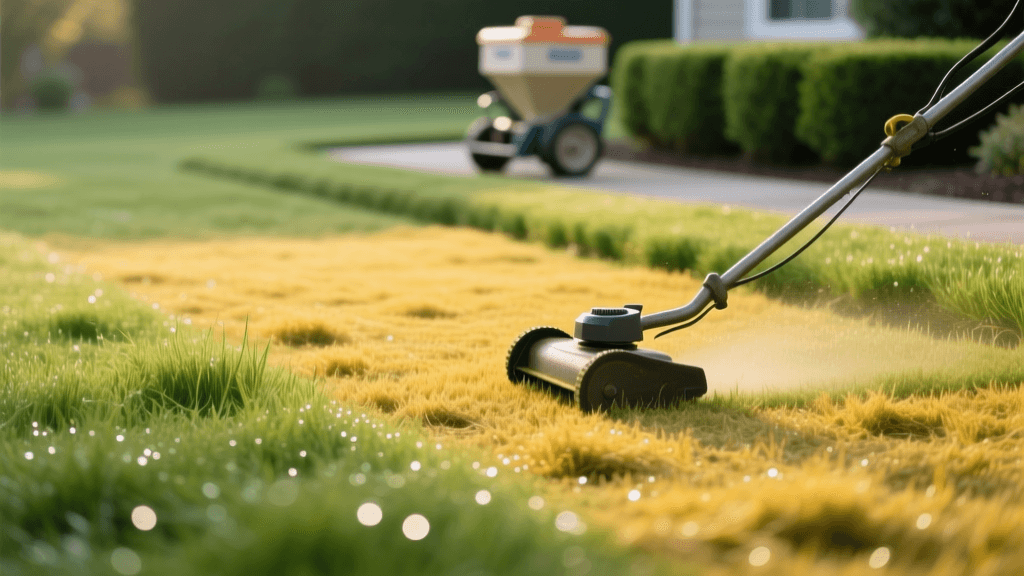
Why Your Grass Turns Yellow And How To Fix It
The Most Common Reasons Grass Loses Its Green
A lawn that shifts from lush green to a dull, patchy yellow is one of the most frustrating sights for any homeowner. The discoloration usually means something in the grass's environment or care routine has gone off track. Identifying the cause matters — the fix for nitrogen deficiency looks nothing like the fix for overwatering or fungal disease. Getting it right saves time, money, and the grass itself.
Yellow grass, technically called chlorosis, happens when grass blades can’t make enough chlorophyll. Chlorophyll needs certain nutrients, steady moisture, soil pH in the right range, and healthy roots. Mess with any one of those, and the green fades. The problem is that several different issues produce nearly identical symptoms on the surface, which is why checking things step by step works better than grabbing the nearest bag of fertilizer.
Nitrogen Deficiency: The Leading Culprit
Nitrogen is the nutrient most directly tied to deep green color in turfgrass. It helps make chlorophyll and supports fast cell division, keeping grass blades dense and upright. When nitrogen runs low, the oldest leaves yellow first — usually the lower blades — while newer growth may stay greener for a short time. If the shortage continues, the whole lawn takes on a pale yellow or lime-green look.
According to research from the University of Georgia Cooperative Extension (2022), cool-season grasses like tall fescue and Kentucky bluegrass need between 2 and 4 pounds of actual nitrogen per 1,000 square feet each year, while warm-season grasses like Bermuda and Zoysia can need up to 6 pounds per 1,000 square feet during active growth. Most homeowners apply less than this, especially in spring when they skip the first fertilizer application.
Choosing the Right Fertilizer NPK Ratio
Fertilizer bags show three numbers representing nitrogen (N), phosphorus (P), and potassium (K) by percentage of weight. For a lawn showing nitrogen-driven yellowing, pick a product with a high first number. A 32-0-10 fertilizer like Scotts Turf Builder Lawn Food gives a strong nitrogen dose plus potassium for root strength, with no phosphorus — fine for established lawns where phosphorus levels are already okay. For new lawns or those recovering from stress, a balanced 16-4-8 ratio helps both green-up and root development.
Slow-release nitrogen sources, such as sulfur-coated urea or polymer-coated urea (found in products like Milorganite 6-4-0 or Lebanon Turf's ProScape line), feed grass over 8 to 12 weeks instead of all at once. This lowers the risk of burn and keeps color steadier between applications. Fast-release sources like ammonium sulfate (21-0-0) green up grass in 3 to 5 days but need careful handling to avoid scorching.
Application Timing by Season
Time nitrogen applications to match when the grass is actively growing. Fertilizing when grass is dormant or heat-stressed wastes product and can hurt roots. Here’s a general schedule for the two main grass types:
- Cool-season grasses (fescue, bluegrass, ryegrass): Feed mainly in early fall (late August through October) when soil temperatures drop below 70°F; give a second round in early spring (March to April) as growth picks up. Hold off on heavy nitrogen in June and July.
- Warm-season grasses (Bermuda, Zoysia, St. Augustine, centipede): Start feeding when soil temperatures consistently hit 65°F, usually April to May in most of the Southeast and Southwest. Continue monthly through August, then stop 6 to 8 weeks before the first expected frost.
- Soil temperature, not air temperature, is the real signal. A $15 soil thermometer from any garden center makes it easy to check.
- Never apply nitrogen to drought-stressed grass unless you water it in right away — dry soil concentrates salts and burns roots.
Watering Problems: Too Much and Too Little Both Cause Yellow
Overwatering might seem like an odd reason for yellowing, but it’s surprisingly common. When soil stays soaked for too long, oxygen gets squeezed out of the root zone. Grass roots need oxygen to breathe; without it, they suffocate and stop pulling up nutrients — even if those nutrients are sitting right there in the soil. The result is yellowing that looks just like a nutrient shortage but won’t improve with fertilizer.
Underwatering shows up differently. Drought-stressed grass first turns a blue-gray, then yellows, then browns from the tips inward. Footprints that stay visible in the lawn for more than 30 minutes are a solid early sign — the grass blades don’t have enough pressure to bounce back.
How Much Water Grass Actually Needs
Most established lawns need about 1 to 1.5 inches of water per week, or roughly 620 gallons per 1,000 square feet weekly during the growing season. That number comes from the Irrigation Association (2021), which recommends deep, infrequent watering instead of light daily sprinkles. Applying the full weekly amount in two sessions — rather than seven — pushes roots deeper, helping the lawn handle dry spells better and lowering disease risk.
To measure how much your sprinkler system actually puts down, set several straight-sided cans (tuna cans work well) across the lawn and run the system for 15 minutes. Measure the water depth and figure out how long it needs to run to deliver 0.5 inches per session. Most homeowners find their systems either run too short or overlap poorly — creating wet and dry patches that both show up as uneven yellowing.
"Turfgrass irrigation efficiency studies consistently show that the majority of residential lawn irrigation is applied at the wrong time of day, with late afternoon and evening watering increasing disease incidence by 30 to 50 percent compared to early morning application." — Purdue University Turfgrass Science Program, 2020
Water between 4 a.m. and 9 a.m. whenever possible. That gives the grass time to dry during the day, cutting down on the leaf wetness that fungi need to take hold.
Soil pH and Its Effect on Nutrient Availability
Even a lawn that gets plenty of water and fertilizer can yellow if the soil pH is off. Most turfgrasses do best between pH 6.0 and 7.0. Outside that range, nutrients stick to soil particles and become unavailable to roots — a situation called nutrient lockout. Iron deficiency, which shows up as yellow tissue between green veins, is almost always due to pH, not a true lack of iron in the soil.
A basic soil test from your local cooperative extension office — offered through places like the North Carolina State University Extension Service or the Texas A&M AgriLife Extension — costs $10 to $20 and tells you pH, key nutrient levels, and whether you need lime or sulfur. Testing every two to three years is enough for most lawns, though lawns in heavy-rain areas or those getting lots of fertilizer may benefit from yearly checks.
| Soil pH | Condition | Common Nutrient Problems | Amendment |
|---|---|---|---|
| Below 5.5 | Strongly acidic | Aluminum toxicity, phosphorus lockout | Dolomitic limestone at 50–100 lbs/1,000 sq ft |
| 5.5–6.0 | Moderately acidic | Reduced calcium and magnesium uptake | Calcitic limestone at 25–50 lbs/1,000 sq ft |
| 6.0–7.0 | Optimal range | Minimal | None required |
| 7.0–7.5 | Mildly alkaline | Iron and manganese deficiency | Elemental sulfur at 5–10 lbs/1,000 sq ft |
| Above 7.5 | Strongly alkaline | Severe iron chlorosis, zinc deficiency | Acidifying fertilizer + sulfur; foliar iron spray |
Lime raises pH and sulfur lowers it, but both work slowly — expect 3 to 6 months before you see a real shift. For quick relief from iron chlorosis on alkaline soils, a foliar spray of chelated iron (such as Ferti-lome Chelated Liquid Iron) delivers iron straight through the leaf and greens up grass in 48 to 72 hours, though it doesn’t fix the underlying pH issue.
Mowing Practices That Stress Grass Into Yellowing
Mowing height and frequency affect grass color and health directly. Cutting more than one-third of the blade height in a single pass — the “one-third rule” — removes too much leaf tissue at once. The grass shifts energy from root maintenance and chlorophyll production to emergency regrowth, causing temporary yellowing or browning of cut tips that can last several days.
Dull mower blades make this worse. A sharp blade makes a clean cut that heals fast. A dull blade shreds the grass, leaving ragged edges that dry out and turn brown or yellow within 24 hours. Blades should be sharpened or replaced every 20 to 25 hours of mowing time — for most homeowners, that means at least once per season, and ideally twice.
Recommended mowing heights vary by grass species and change with the season:
- Kentucky bluegrass: 2.5 to 3.5 inches during the growing season; raise to 3.5 to 4 inches during summer heat stress.
- Tall fescue: 3 to 4 inches year-round; never cut below 2.5 inches.
- Bermudagrass: 0.5 to 1.5 inches for hybrid varieties; 1.5 to 2.5 inches for common Bermuda.
- Zoysia: 1 to 2.5 inches depending on variety; Empire Zoysia performs best at 2 to 2.5 inches.
- St. Augustine: 3 to 4 inches; Floratam variety should not be cut below 3 inches.
Mow based on how fast the grass is growing — not the calendar. During peak spring growth, cool-season grasses may need mowing every 4 to 5 days to stay within the one-third rule. During summer dormancy or drought, mowing every 10 to 14 days — or skipping altogether — cuts down on stress. Letting grass get too tall and then scalping it does far more damage than missing a mowing.
Fungal Disease and Pest Damage That Mimic Nutrient Problems
Several common lawn diseases cause yellow patches that look like fertilizer or watering issues. Dollar spot, caused by the fungus Clarireedia jacksonii, creates silver-dollar-sized yellow-tan spots that merge into larger irregular patches. It thrives in lawns low on nitrogen and with long periods of wet grass — so proper fertilization and morning watering both help prevent it. Products containing propiconazole (such as Bonide Infuse Systemic Disease Control) or azoxystrobin (Scotts DiseaseEx) work well when applied at the first sign.
Large patch disease, caused by Rhizoctonia solani, hits warm-season grasses in fall and spring when soil temperatures sit between 50°F and 70°F. It forms circular yellow-orange patches ranging from 1 foot to over 20 feet wide. The outer edge often shows the strongest yellowing, while the center may recover or die off completely. Fungicide applications in September and October — before soil temps drop below 70°F — work better than waiting until symptoms appear.
Grub damage from Japanese beetle larvae (Popillia japonica) and masked chafer beetles cuts grass roots just below the soil surface. Affected areas yellow, then brown, in irregular patches, and the turf lifts up easily like a loose carpet because the roots are gone. Grub counts above 10 per square foot usually cause visible damage. Preventive treatments using imidacloprid (Bayer Grub Control) applied in June and July — when eggs are hatching — work better than trying to kill established grubs later in summer.
Telling disease and pest damage apart from nutrient problems means looking past the color. Pull back affected turf and check the roots and soil. Healthy roots are white and firm; diseased or grub-damaged roots are brown, mushy, or missing. Also check the pattern — nutrient issues tend to spread evenly, while disease and pests create distinct patches with clear edges. When in doubt, your local cooperative extension office can ID samples and suggest targeted fixes, saving you from broad-spectrum treatments that may miss the real issue.