Tree Care
Winter Tree Care Guide: Protecting Trees From Frost Damage
The Hidden Dangers of Winter Weather on Trees
As the vibrant colors of autumn fade and the first hard frosts settle over your landscape, trees enter a period of dormancy. However, dormancy does not mean invulnerability. Winter is arguably the most stressful season for young, newly planted, and thin-barked trees. Freezing temperatures, harsh winds, heavy snow loads, and fluctuating winter sun can cause severe physiological damage that may not become apparent until the following spring. For homeowners and landscape enthusiasts, understanding the mechanics of winter tree stress is the first step toward preserving the health and structural integrity of your landscape's most valuable assets.
Young trees, particularly those planted within the last three to five years, have not yet developed the thick, corky outer bark required to insulate their sensitive vascular tissues. Furthermore, evergreen species continue to lose moisture through their needles throughout the winter, making them highly susceptible to desiccation when the ground is frozen and roots cannot uptake replacement water. By implementing a proactive seasonal maintenance strategy, you can mitigate frost cracking, root dieback, and wildlife damage, ensuring your trees emerge vigorous and healthy in the spring.
Understanding Sunscald and Frost Cracks
One of the most common and destructive winter ailments is sunscald, also known as southwest injury. During crisp, clear winter days, the sun's rays hit the southwest-facing side of a tree trunk, warming the bark and stimulating the underlying cambium cells to break dormancy. When the sun sets or clouds roll in, temperatures plummet rapidly. This sudden freeze kills the newly active cells, resulting in sunken, discolored, and eventually splitting bark. Species with thin, smooth bark—such as maples, ash, crabapples, plums, and honeylocusts—are exceptionally prone to this damage.
Frost cracks are another thermal-related issue. They occur when the extreme temperature differential between the sun-warmed outer wood and the freezing inner wood causes the trunk to split vertically. These deep fissures expose the heartwood to decay fungi, carpenter ants, and boring insects, severely compromising the tree's structural stability and long-term health.
How to Properly Wrap Tree Trunks
To prevent sunscald and frost cracks, wrapping the trunks of vulnerable trees is a highly effective and inexpensive seasonal maintenance task. Commercial tree wraps, such as DeWitt Fabric Tree Wrap or traditional corrugated paper wrap, act as a thermal insulator, keeping the bark temperature stable and reflecting harsh UV rays.
- Timing: Apply wrap in late November after the first hard freeze and remove it in early April to prevent trapping spring moisture and harboring pests.
- Application Technique: Start at the base of the trunk, slightly overlapping the soil line. Wrap upward at a slight angle, overlapping each layer by about one-third of the wrap's width. Continue until you reach the first major scaffold branches.
- Cost & Materials: A standard roll of paper or fabric wrap costs between $5 and $12 and is sufficient for several young trees. Avoid using dark-colored materials or plastic tapes, which can absorb heat and girdle the expanding trunk.
Insulating Roots with Proper Winter Mulching
While the canopy is dormant, the root system remains vulnerable to extreme temperature swings. A sudden freeze without an insulating snow cover can cause the soil to freeze deeply, killing fine, water-absorbing feeder roots. Applying a proper layer of organic mulch mimics the natural forest floor, regulating soil temperature and retaining vital moisture.
The Donut Mulching Technique
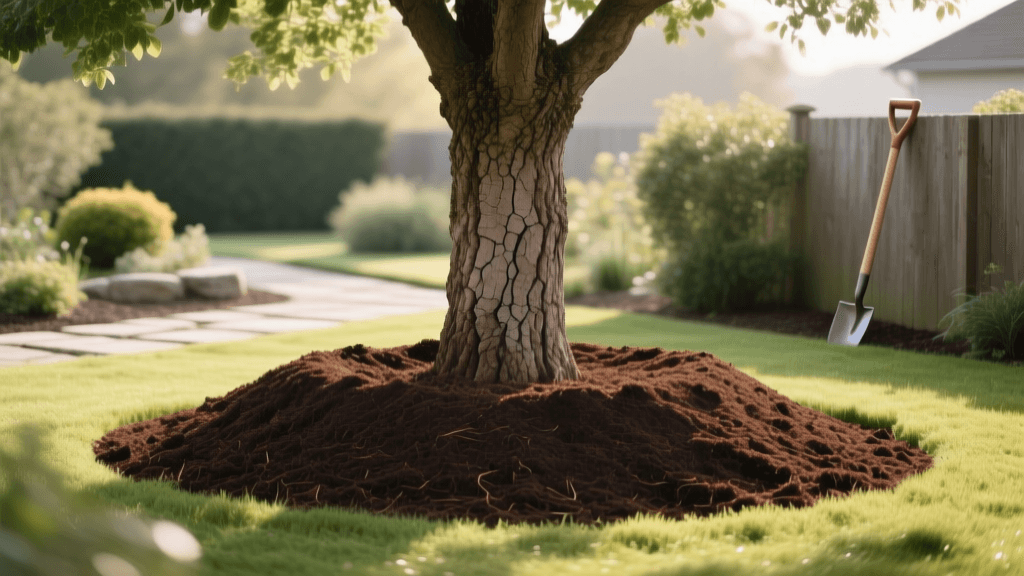
Proper mulching requires precision. The infamous 'volcano mulching' method—piling mulch high against the trunk—traps moisture against the bark, leading to stem girdling roots, fungal cankers, and rodent habitation. Instead, utilize the 'donut' method:
- Measurements: Spread a 2 to 4-inch layer of organic mulch (such as shredded hardwood bark or pine needles) in a ring extending to the tree's drip line, or at least a 3-foot radius for younger trees.
- The Gap: Keep the mulch exactly 3 to 4 inches away from the trunk itself. The root flare should always be visible and exposed to the air.
- Cost: Bulk shredded bark mulch typically costs $30 to $50 per cubic yard, making it an economical investment for long-term root insulation.
Hydration and Anti-Desiccant Applications
Winter drought is a silent killer of landscape trees. When the ground freezes, roots cannot absorb water, but evergreens and some deciduous species continue to transpire moisture into dry winter winds. If the tree enters winter under-hydrated, cellular dehydration and winter burn will quickly follow.
Before the ground freezes solid, usually in late autumn, provide a deep, slow soaking to your trees. A general rule of thumb is to apply 10 gallons of water per inch of trunk diameter (measured at knee height). Use a soaker hose or a slow-drip root irrigator to ensure the water penetrates 12 to 18 inches into the soil profile where the feeder roots reside.
For broadleaf evergreens like rhododendrons, hollies, and boxwoods, as well as newly planted conifers, applying an anti-desiccant spray is crucial. Products like Wilt-Pruf create a flexible, clear polymer coating over the leaf stomata, reducing moisture loss by up to 60 percent.
- Application Rules: Spray in late November or December when temperatures are above 40°F and no rain is forecast for 24 hours. A second application in late February is highly recommended, as the protective coating degrades under UV exposure over time.
Protecting Bark from Rodents and Wildlife
When natural food sources are buried under snow, voles, rabbits, and deer will turn to the nutritious inner bark of your trees. Voles, in particular, can girdle a young tree completely beneath the snow line, severing the phloem and killing the tree before spring arrives.
To deter these pests, install a physical barrier. Use 1/4-inch galvanized hardware cloth rather than flimsy plastic guards, which rodents can easily chew through. Form the hardware cloth into a cylinder around the trunk, ensuring it stands at least 18 inches above the anticipated snow line. Crucially, bury the bottom edge 2 to 3 inches below the soil surface to prevent voles from tunneling underneath. A single sheet of hardware cloth costs roughly $15 to $25 and can be reused for many winters.
Seasonal Winter Tree Care Schedule
Staying organized is key to effective seasonal maintenance. Refer to the following structured schedule to ensure no critical winterizing step is overlooked.
| Month | Primary Task | Details & Measurements |
|---|---|---|
| November | Deep Watering & Wrapping | Apply 10 gallons of water per inch of trunk diameter. Install tree wraps on thin-barked species. |
| December | Mulching & Anti-Desiccants | Refresh mulch to 2-4 inches deep (keep 3 inches from trunk). Spray Wilt-Pruf on evergreens above 40°F. |
| January | Snow Load Management | Gently brush heavy, wet snow off evergreen branches using upward strokes to prevent splitting. |
| February | Second Anti-Desiccant Spray | Reapply polymer sprays to broadleaf evergreens to combat late-wind desiccation. |
| March | Pruning & Inspection | Prune dead or crossing branches while the tree is still dormant and the structure is visible. |
| April | Wrap Removal | Remove all trunk wraps to allow the bark to breathe and prevent fungal infections. |
Expert Insights and Authoritative Guidance
Adhering to proven, science-backed methodologies is essential for long-term tree health. According to the University of Minnesota Extension in their comprehensive guide on 'Winter Injury to Trees and Shrubs,' cultural practices during the late summer and early autumn heavily influence a tree's winter hardiness. The Extension explicitly advises against late-summer pruning and nitrogen-heavy fertilization, as these practices stimulate tender new growth that will not have time to lignify (harden off) before the first freeze. This new growth is almost guaranteed to suffer severe dieback.
'Trees that are stressed by drought, defoliation, or poor planting practices are much more susceptible to winter injury. Ensuring adequate soil moisture late into the fall is one of the most effective preventative measures a homeowner can take.' — University of Minnesota Extension, Department of Forest Resources.
By combining authoritative guidance with actionable, on-the-ground maintenance—such as precise mulching, strategic wrapping, and targeted hydration—you transform your landscape from a vulnerable collection of plants into a resilient, thriving ecosystem capable of weathering the harshest winter conditions.