Tree Care
Winterizing Trees: Essential Seasonal Protection Guide
The Hidden Dangers of Winter Weather
Trees enter a state of dormancy during the winter, but this does not mean they are invulnerable. In fact, the transition from late autumn to early spring presents some of the most severe environmental stresses a tree can face. Rapid temperature fluctuations, desiccating winter winds, heavy snow loads, and opportunistic pests can cause irreversible damage to both young saplings and mature specimens. According to The Morton Arboretum, winter injury often goes unnoticed until the following spring when branches fail to leaf out or bark splits violently. By implementing a proactive seasonal maintenance strategy, homeowners can safeguard their landscape investments and ensure vigorous spring growth. This comprehensive guide details the exact steps, products, and timing required to winterize your trees effectively.
Deep Hydration Before the Freeze
One of the most common misconceptions in tree care is that trees do not need water during the colder months. In reality, evergreen trees continue to lose moisture through their needles throughout the winter, while deciduous trees need adequate soil moisture to survive the freezing and thawing cycles. If the ground freezes while the root zone is dry, the tree suffers from severe winter drought stress.
Watering Measurements and Techniques
The Colorado State University Extension recommends deep watering trees until the ground freezes solid. For newly planted trees and those under five years old, apply 10 to 15 gallons of water per week during dry autumn spells. Use a soaker hose or a slow-dripping garden hose placed at the drip line, which is the area directly beneath the outermost circumference of the tree canopy. For mature trees, a general rule of thumb is to provide 10 gallons of water for every inch of the trunk diameter measured at knee height. Watering should only be done when the air temperature is above 40 degrees Fahrenheit and the soil is not frozen. The cost of municipal water for this deep soaking is negligible compared to the hundreds or thousands of dollars required to remove and replace a mature, drought-stressed tree.
Strategic Mulching for Root Insulation
Mulch acts as a critical insulating blanket, moderating soil temperatures and retaining vital moisture. However, improper mulching can be just as detrimental as neglecting it altogether.
The Donut Method
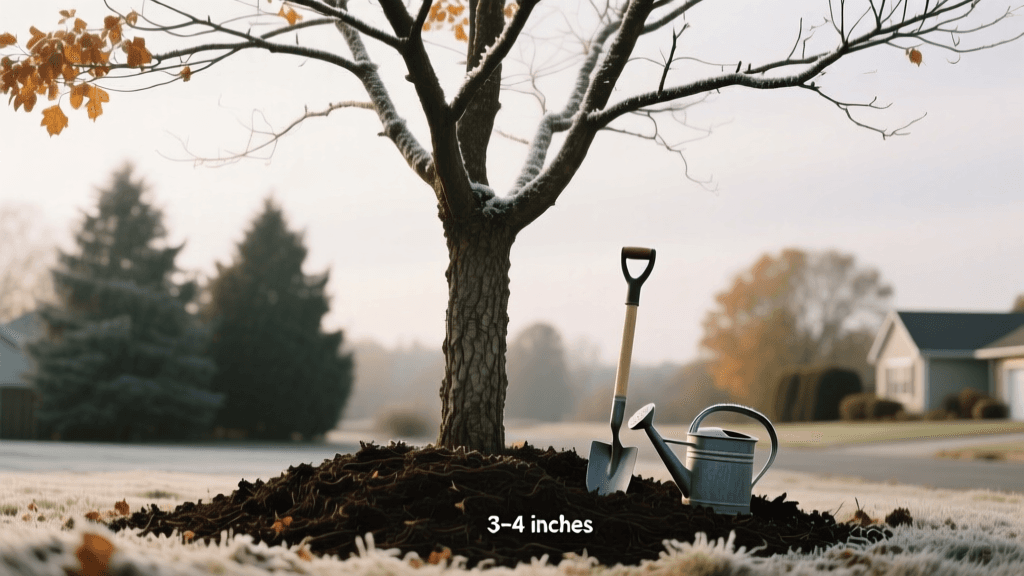
To properly winterize your tree beds, apply a 2 to 4-inch layer of organic mulch, such as shredded hardwood bark or cedar chips. The key is to employ the donut method: keep the mulch at least 3 to 4 inches away from the base of the trunk to prevent rot, rodent habitation, and fungal diseases. Extend the mulch ring out to the drip line if possible, or at least a 3-foot radius from the trunk for younger trees. A standard 2-cubic-foot bag of premium cedar mulch costs between $4 and $7 and covers approximately 12 square feet at a 2-inch depth. Avoid piling mulch against the trunk in a volcano shape, as this traps moisture against the bark and invites opportunistic pathogens and bark-gnawing voles seeking winter shelter.
Preventing Sunscald and Frost Cracks
Thin-barked tree species, including Red Maple, Honeylocust, Linden, and Ash, are highly susceptible to a phenomenon known as sunscald. On bright, sunny winter days, the dark bark absorbs solar radiation, warming the cambium layer beneath and stimulating cellular activity. When the sun sets or a cloud passes over, temperatures plummet rapidly, causing the active cells to freeze and burst. This results in elongated, sunken cankers or violent vertical splits known as frost cracks.
Trunk Wrapping Protocols
To prevent sunscald, wrap the trunks of vulnerable trees in late autumn. Use a commercial tree wrap made of crepe paper or polypropylene, such as DeWitt Tree Wrap, which typically costs around $10 to $15 per roll. Begin wrapping at the base of the trunk and overlap each layer by one-third, working your way up to the first set of lower branches. Secure the top with a piece of masking tape or twine. Never use wire or duct tape, which can girdle the expanding trunk. It is absolutely crucial to remove the wrap in early spring as soon as the threat of hard freezes has passed. Leaving wrap on during the growing season traps moisture and provides a perfect hiding spot for bronze birch borers and other destructive insects.
Anti-Desiccants for Evergreen Protection
Broadleaf evergreens, such as Rhododendrons, Hollies, and Boxwoods, are particularly vulnerable to winter desiccation. Because their leaves remain on the plant, they continue to transpire moisture into the dry winter air. When the ground is frozen, the roots cannot replace this lost water, leading to severe leaf scorch and tip dieback.
Application Timing and Products
Applying an anti-desiccant spray, commonly known as an anti-transpirant, creates a protective, waxy polymer coating over the foliage that slows moisture loss. Products like Wilt Pruf or Vapor Gard are industry standards and can be purchased at most garden centers for $15 to $25 per quart of concentrate. According to the University of Minnesota Extension, anti-desiccants must be applied when daytime temperatures are between 40 and 50 degrees Fahrenheit, ensuring the spray has time to dry completely before freezing. Plan for an initial application in late November or early December, followed by a second application in mid-to-late February, as the protective coating degrades under UV exposure over a period of six to eight weeks.
Deterring Winter Rodent Damage
When snow blankets the ground, hungry voles and rabbits turn to tree bark as their primary food source. They chew through the outer bark and consume the nutrient-rich phloem layer beneath, effectively girdling and killing the tree. To prevent this, install a physical barrier using hardware cloth or plastic tree guards. Bury the bottom of the guard two inches below the soil line and ensure it extends at least 18 inches above the anticipated snow line. This simple mechanical barrier costs less than $5 per tree and saves you from the heartbreak of discovering a girdled sapling during the spring thaw.
Dormant Pruning Practices
Late winter is the optimal time for structural pruning. With the leaves gone, the branching architecture is fully visible, allowing arborists and homeowners to identify crossing branches, weak crotches, and diseased wood. Furthermore, pruning during the coldest months of the year prevents the spread of devastating diseases like oak wilt and fire blight, as the insect vectors and fungal spores that transmit them are entirely dormant.
The Three-Cut Method and Snow Load Management
When removing heavy limbs to prevent winter snow-load breakage, always utilize the three-cut method to prevent the heavy branch from tearing the bark down the main trunk. First, make an undercut about a third of the way through the branch, roughly 12 inches from the trunk. Second, make a top cut an inch further out, allowing the bulk of the branch to fall safely. Finally, make a clean, precise finishing cut just outside the branch collar. Never apply pruning paint or wound sealants; research shows these products actually hinder the tree natural compartmentalization process and trap decay-causing organisms inside the wound. During severe winter storms, gently brush heavy snow off multi-stemmed evergreens using a broom, sweeping upward to avoid putting extra downward pressure on the brittle, frozen limbs.
Comprehensive Winter Tree Care Schedule
To help you stay organized, refer to this seasonal maintenance table outlining the core tasks required to protect your trees from late autumn through early spring.
| Maintenance Task | Optimal Timing | Target Species | Estimated Material Cost |
|---|---|---|---|
| Deep Root Hydration | October to November (Pre-Freeze) | All Newly Planted and Evergreen Trees | Minimal (Water Utility Rates) |
| Insulating Mulch Application | November (After Ground Chills) | All Trees (Especially Shallow-Rooted) | $4 - $7 per 2 cu. ft. bag |
| Trunk Wrapping | Late November | Maple, Ash, Linden, Honeylocust | $10 - $15 per roll |
| Rodent Guard Installation | Before First Snowfall | Young Saplings, Fruit Trees | $3 - $5 per tree guard |
| Anti-Desiccant Spraying | December and February | Broadleaf Evergreens, Arborvitae | $15 - $25 per quart concentrate |
| Structural Dormant Pruning | Mid-February to Early March | Oaks, Elms, Fruit Trees, Hardwoods | $75 - $150 (Professional Arborist) |
Conclusion
Winterizing your trees is a vital component of comprehensive landscape management. By taking proactive steps to hydrate, insulate, wrap, and prune your trees during the dormant season, you mitigate the severe risks posed by freezing temperatures and winter drought. The relatively small investment of time and materials in late autumn yields massive dividends when spring arrives, resulting in a healthier, safer, and more resilient canopy. For severe storm damage or complex pruning needs involving heavy limbs near power lines, always consult a certified arborist to ensure the work is performed safely and in accordance with modern arboricultural standards.