Tree Care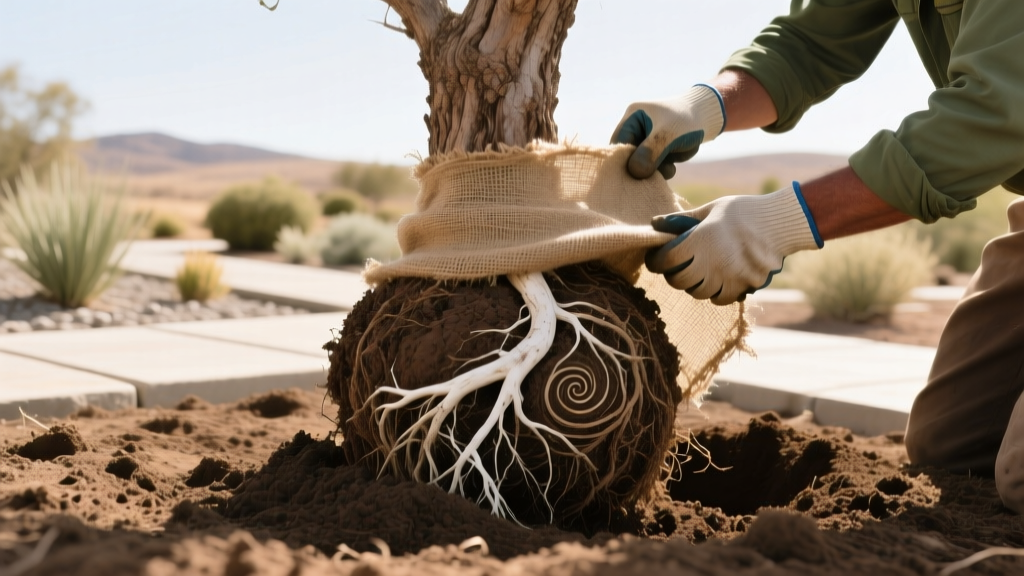
Xeriscape Tree Planting 2026: Root Ball Prep & Burlap Removal
James MillerPublished
The Xeriscape Challenge: Why Root Preparation is Non-Negotiable in 2026
As municipal water restrictions and prolonged drought conditions continue to shape landscaping trends in 2026, xeriscaping has evolved from a niche practice into a mainstream necessity. However, many homeowners and even professional landscapers make a fatal error when integrating trees into low-water landscapes: they treat the planting process exactly as they would in a high-rainfall environment. In a xeriscape, water is a precious, limited resource. Every drop must be utilized efficiently by the tree's root system. If the root ball is not properly prepared, and if burlap or wire baskets are left intact, the tree will fail to establish, leading to chronic stress, stunted growth, and eventual death, regardless of how drought-tolerant the species is supposed to be.
Proper root ball preparation and complete burlap removal are the foundational steps for xeriscape tree survival. In arid and semi-arid climates, the soil interface between the nursery-grown root ball and the native landscape soil dictates how effectively a tree can forage for deep moisture. This comprehensive guide details the exact techniques required to prepare balled-and-burlapped (B&B) and container-grown trees for low-water environments in 2026.
The Burlap Dilemma: Natural vs. Synthetic in Arid Climates
For decades, a persistent myth in the landscaping industry suggested that natural burlap would simply rot away in the soil and therefore did not need to be removed. In a xeriscape environment, this myth is not just incorrect; it is detrimental. According to extensive research by the University of Florida IFAS Extension, leaving any burlap on the root ball creates a physical and hydrological barrier that severely restricts root expansion and water movement.
In low-water landscapes, capillary action is already fighting against dry air and fast-draining native soils. Natural burlap acts as a wick, drawing moisture out of the root ball and exposing it to the dry surrounding soil, accelerating desiccation. Furthermore, much of the burlap used in modern nurseries is treated with chemical preservatives or is entirely synthetic (polypropylene). Synthetic burlap will never decompose. It creates a permanent hydrophobic barrier that prevents native soil moisture from reaching the root mass and stops roots from penetrating outward into the xeriscape soil.
2026 Xeriscape Rule of Thumb: Never leave burlap on a root ball. Once the tree is positioned in the planting hole, cut away and remove 100% of the burlap from the top, sides, and bottom of the root ball before backfilling.
Wire Basket Removal: Preventing Girdling in Low-Water Zones
Balled-and-burlapped trees are often secured in heavy galvanized wire baskets. While some older guidelines suggested leaving the bottom half of the basket to maintain the root ball's structural integrity, modern arboriculture standards strongly advise against this, especially in xeriscapes. In low-water environments, trees must send roots deep and wide to survive dry spells. A wire basket restricts lateral root growth and will eventually girdle the expanding trunk and structural roots as the tree matures.
When planting in a xeriscape, follow these steps for wire basket management:
- Position First: Lower the tree into the planting hole while the basket is still intact to prevent the heavy clay root ball from fracturing.
- Cut the Top Rings: Use heavy-duty bolt cutters to remove the top one or two horizontal rings of the wire basket.
- Remove the Burlap: Pull back all burlap and twine from the top and sides of the root ball.
- Extract the Basket: If the soil structure allows, gently slide the remaining basket out from under the root ball. If the root ball is highly unstable and crumbling, cut away as much of the vertical and bottom wire as physically possible without destroying the root mass, ensuring no wire remains near the root flare or upper lateral roots.
Advanced Root Ball Preparation: Shaving and Hydro-Washing
One of the most critical challenges in xeriscape tree planting is the 'soil interface problem.' Nursery trees are typically grown in a highly organic, moisture-retentive potting mix or heavy clay. Xeriscape native soils are often sandy, rocky, or highly alkaline with low organic matter. When you place a moisture-retentive root ball into fast-draining xeriscape soil, water applied to the native soil will bypass the root ball entirely, taking the path of least resistance. Conversely, if you water the root ball, the surrounding dry native soil will wick the moisture away, leaving the tree parched.
To solve this in 2026, arborists recommend two primary root ball preparation techniques for xeriscapes:
1. Root Ball Shaving (For Container and B&B Trees)
Using a sharp hori-hori knife, pruning saw, or specialized root-shaving tool, shave off the outer 1 to 2 inches of the entire root ball. This removes the artificial nursery soil barrier and exposes the fine feeder roots directly to the native backfill. It also severs any small circling roots that have formed against the container walls or burlap edge.
2. Hydro-Washing (Bare-Rooting)
For smaller B&B trees or when planting in extremely rocky xeriscape soils, hydro-washing is highly effective. Using a specialized root-washing nozzle or a standard garden hose with a gentle spray, wash away the outer 3 to 4 inches of nursery soil. This allows you to inspect the root architecture, remove all girdling roots, and place the bare roots directly into the native soil, ensuring immediate contact and eliminating the perched water table effect.
Addressing Circling Roots: The Four-Slice Method
Trees grown in containers often develop circling roots at the bottom and sides of the pot. If planted in a xeriscape without correction, these roots will eventually strangle the tree's vascular system, a condition that is often fatal during the extreme heat waves common in low-water regions. The Arbor Day Foundation emphasizes that correcting root architecture at the time of planting is the only window of opportunity you have.
For trees with dense, matted root systems, employ the Four-Slice Method:
- Make four vertical slices down the sides of the root ball, about 1 inch deep, spacing them evenly like the points of a compass.
- Make an 'X' across the bottom of the root ball, cutting about 1 inch deep into the root mass.
- Use your fingers or a hand cultivator to tease the cut roots outward so they point away from the center of the trunk.
- This stimulates the tree to produce new, outward-growing lateral roots that will anchor the tree and seek out deep xeriscape moisture.
Comparison Chart: Nursery Stock Types for Xeriscapes
Choosing the right nursery stock type can significantly reduce the amount of root ball preparation required and improve survival rates in low-water landscapes.
| Stock Type | Xeriscape Prep Required | Moisture Interface Risk | Best Use in Xeriscape |
|---|---|---|---|
| Bare Root | Low (No soil interface) | Very Low | Deciduous trees, riparian zones, winter planting |
| Container Grown | High (Shaving/Washing needed) | High (Nursery mix vs. native) | Evergreens, smaller ornamentals, year-round planting |
| Balled & Burlapped | Very High (Burlap/basket removal) | High (Clay vs. sandy native) | Large shade trees, specimen plantings |
The Planting Hole: Avoiding the Bathtub Effect
In xeriscaping, how you dig the hole is just as important as how you prep the root ball. The Colorado State University Extension warns against the 'bathtub effect' in heavy clay soils, but in sandy xeriscape soils, the opposite problem occurs: the 'sump effect.'
If you dig a deep, narrow hole and amend the backfill with heavy compost or peat moss, you create a sponge that holds water in the root zone while the surrounding native soil remains dry. This prevents roots from growing outward into the native soil, defeating the purpose of planting a drought-tolerant tree.
2026 Xeriscape Planting Hole Specifications:
- Width: Dig the hole 2 to 3 times wider than the prepared root ball. This breaks up compacted native soil and encourages lateral root spread.
- Depth: Dig the hole no deeper than the height of the root ball. In fact, in poorly draining soils, plant the tree 1 to 2 inches above grade.
- Backfill: Use 100% native soil to backfill the hole. Do not add fertilizer, peat moss, or heavy compost to the planting hole. You want the roots to adapt to the native xeriscape soil immediately.
- Root Flare: The root flare (where the trunk widens at the base) must be fully visible and sit slightly above the final grade level. Burying the root flare in a xeriscape leads to trunk rot and suffocates the root crown.
Post-Planting Xeriscape Mulching and Establishment
Once the burlap is removed, the roots are shaved, and the native soil is backfilled, the final step is proper mulching. In a xeriscape, inorganic mulches like gravel or decomposed granite are popular for their aesthetic and low-maintenance qualities. However, for newly planted trees, organic mulch is vastly superior for the first two to three years of establishment.
Apply a 3-inch layer of coarse wood chips or shredded bark in a wide ring around the tree, extending out to the dripline if possible. Keep the mulch at least 4 inches away from the trunk to prevent rodent damage and fungal infections. Organic mulch moderates soil temperature, reduces evaporation, and slowly breaks down to feed the soil microbiome, which is essential for helping roots access tightly bound nutrients in arid soils.
Even drought-tolerant xeriscape trees require deep, infrequent watering during their first two summers to establish. Use a slow-release drip irrigation system or a deep-root watering probe to deliver water directly to the bottom of the root zone, encouraging roots to grow downward away from the hot, dry surface. By meticulously preparing the root ball and removing all burlap and wire barriers, you give your xeriscape trees the structural foundation they need to thrive in a low-water world for decades to come.