Tree Care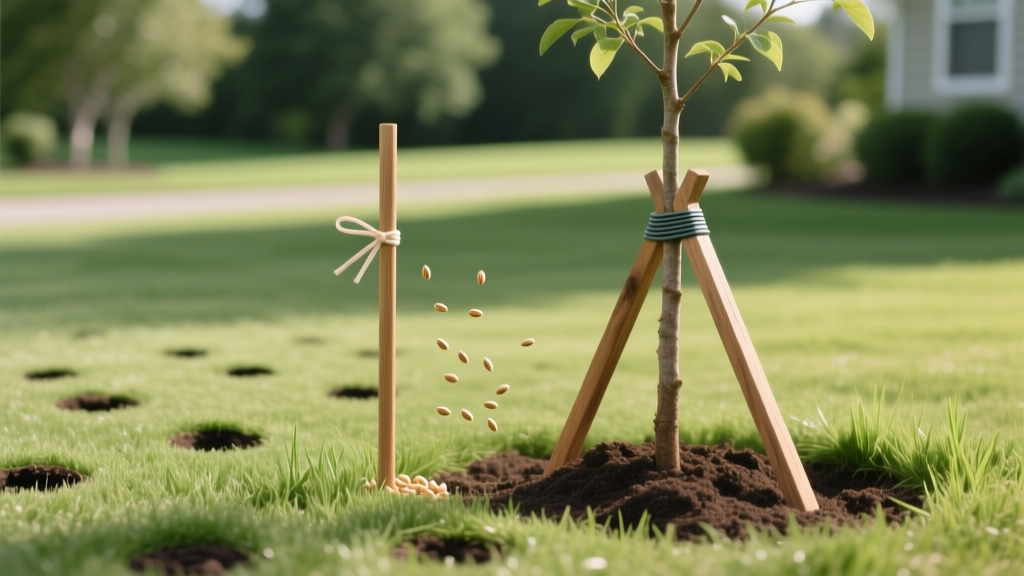
Tree Staking 2026: Single vs Double Stakes & Lawn Seeding Guide
Emily WatsonPublished
The Intersection of Tree Staking and Lawn Renovation
As we navigate the 2026 landscaping season, homeowners and lawn care professionals are increasingly recognizing that tree establishment and turfgrass health are deeply interconnected. When you plant a young tree, the surrounding soil often suffers from severe compaction due to foot traffic, heavy nursery pots, and the digging process itself. To achieve a pristine yard, you must address both the structural support of the new tree and the aeration and seeding of the surrounding lawn. However, the method you choose for staking your young tree—specifically single stake versus double stake configurations—will dramatically dictate how you approach core aeration, liquid aeration, and overseeding.
Driving stakes into the earth creates localized soil compression and physical barriers that can interfere with modern stand-on aerators and disrupt the delicate feeder roots of a newly planted tree. In this comprehensive 2026 guide, we will explore the mechanics of single and double staking through the lens of lawn aeration and seeding, ensuring your trees grow straight and your turf remains thick, healthy, and deeply rooted.
Why Staking Method Matters for Your Soil and Turf
According to the University of Minnesota Extension, most young trees do not require staking unless they are in high-wind areas, have a small root ball relative to their canopy, or are planted in exceptionally loose soils. However, when staking is necessary, the physical footprint of the stakes alters your lawn care strategy.
Compacted soil restricts oxygen flow to both your grass roots and your tree's peripheral feeder roots. Aeration is essential to relieve this compaction. But if you place stakes haphazardly, you risk striking the tree's root ball with aerator tines or creating 'dead zones' where grass seed cannot establish due to the shade and physical obstruction of the staking hardware. Understanding the geometry of single versus double staking is the first step toward a unified tree-and-turf care plan.
Single Stake vs. Double Stake: A 2026 Comparison
The debate between single and double staking has evolved. In 2026, arborists emphasize that the choice should be dictated not just by wind load, but by how the surrounding landscape will be maintained. Below is a detailed comparison of how each method impacts your aeration and seeding efforts.
| Feature | Single Stake Method | Double Stake Method |
|---|---|---|
| Best For | Sheltered yards, small caliper trees (under 2 inches) | High wind zones, larger caliper trees, sloped terrain |
| Lawn Aeration Access | High (leaves three sides open for aerator maneuverability) | Moderate (creates a physical barrier on two sides) |
| Root Ball Disturbance | Moderate (asymmetric tension can pull the root ball slightly) | Low (symmetrical support anchors the root ball firmly) |
| Overseeding Ease | Excellent (easy to broadcast seed evenly around the trunk) | Good (requires hand-casting near the stakes and ties) |
| 2026 Avg. Kit Cost | $25 - $40 | $45 - $75 |
The Single Stake Approach
A single stake is driven into the ground on the windward side of the tree (the direction from which the prevailing wind blows). The tree is then tethered to the stake using a flexible, biodegradable coir tie or a wide nylon strap. From an aeration perspective, the single stake is highly favorable. It leaves a wide, unobstructed radius around the tree, allowing you to maneuver a walk-behind or stand-on core aerator close to the root ball without the tines striking wooden or fiberglass posts. This ensures maximum soil fracturing and plug removal right up to the edge of the mulch ring.
The Double Stake Approach
Double staking involves placing two stakes outside the root ball, typically opposite each other or forming a triangle with a third stake. The tree is secured between them, preventing the root ball from pivoting in the soil. While The Morton Arboretum notes that double staking provides superior anchorage for top-heavy trees, it creates a 'gate' that blocks wide aeration equipment. You will likely need to rely on manual aeration tools or liquid aeration treatments within the immediate perimeter of a double-staked tree to avoid damaging the stakes or the equipment.
Aeration Strategies: Core vs. Liquid Around Stakes
When dealing with newly planted trees and fresh stakes, traditional core aeration carries inherent risks. The tines of a core aerator penetrate 2 to 4 inches into the soil. If the tree was planted recently, its peripheral feeder roots are shallow and vulnerable. Severing these roots with aerator tines can stunt the tree's first-year growth.
Core Aeration Outside the Drip Line
For the broader lawn surrounding the tree, core aeration remains the gold standard for breaking up thatch and relieving deep compaction. Keep the aerator at least 12 inches away from the base of the stakes. This ensures you are pulling plugs from the established turf zone without risking the structural integrity of the stake holes, which could cause the stakes to lean and pull the young tree out of plumb.
Liquid Aeration Inside the Stake Perimeter
In 2026, liquid aeration has become a vital tool for tight spaces. Liquid aerators utilize humic acids, fulvic acids, and advanced soil surfactants to break the ionic bonds in compacted clay soils, creating microscopic pore spaces for oxygen and water. Because you cannot safely run a mechanical core aerator between double stakes without risking root damage or hitting the posts, applying a high-quality liquid aerator (such as N-EXT Air-8 or similar 2026 formulations) directly to the soil inside the staking perimeter is the safest, most effective way to ensure the tree's root ball receives adequate gas exchange.
Overseeding Strategies for Staked Tree Zones
Seeding around a staked tree requires precision. The goal is to establish a dense turfgrass canopy that prevents weed competition and soil erosion around the tree base, without burying the tree's root flare or promoting fungal diseases on the wooden stakes.
- Choose the Right Seed: For most North American lawns in 2026, Turf-Type Tall Fescue (TTTF) is recommended around tree zones due to its deep rooting capability and shade tolerance. If your yard receives full sun, a Kentucky Bluegrass (KBG) mix will knit together beautifully around the stake bases.
- Maintain the Mulch Ring: Never seed directly up to the tree trunk. Maintain a 2-to-3-inch layer of organic mulch in a 3-foot radius around the trunk. The stakes should be driven just outside this mulch ring, directly into the turf zone.
- Hand-Casting Near Stakes: When using a rotary spreader, the seed will often bounce off the wooden or metal stakes, leaving bare patches. Use a hand-crank spreader or broadcast by hand within a 2-foot radius of the stakes to ensure even seed distribution.
- Moisture Management: New grass seed requires frequent, light waterings. However, constant moisture on the lower 6 inches of wooden tree stakes can lead to rapid rot and termite attraction. Elevate your sprinkler heads to target the soil, or use drip irrigation rings around the tree base to keep the seed moist while allowing the wooden stakes to dry out.
Step-by-Step: Staking, Aerating, and Seeding in One Weekend
To maximize your efficiency and protect both your tree and your turf, follow this sequential weekend protocol:
Day 1: Staking and Soil Prep
- Locate your underground utilities before driving any stakes.
- Drive your single or double stakes 18 inches deep using a sledgehammer and a block of wood to prevent splintering. Drive them outside the root ball but inside the intended turf zone.
- Apply a liquid aeration treatment to the compacted soil immediately surrounding the root ball and stake bases. Water it in deeply to activate the soil surfactants.
Day 2: Core Aeration and Seeding
- Run your mechanical core aerator over the rest of the lawn, keeping a 12-inch buffer zone around the tree stakes to prevent destabilizing them.
- Leave the soil plugs on the lawn to decompose; they will reintroduce beneficial microbes to the turf zone.
- Overseed the entire area using a 2026-certified weed-free tall fescue blend at a rate of 6-8 lbs per 1,000 square feet.
- Apply a starter fertilizer rich in phosphorus to encourage rapid root development for both the grass and the peripheral tree roots.
Day 3: Securing the Tree
- Once the heavy foot traffic of aeration and seeding is complete, secure the tree to the stakes. Use wide, flexible mesh ties that allow for a 2-inch sway radius. This micro-movement is critical for triggering the release of growth hormones that thicken the tree's trunk over the 2026 growing season.
Final Thoughts on 2026 Soil Health Standards
Integrating tree care with lawn renovation requires a holistic view of your soil ecosystem. Whether you opt for the unobstructed access of a single stake or the robust wind resistance of a double stake, the key to success lies in adapting your aeration and seeding techniques to the physical barriers present in your yard. By leveraging modern liquid aeration for tight spaces and carefully managing your seed distribution and watering schedules, you can cultivate a landscape where both your young trees and your turfgrass thrive in perfect harmony. For more detailed information on establishing healthy root systems, consult the resources provided by Penn State Extension on proper lawn aeration timing and techniques.