Tree Care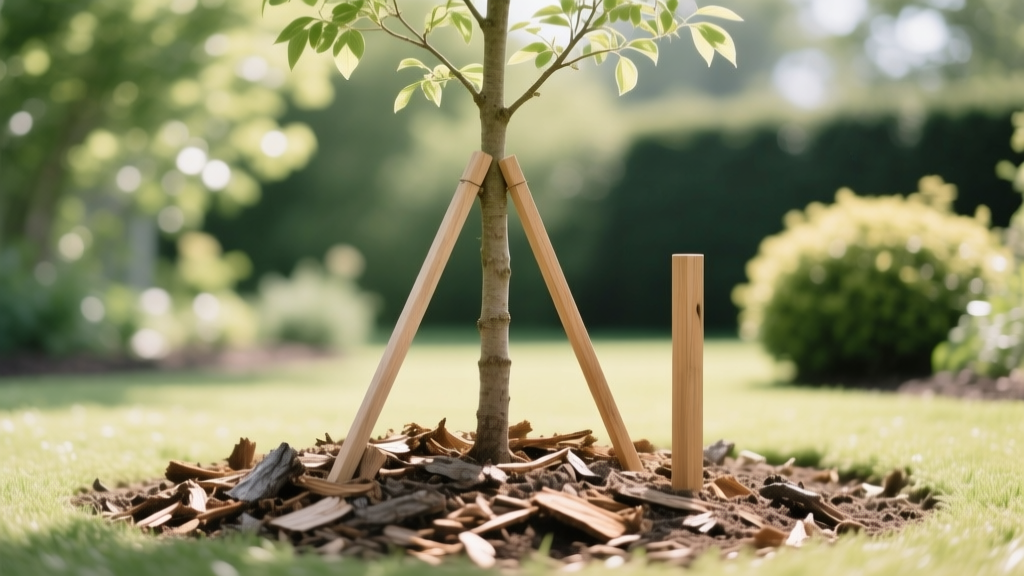
Single vs Double Stake Guide 2026: Mulching Young Trees
Robert HayesPublished
The Intersection of Staking and Mulching in 2026
When planting a young tree, the physical support of the trunk and the biological support of the root zone are inextricably linked. As we navigate the unpredictable spring gales and shifting climate patterns of 2026, proper tree establishment requires a holistic approach. Many homeowners focus heavily on whether to use a single stake or a double stake, but they often ignore the crucial mulching methods and materials that interact directly with those stakes. Improper mulching around staked trees can lead to hidden girdling, trunk rot, and delayed root establishment.
In this comprehensive 2026 guide, we will break down the mechanics of single versus double staking, and more importantly, how to integrate proper mulching techniques to ensure your young trees thrive rather than merely survive their first critical years.
Do You Actually Need to Stake Your Tree?
Before deciding between a single or double stake, the modern arboricultural consensus for 2026 remains clear: do not stake a tree unless absolutely necessary. Trees that are allowed to sway gently in the wind develop stronger, more resilient trunk taper and denser root systems. According to the Arbor Day Foundation, staking should be reserved for specific scenarios:
- The tree is top-heavy with a small root ball.
- The planting site is exposed to constant, high-velocity winds.
- The trunk is exceptionally slender and cannot support the canopy's weight.
- The tree is planted in a high-traffic area where physical protection from pedestrians or machinery is required.
If your tree can stand upright on its own after planting, skip the stakes and focus entirely on your mulch ring.
Single Stake vs. Double Stake: Which to Choose?
If staking is required, the choice between a single stake and a double stake depends on the prevailing wind direction, the tree's caliper (trunk thickness), and the soil composition.
Single Stake Method
A single stake is typically driven into the ground on the windward side of the tree (the side the wind blows from). This method is best for smaller caliper trees or those planted in areas with a dominant, unidirectional wind pattern. The tie is placed low on the trunk, allowing the upper portion of the tree to flex. This flexibility is vital for stimulating the production of reaction wood, which thickens the trunk.
Double Stake Method
Double staking involves placing two stakes on opposite sides of the tree, perpendicular to the prevailing wind. This method is ideal for larger caliper trees, bare-root trees with heavy canopies, or sites with multidirectional, turbulent winds. The ties are attached to both stakes, cradling the lower trunk while still permitting the canopy to sway.
Comparison Chart: Single vs. Double Staking
| Feature | Single Stake | Double Stake |
|---|---|---|
| Best For | Small caliper, unidirectional wind | Large caliper, multidirectional wind |
| Stake Placement | Windward side only | Opposite sides, perpendicular to wind |
| Trunk Flexibility | High (upper trunk sways freely) | Moderate (cradled lower trunk) |
| Mulch Ring Impact | Minimal intrusion into root zone | Requires wider mulch ring planning |
| Hardware Needed | 1 stake, 1 wide strap | 2 stakes, 2 wide straps |
The Mulching Angle: Protecting the Root Flare Around Stakes
This is where many 2026 planting projects fail. Stakes must be driven through the soil, and inevitably, they interact with the mulch layer. The most common and fatal mistake is 'volcano mulching'—piling mulch high against the trunk and the base of the stakes.
When mulch is piled against a stake, it creates a moisture wick. Water travels down the stake and pools against the tree's root flare. This constant moisture leads to Phytophthora collar rot, invites boring insects, and causes the bark to decay. Furthermore, thick mulch hides the staking straps. As the tree grows in caliper throughout the 2026 growing season, a hidden strap will quickly girdle the tree, cutting off the phloem and killing it.
The 'Donut' Mulching Method for Staked Trees
To properly mulch a staked tree, you must employ the donut method. According to best practices outlined by the Morton Arboretum, mulch should never touch the trunk of the tree or the base of the wooden or metal stakes.
- Clear the Base: Expose the root flare completely. The trunk should look like it is emerging from the soil like a trumpet, not a telephone pole.
- Create the Inner Gap: Leave a 3-to-4-inch bare soil ring immediately around the trunk and the base of each stake.
- Apply the Mulch: Spread your mulch starting from the outside of that bare ring, extending out to the drip line if possible (or at least a 3-foot radius).
- Depth Control: Keep the mulch layer between 2 to 3 inches deep. Never exceed 4 inches, as this restricts oxygen flow to the fine feeder roots.
Best Mulching Materials for Staked Young Trees
The material you choose for your mulch ring impacts soil biology, moisture retention, and stake stability.
1. Coarse Arborist Woodchips (Top Recommendation)
Un-dyed, coarse arborist woodchips are the gold standard for 2026. They allow for excellent gas exchange, break down slowly to feed soil fungi (mycorrhizae), and do not mat down and repel water. Because they are coarse, they won't easily pile up against the stakes during heavy rains.
2. Composted Pine Bark
For acid-loving trees like oaks or maples, composted pine bark nuggets are an excellent choice. Avoid finely shredded bark ('double shredded'), as it forms a hydrophobic crust that prevents water from reaching the root ball, forcing you to water around the outside of the mulch ring where the stakes are located.
3. Materials to Avoid
- Dyed Mulches: Often made from recycled pallets, these can leach unknown chemicals into the root zone and tie up soil nitrogen as they decompose.
- Rubber Mulch: Does not break down, offers no biological benefit, and can heat up to extreme temperatures in the summer sun, damaging the shallow roots and the base of wooden stakes.
- Landscape Fabric: Never place landscape fabric under your mulch around a young tree. It blocks water, restricts oxygen, and makes it impossible to monitor the root flare and stake ties for girdling.
Step-by-Step Installation: Staking and Mulching Together
Follow this sequence to ensure your staking and mulching methods complement rather than compromise each other.
- Plant the Tree: Ensure the root flare is 1-2 inches above the surrounding grade to account for soil settling.
- Drive the Stakes: Use 6-foot wooden or fiberglass stakes. Drive them 18 inches into the ground outside the root ball. For a double stake, place them 18-24 inches apart on either side of the trunk.
- Attach the Ties: Use wide, flexible, UV-resistant canvas straps or specialized biodegradable tree ties available in 2026. Attach them at the lowest point that keeps the tree upright (usually 12 to 18 inches above grade). Leave 1 inch of slack so the tree can sway.
- Apply the Mulch: Spread your coarse arborist woodchips in a 3-foot radius, maintaining the 3-inch bare 'donut' hole around the trunk and the stakes.
- Water Deeply: Water the root ball thoroughly to settle the soil and the mulch layer.
Seasonal Maintenance and Stake Removal
The most critical rule of tree staking is that it must be temporary. Stakes are training wheels, not permanent crutches. Plan to inspect your stakes and mulch ring at the end of the first growing season (late autumn 2026) and again in early spring 2027.
Gently push the trunk. If the root ball holds firm and the trunk bends, it is time to remove the stakes. Leaving stakes in place for multiple years results in a tree that is tall, spindly, and highly susceptible to snapping in future storms. When you pull the stakes, take the opportunity to refresh your mulch ring, ensuring the woodchips have not decomposed into a compacted layer that could suffocate the newly established fine roots.
By combining the correct staking technique for your specific site conditions with meticulous, biologically sound mulching methods, you give your young trees the ultimate foundation for a long, healthy, and storm-resilient life.